Blog
Esoteric Physics May Yield a Non-Chemical Energy Storage Alternative

We all know that quantum computing, cryptography, and data links are getting a lot of R&D effort, funding, tangible results, and, yes, well-deserved attention. But a quantum battery that can be charged by a laser to store and then release useful electricity? That’s been a very low-profile development.
Now, a triple-member team comprised of CSIRO (Commonwealth Scientific and Industrial Research Organization, an Australian Government agency that’s responsible for scientific research and its commercial and industrial applications for Australia’s national science agency), RMIT University (Royal Melbourne Institute of Technology), and the University of Melbourne have developed a proof-of-concept quantum battery capable of being charged, storing, and releasing energy.
Quantum Battery: A Potential Energy Storage Savior?
This approach could enable much faster charging and greater energy storage capacity. Their effort constitutes a major step toward a functional version of this non-chemical battery technology. The team maintains that the prototype represents the closest progress yet toward a working quantum battery. It’s based on established principles of quantum physics, much of which is counterintuitive or seems to contradict “conventional” physics, but actually occupies its own space in modern physics.
Although fully operational quantum batteries aren’t yet available, the researchers say that progress like this could eventually reshape how energy is stored and used. (Note: these sorts of optimistic extrapolations are fairly common in nearly every battery “breakthrough” claim.)
There’s another interesting aspect to these quantum batteries. Team member and PhD candidate Daniel Tibben said the results reveal an unexpected benefit, “Our study found quantum batteries charge faster as they get larger, which is not how today’s batteries work.”
He added, “It’s a sign that quantum batteries could one day outperform conventional energy storage technologies.” (Once again, we have some very hopeful prediction-trajectories from a very early lab demonstration.)
How Does the Battery Work?
Unlike most conventional batteries that depend on chemical reactions, quantum batteries rely on quantum superposition and interactions between light and electrons. Superextensivity — where the response of a physical system scales super-linearly with size — originates from collective quantum effects and provides a promising route to augment next-generation quantum technologies.
They used a microcavity quantum battery as an experimental platform. Superextensivity captures light energy from a focused light source and converts it to an electric current via the incorporation of charge transport layers into the resonant microcavity. This architecture enables, for the first time, a complete quantum battery charge/discharge cycle.
In these batteries, quantum entanglement serves to minimize the number of traversed states during charging, or trigger collective effects that increase the effective coupling between the battery and its energy source. Consequently, it’s theorized that they exhibit exotic properties such as a charging power that scales faster than the battery capacity — a property called superextensivity.
They demonstrated that strong light–matter coupling induced by the microcavity leads to superextensive scaling of the steady-state electrical discharging power under low-intensity, incoherent illumination. Their results provide the first experimental demonstration of superextensive light-to-charge conversion in steady state, highlighting the feasibility of leveraging strong light–matter coupling for enhanced energy harvesting under low-light conditions.
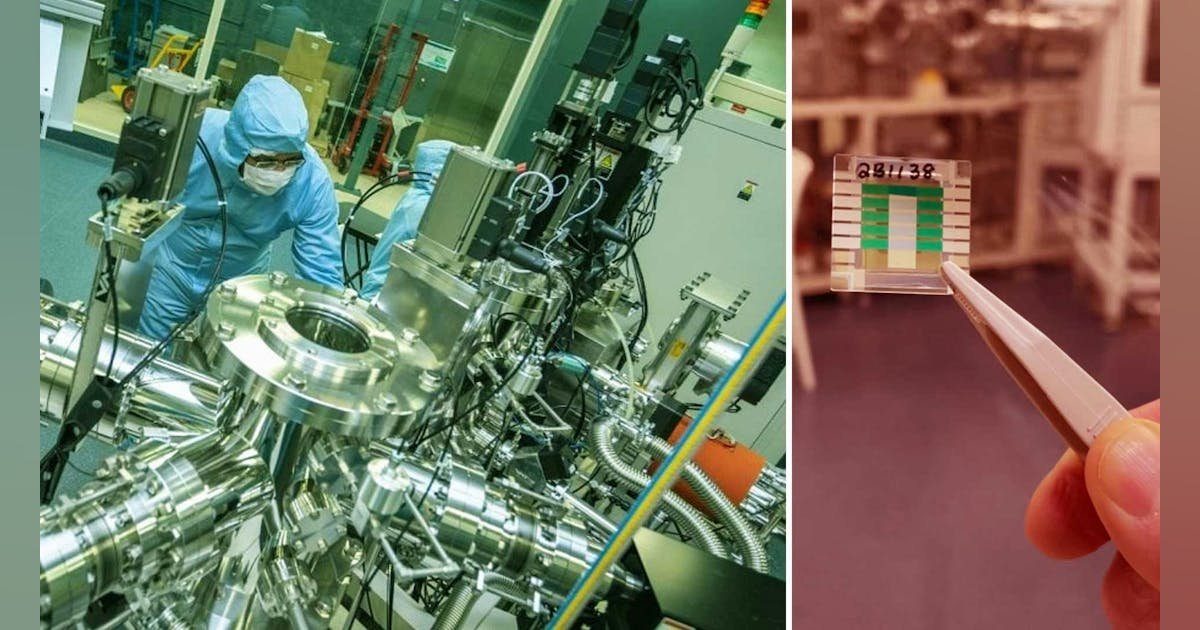
The team’s prototype is a small, layered organic device that can be wirelessly charged with a laser (Fig. 1). They engineered a superabsorbing quantum battery that’s wirelessly charged by either a coherent or an incoherent light source and outputs superextensive electrical power.