Blog
Best of Sensors: Woman of the Year Tianyue Yu

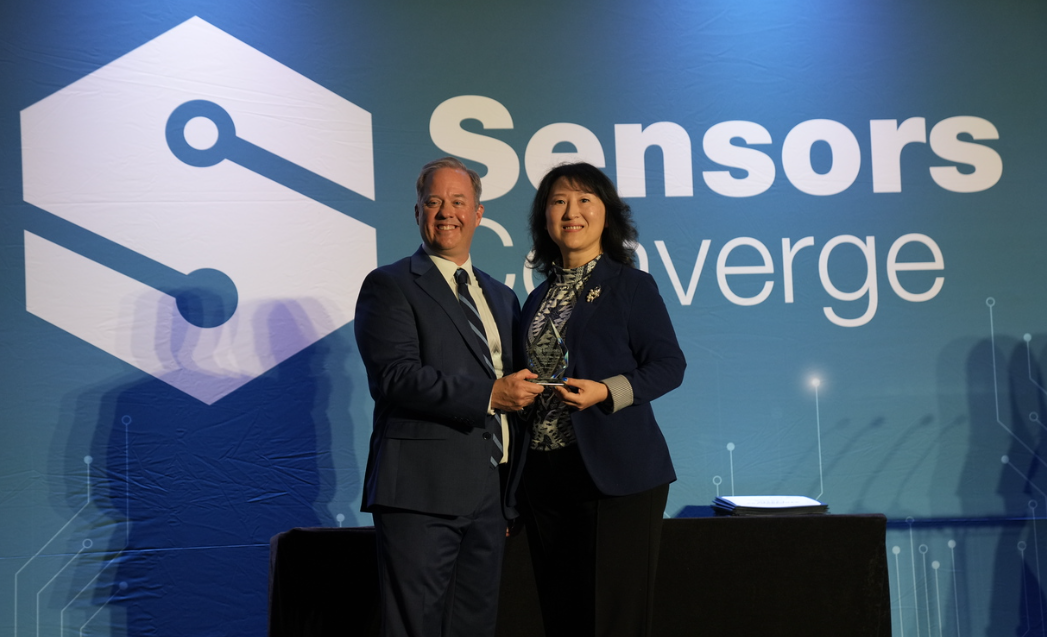
Tianyue Yu was named Woman of the Year at Best of Sensors 2026 in a May 6 ceremony at Sensors Converge in Santa Clara, CA. Her experience as a deep tech executive spans more than two decades. She holds a PhD from Cornell University and is founder and CEO of Q3D Sensing in the Bay area. She previously co-founded Quanergy in 2012 and served as CTO and board director.
Q3D Sensing provides long-range, high-precision 3D reality capture with a pocket-sized LiDAR sensor that attaches to smartphone and tablets.
She was recognized for her experience as both a technologist and founder, which represents a “rare combination of scientific leadership and entrepreneurial execution.” She also serves as an “important role model in an industry where diverse leadership is critical to continued innovation,” the judges said.
Fierce Sensors: Congratulations! In general, what’s your reaction to being named Woman of the Year at Best of Sensors 2026? Were you surprised?
Yu: I was very honored — and yes, a little surprised. When you are building a deep-tech company, most days are very practical: solving technical problems, talking to customers, working with the team, and trying to move the company forward. You do not usually stop and think about recognition. So the award was a very meaningful moment. It made me pause and feel grateful — for the people who supported me, for the teams I have worked with, and for the chance to build technology in a field I love.
FS: You were named by Charlene Soucy of Questex as a role model in the industry, and I wonder if you can comment on what it means to recognize women generally for their work in sensors and related tech?
Yu: It really matters because sensors and deep tech are still fields where women are not always very visible. But women are consistently inventing, engineering, leading teams, building companies, and bringing products to market. Recognition helps make that visible.
It tells younger women that this is a place where they belong, not as an exception, but as builders and leaders. I also think it is important that women are recognized for the substance of the work: the technology, the execution, the persistence, and the impact.
FS: Can you comment on what your career as a woman has been like? Have you faced any significant obstacles?
Yu: I have been fortunate to work with many talented and supportive people, but yes, there have been challenges. In hardware, semiconductors, LiDAR, and engineering leadership, I was often one of very few women in the room. Sometimes the obstacle is not dramatic. It is more subtle.
You may need to prove your technical credibility harder. You may need to be very clear, very prepared, and very persistent. Over time, I learned to focus on the work. If the technology works, if the customer problem is real, and if you keep showing up, people will listen.
FS: What can be done to bring in more women to the engineering profession as developers or related roles? Is there any way to encourage more women entrepreneurs? How do women get to be CEOs in today’s world in engineering. (Only about 12% of engineers are women in the US and less than that amount are CEOs in engineering companies.)
Yu: We need to show girls and young women that engineering is not only about equations or code. It is about solving real problems in the world: in health, climate, transportation, robotics, manufacturing, cities, and AI.
Mentorship helps, but sponsorship matters even more. Women need people who open doors, recommend them, fund them, hire them, and put them in leadership conversations. For women entrepreneurs, access to capital and networks is critical. Many women have the ideas and ability, but not always the same access. We should cultivate an environment where those networks are more open and nurture and encourage women entrepreneurs to be bold and confident in taking up leadership roles, including CEO.
FS: In terms of your work at Q3D Sensing, here’s a compound question: What was it like to found it and did you ever face difficulties, want to give up? How did you overcome that? How big is the company today and will you be seeking an IPO any time soon? Are any important announcements of new tech coming soon…Can you describe?
Yu: I am a serial deep-tech entrepreneur, and deep tech is never a straight line. Before Q3D Sensing, I was co-founder and CTO of Quanergy, also in 3D technology, where we built the company from a Silicon Valley garage startup to NYSE IPO. Founding Q3D Sensing is deeply meaningful and a natural extension of what I have been passionate about for many years.
The opportunity is vast, and the ambition is high. We are building across hardware, software, spatial data, customer workflows, and market timing. Every layer has to work. There have been difficult moments, of course. But I never really thought, “I should give up.” I thought, “We need to learn faster, focus better, and keep going.”
Q3D is still an early-stage company, so an IPO is not the near-term focus. Our focus is building a great product, serving customers, and proving repeatable value.
We do have important product work coming, so stay tuned. Our goal is to make high-quality 3D reality capture much more mobile and accessible, uniting visual context and measurement into distributed spatial intelligence.
FS: Can you describe your level of optimism around sensing tech generally and where it is headed? It might have taken longer than many wanted for some of the Edge AI applications to emerge, but AI has been a gift and a burden for some. What do you see as the biggest obstacles Edge AI and AI for sensors faces?
Yu: I am very optimistic. AI has made amazing progress with text, images, and video, but the physical world is much harder. Real environments involve geometry, scale, motion, lighting changes, messy objects, and safety constraints. That is why sensors matter greatly. Sensors are how AI connects to reality. The biggest challenge is not only better AI models. It is better real-world data, accurate, reliable, spatially grounded data, that AI can actually use. Edge AI must also operate under real constraints of power, compute, cost, latency, privacy, and reliability. I think the next big wave will come from combining sensors, edge computing, and AI into practical systems that solve real physical-world problems.
FS: Why does 3D sensing matter now, especially in the AI era?
Yu: 3D sensing matters now because AI is moving from understanding digital content to interacting with the physical world. Language models are powerful, but language alone does not tell an AI system how wide a hallway is, whether a machine will fit in a room, how far away an object is, or how a space has changed over time. For that, AI needs spatial understanding.
3D sensing provides the bridge between the real world and digital intelligence. It allows software to understand shape, distance, scale, and structure. That is important for construction, robotics, manufacturing, logistics, infrastructure, real estate, insurance, security, and many other industries.
The next wave of AI will need physical-world data. Q3D is dedicated to streamline that journey.
FS: What is Q3D’s long-term vision?
Yu: Q3D’s long-term vision is to make 3D reality capture and spatial intelligence scalable and accessible to all.
Today, much of the physical world is still measured, inspected, and documented manually. That creates friction, cost, and information loss. We believe 3D reality capture should be much easier, more affordable, and more widely available.
In the near term, that means giving professionals better tools to capture spaces quickly and accurately. Over time, it means enabling a spatial data network that can support digital twins, robotics, simulation, AI training, physical asset management, and many other applications.
We see Q3D as part of the data infrastructure for physical AI.
FS: Finally, what advice would you give to young women who want to enter deep tech?
Yu: Do not be intimidated by hard fields. Hardware, sensors, AI, semiconductors, robotics, genetics, medicine and deep tech can look difficult from the outside, but every expert started as a beginner.
Build strong fundamentals. Find real problems. Work with people who challenge you. Do not wait until you feel perfectly ready.
Also, do not assume you need to choose between being technical and being a leader. The best technical leaders can understand the details and also communicate the bigger vision. That combination is very powerful.
Most importantly, stay curious and persistent. Deep tech rewards people who are willing to keep learning across disciplines.
Other profiles of Best of Sensors 2026 winners are available online.