Blog
Sensors are essential to robots, as Computex made clear

Robots are sensor-driven and that’s a good thing for sensor makers, who foresee attractive growth rates that analysts have forecast.
These strong growth forecasts make sense, if you consider the excitement around the robot sector clearly on display at Computex 2026 in Taipei.
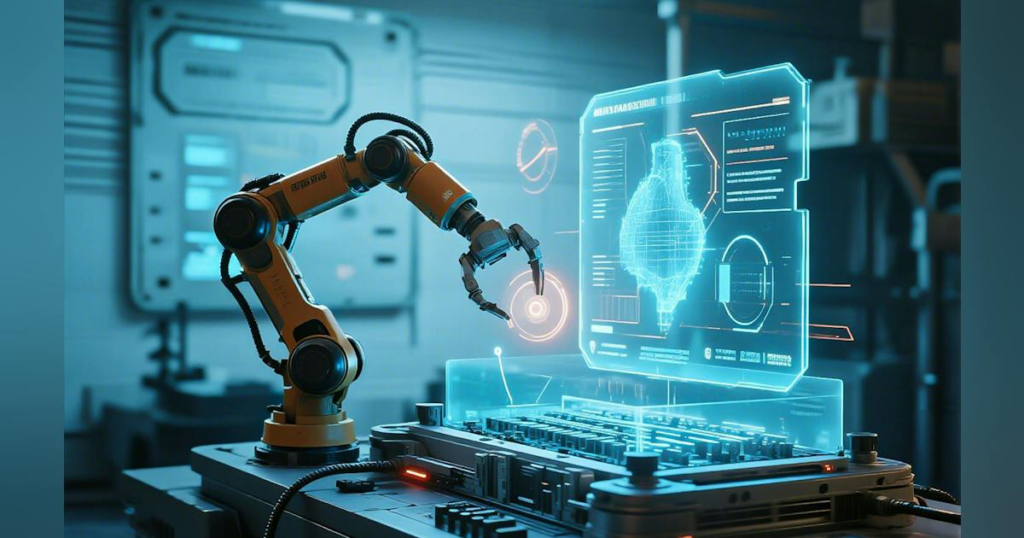
Robots were seemingly everywhere, from robot arms that operate in a fixed state in a factory to humanoids conducting simple tasks, like sorting boxes by size based on motion and other sensors. One humanoid used a high-definition optical sensor to judge defects inside PCBs and communicated the results via voice. While there were many models of humanoids, most were standing stationary, drawing some criticism from analysts on hand.
Industry giants Intel, Nvidia and Qualcomm all made a big pitch for robotics at the event (all covered previously by Fierce Sensors), with various iterations of robot platforms that match their latest chips with robots from third party partners and an array of sensors providers.
These vendors all rely on AI models and other software from other companies to help robots reason what to do if a box is dropped or a human steps in the way, causing the robot to stop moving or working, for safety. AI has created this new capability, adding to the industry excitement, but still—the sensors are vital to make it all happen.
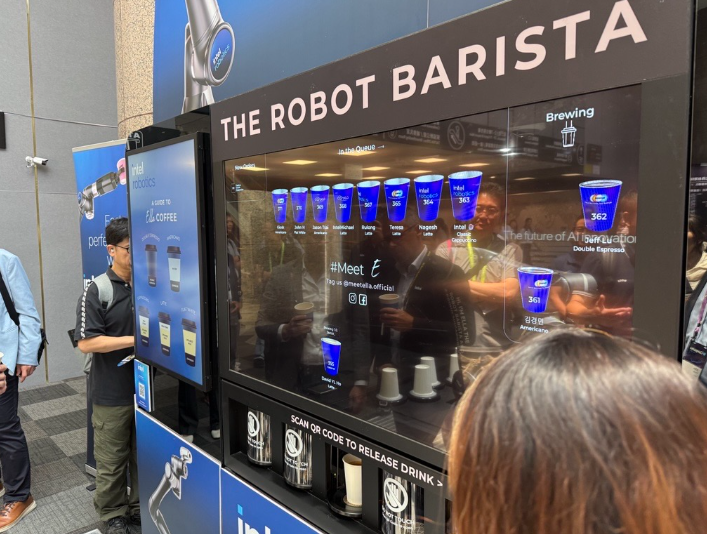
Intel set up a Robotics and Edge AI pavilion at the Taipei World Trade Center with more than a dozen smaller companies. The company even sponsored a SUV-sized robot barista that serves more than 200 cups of coffee per hour.
The coffee service attracted a small crowd of mostly jet-lagged Americans who each ordered a free artisanal latte or expresso. Or maybe just a black Americano. Some of the customers were smart to realize that even with the jazzy robot barista with its robot arm swinging back and forth inside a large glass box, a good cup of joe comes down to, often, the water and coffee quality and the way the coffee is roasted and prepared.
The Ella robot barista on display was developed by Crown Digital out of Singapore and powered by SensoryAI’s multi-agent operating system. The company sees itself as more than a robotics maker and calls itself an operating company for the service industry, including restaurants and hospitality.
Yes, it makes sense to have a robot barista installed in a large venue like a Computex where thousands of tired techies need a boost. The tech inside Ella is admittedly pretty remarkable, even if Ella is not a humanoid and, instead, a glorified, but quick, robot arm.
Really, Ella is so much more, as an Intel executive told Fierce. The version running at Computex runs on a single Intel Core Ultra Series 3 chip, just introduced by Intel this year. The chip combines a CPU, GPU, and NPU among memory and other elements and seems destined to be the Intel x86 workhorse for just about any Edge AI invention in the works or on the minds of developers at young startups. In overly simply terms, the NPU is where the sensing data is gathered and GPU handles inference while the CPU acts as an orchestrator to make things work in proper order or harmoniously.
John Healy, general manager of the industrial and robotics division at Intel, smiled broadly as he described how Ella works. The machine manages a long list of coffee orders at one time (each order executed in under 0.1 seconds), and mixes up several coffees poured into cups that appear at six different windows, each labeled with a customer’s name on a vivid screen. The orchestration tracks not only the customer orders, but the stockpile of coffee, water, milk and more and the temperature of water, milk and the heat applied. There are temperature sensors at every step. CrownD is the edge runtime used to control the physical hardware, while Sensory OS uses a hybrid cloud approach with autonomous service from the cloud to the edge and the actual device. There’s also a local AI agent called Guardian for diagnosis and resolution of problems.
A Crown Digital rep on site said the entire Ella machine costs “six figures” while Intel’s Series 3 chip alone would sell for around $1,500 at the top end. What those numbers don’t reflect is all the small devices and human collaboration involved in making the machine work, along with software licenses, connectivity, the actual robot, actuators and other components.
It’s not right to look at a single component cost, and instead the cost of implementation and the development required, Healy said. There are multiple AI agents involved all operating in a real-time control platform. Young developers will need to look past the cost of a single chip when making an Edge AI project, in other words.
With all the collaboration needed to make Ella and other robots displayed at Computex, it was interesting that Intel CEO Lip-Bu Tan told reporters in a slightly different context regarding the advent of the CPU, an Intel mainstay: “The ecosystem is very important; the key word is open standards.”
Kevork Kechichian, general manager of Intel’s data center group, added: “The whole system is partnerships; not one company can do everything on their own. We’re looking for all partnerships, building on each other’s strengths.”
What was clear on my visit to Computex is how robotics is more than ever a sensor story, as modern systems layer vision, motion and positioning tech. In the case of humanoids, there’s added force, tactile and joint sensing. The shift from fixed industrial arms that have been around for decades to mobile and autonomous machines is driving a steady increase in sensor content per robot, benefiting suppliers across the vision, inertial and positioning ecosystems.
How analysts view sensors for robots
While Ella is a fixed arm robot, its ability to use many agents to wrestle multiple demands gives an insight to why the sensor market for robots will grow at a healthy rate.
Every robot uses multiple sensors and new autonomous mobile robots and collaborative arms and emerging humanoids each drive more sensors per units, multiplying demand. Sensors are essential because robots need perception.
One of the most optimistic forecasts from Fortune Business Insights sees growth in sensors for robots increasing by 11% annually and reaching $9 billion in 2034, up from $4 billion in 2026.
Autonomous robots will require sensors for vision, lidar, IMUs and GPS.
Some analysts are not as impressed by humanoids, even calling them over-hyped. Phil Solis, an analyst at IDC, noticed that multiple smaller companies are making humanoid robots, but when they demonstrate their capabilities they don’t even move, but instead, they often stand in place to perform a function with eyes and hands.
“Intel is probably at a sweet spot,” Solis told Fierce, noting it has partnered with multiple robotics makers that use its Series 3 chip in just recent months. “So much of what’s happening with robots is just marketing, where companies anthropomorphize humanoids based on what people see in science fiction,” he said.
Still he sees a technology progression that helps describe why robots were a big theme at Computex. “Physical AI is a continuum, moving beyond multiple models of LLMs,” he said.
One of the most impressive demonstrations he’s seen lately is from Boston Dynamics in which an Atlas humanoid lifted and carried a loaded mini-refrigerator across a lab.
“Robots will continue to be strong in industrial settings,“ he said. Other purposes might be more elusive, as one robot arm maker said at a Computex demo.
“I see robot arms with better hands in five years, but a robot that takes care of your kids, well, that’s a long way off,” he said.