Blog
ADAS transitioning from sensors to software

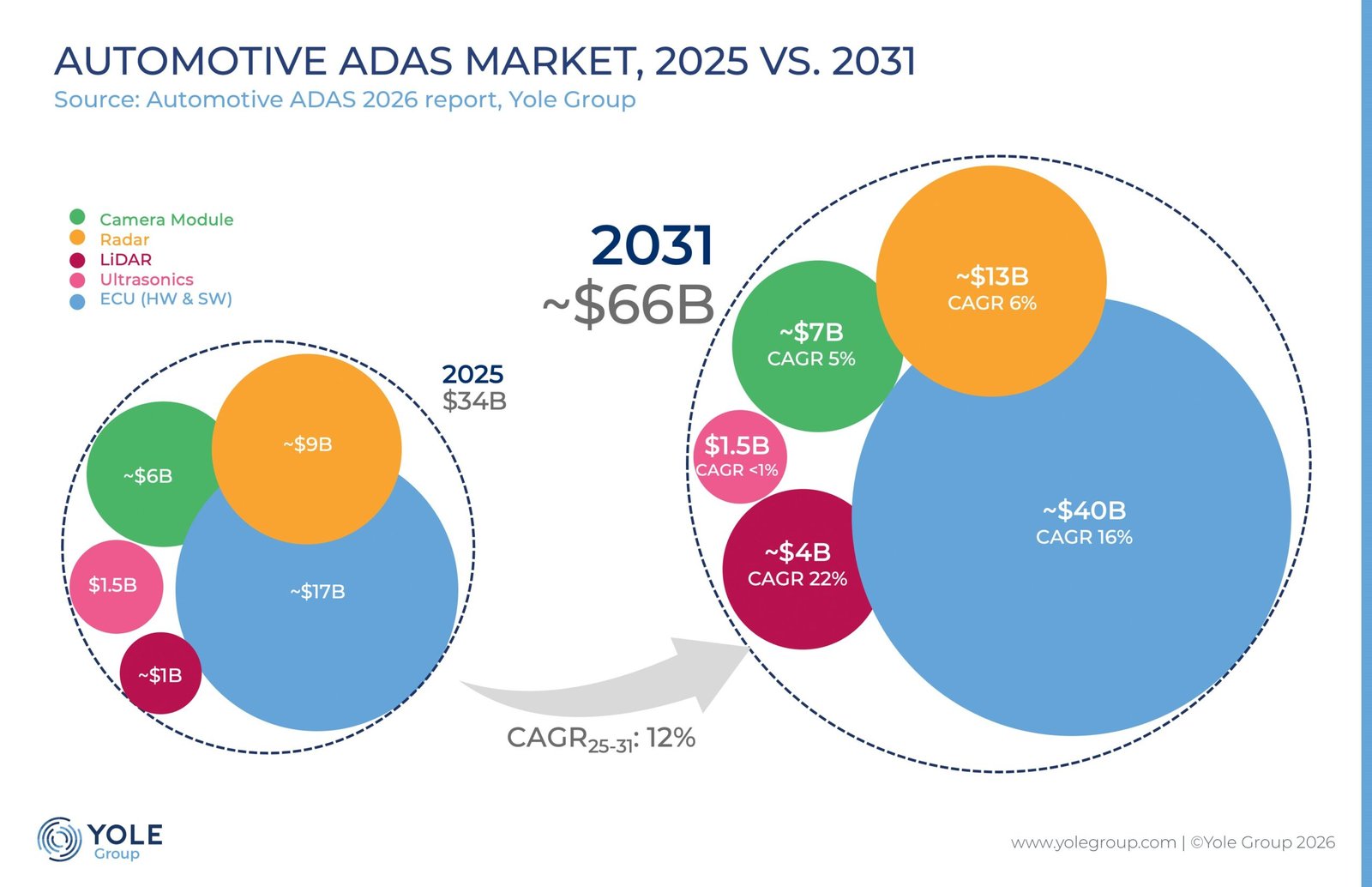
Supply chain: China is emerging as the fastest-growing and most dynamic ADAS ecosystem, reshaping global competition. Yole Group sees new roles across OEMs, Tier-1s, and semiconductor players: control is moving toward compute platforms and software integration.
Sensor innovation continues, but differentiation increasingly depends on integration within centralized, software-defined architectures.
The transition toward software-defined ADAS platforms is reshaping supply chains, accelerating ecosystem transformation, and redefining industry leadership.As vehicles become increasingly software-defined, ADAS is no longer driven solely by the proliferation of sensors.Instead, the market is transitioning to integrated platforms combining sensing, centralized computing, and software.
This shift is redefining value creation across the automotive ecosystem and accelerating the convergence between hardware and software capabilities.
“The ADAS market is entering a new phase where value is no longer driven by the proliferation of sensors, but by the ability to integrate sensing, computing, and software into scalable platforms,” says Yole’s Pierrick Boulay, “this transition is fundamentally reshaping how the industry creates and captures value.
”While sensor demand remains strong, the fastest growth is now concentrated in computing platforms and software, reflecting the industry’s shift toward domain and centralized architectures.”
A fundamental transition from a sensor-centric approach to a system-level perspective is underway.Cameras remain the backbone of ADAS deployments, while radar technologies are evolving toward higher-resolution imaging solutions, and LiDAR is experiencing the fastest growth, particularly for long-range applications.
However, the true differentiation increasingly lies in how these sensing modalities are orchestrated through software and computing platforms.
Centralized computing architectures are progressively replacing distributed electronic control units, enabling higher processing performance, improved scalability, and more efficient system integration.As a result, software content and system-level optimization are becoming critical levels of competitiveness.
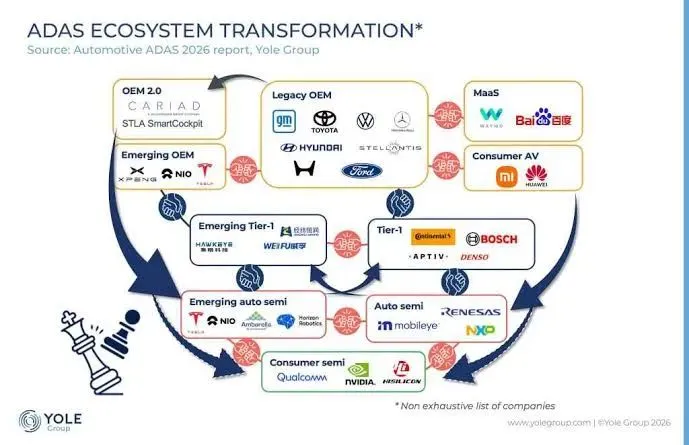
This transformation is significantly impacting the automotive supply chain.“Traditional Tier-1 suppliers are expanding beyond hardware delivery to system integration, software enablement, and validation,” says Boulay “at the same time, semiconductor companies are moving up the value chain by building closer relationships with OEMs and offering more complete platform solutions.”
China is emerging as a distinct and highly dynamic ADAS market. Characterised by rapid deployment of enhanced features, strong local supply chains, and vertically integrated ecosystems, China is accelerating both innovation cycles and adoption rates, particularly for advanced L2+ driver assistance systems.
See all our Automotive content.