Blog
Sensors on Orion will monitor solar radiation to keep crew safe

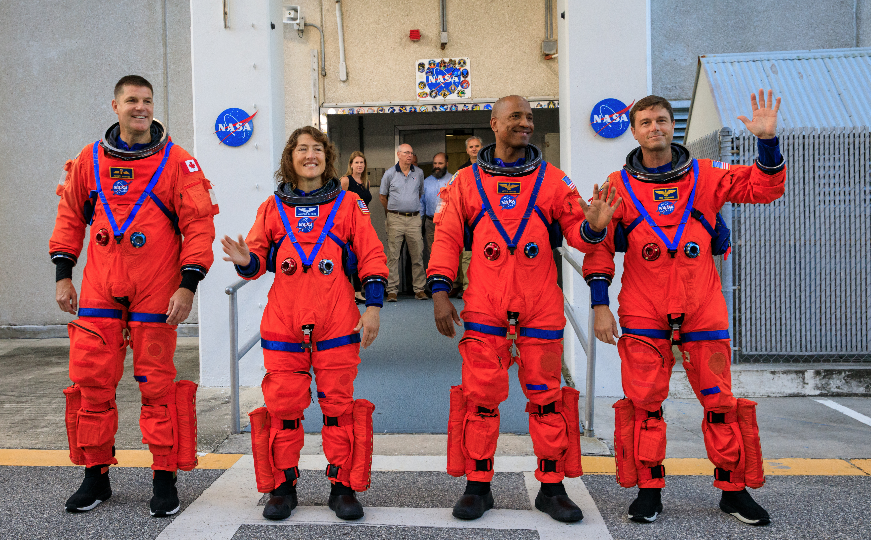
When the Artemis II mission sends four astronauts into deep space on their trip around the Moon, a big concern will be radiation from the Sun and galactic cosmic rays and the effects on their bodies as they ride inside the Orion crew module.
Sensors will play a critical role in detecting the radiation, but when the worst solar flares are sensed, the crew would have to build a makeshift shelter, using stowed equipment to add mass between themselves and incoming radiation particles.
A major objective of Artemis II will be to test this sheltering procedure, NASA said. Orion sits atop the massive Space Launch System which sits ready for launch from Kennedy Space Center in Florida at 6:24 p.m. EDT on Wednesday.
Radiation sensors are deployed throughout Orion, as was the case with Artemis I that passed around the Moon in 2022 without any human crew aboard. Back then, mannequins were used then to measure the environment using various sensors, and they even had names: Commander Moonikin Campos, used to measure vibration and acceleration, and Helga and Zohar, two female phantom torsos made from plastic to mimic human bones and tissues. For Artemis II, crew members aboard Orion will also wear radiation trackers.
Helga and Zohar were part of the Matoshka AstroRad Radiation Experiment (MARE) with Zohar wearing a radiation-shielding vest. The torsos were returned for analysis at the German Space Agency and it was determined that radiation levels inside the Orion capsule are safe for human exploration, with shielding providing significant protection, according to NASA. When Orion in Artemis I passed through the Van Allen Belts with higher radiation levels, the AstroRad vest worn by Zohar reduced radiation dosing to internal organs.
Quick explainer: Radiation is higher in outer space because it lacks Earth’s protective atmosphere and magnetic field, which deflect or block harmful energy particles. Without this protection, astronauts are exposed to high-energy solar particles and galactic cosmic rays with radiation levels up to 100 times higher than on the surface of Earth. The two Van Allen Belts are invisible donut-shaped rings around Earth that trap charged particles, and passing through them can cause high radiation exposure.
While NASA has addressed the Van Allen Belt radiation with shielding, it also is looking at the Sun and the dangers of solar flare radiation. NASA and the National Oceanic and Atmospheric Administration will protect astronauts by monitoring the Sun around the clock to translate space weather into real-time decisions, according to a recent NASA article.
In the event of a severe solar flare condition during the Artemis II flight, astronauts can set up the above-mentioned shelter inside the capsule to absorb and deflect radiation, according to Emily Nelson, NASA flight director for Artemis II, speaking in a news conference on Monday. NASA determined a recent solar flare impacted the southern hemisphere and would not delay the Artemis II launch set for Wednesday evening.

(NASA)
Inside Orion, six radiation sensors in the HERA system built by NASA measure radiation dose rates in different parts of the cabin and Artemis II astronauts wear personal radiation trackers called crew active dosimeters, NASA explained. If radiation levels increase, Orion’s onboard systems display warnings accompanied by an audible alarm. NASA will watch for dosage thresholds moving from caution to a higher threshold that would trigger a recommendation for the crew to take shelter.
“Astronauts are trained to reconfigure their cabin during a solar particle event, removing stowed equipment from storage bays and securing it along areas of the cabin to add mass between themselves and incoming particles,” NASA said in it is March 16 report. “Since Artemis II is the first crewed Artemis mission, testing this procedure in the Orion spacecraft is a major objective of the mission.”
“Once crews add mass to the places that tend to be hotter in terms of radiation exposure, they can then continue to go about their duties,” said Stuart George, a space radiation analyst at NASA Johnson.
Aside from solar flares, crews must still account for radiation from galactic cosmic rays and the Van Allen Belts. The radiation from both sources is expected to be comparable to a 1-month stay on the International Space Station, or about 5% of any astronaut’s career limit. Solar radiation would add to this amount.
NASA’s flight control team, headed by Nelson, will take recommendations from teams monitoring solar eruptions plus real-time measurements from sensors inside Orion to guide the activities of the four astronauts. “We learned from Artemis I a lot about how this spacecraft will operate in this environment,” Nelson said on Monday.
Sensors used in Artemis I analyzed radiation
During the uncrewed Artemis I mission, NASA and the German Space Center and the European Space Agency used 5,600 passive sensors and 34 active radiation detectors during the 25 day mission to provide data on exposure to radiation from the Van Allen Belts. The measurements showed that radiation exposure would vary depending on the location within Orion, but the spacecraft could protect its crew.
NASA’s HERA (Hybrid Electronic Radiation Assessor) and Crew Active Dosimeter were used to measure radiation in Artemis I. NASA and the DLR collaborated on the Matroshka AstroRad Radiation Experiment with sensors placed on and inside the two manikin torsos. From the data, NASA was able to determine it had an effective strategy for managing radiation risks, even though “key challenges remain, especially for long-duration spaceflights and the protection of astronauts on spacewalks,” George said in an earlier statement.

(NASA)
In addition to NASA’s research, another study of Orion’s protections against radiation validated its readiness for crewed exploration of space, according to a paper published in the National Library of Medicine in September 2024.
Other sensors onboard Orion
Sensors aboard Orion go far beyond radiation detection to include inertial navigation through use of IMUs, GPS, barometer/altimeter and more. There are also sensors for tracking stars for navigation and lidars for use in rendezvous and docking procedures. Other environmental monitors rely on sensors that also check for corrosion. The following chart includes links to earlier sources for many of the sensors used in Artemis missions. (Links may need to be copied and pasted into a browser.)

RELATED: Artemis II launch panned for Wednesday with four crew, sensors