
Blog
Renewables Overtake Coal | Electronics Weekly

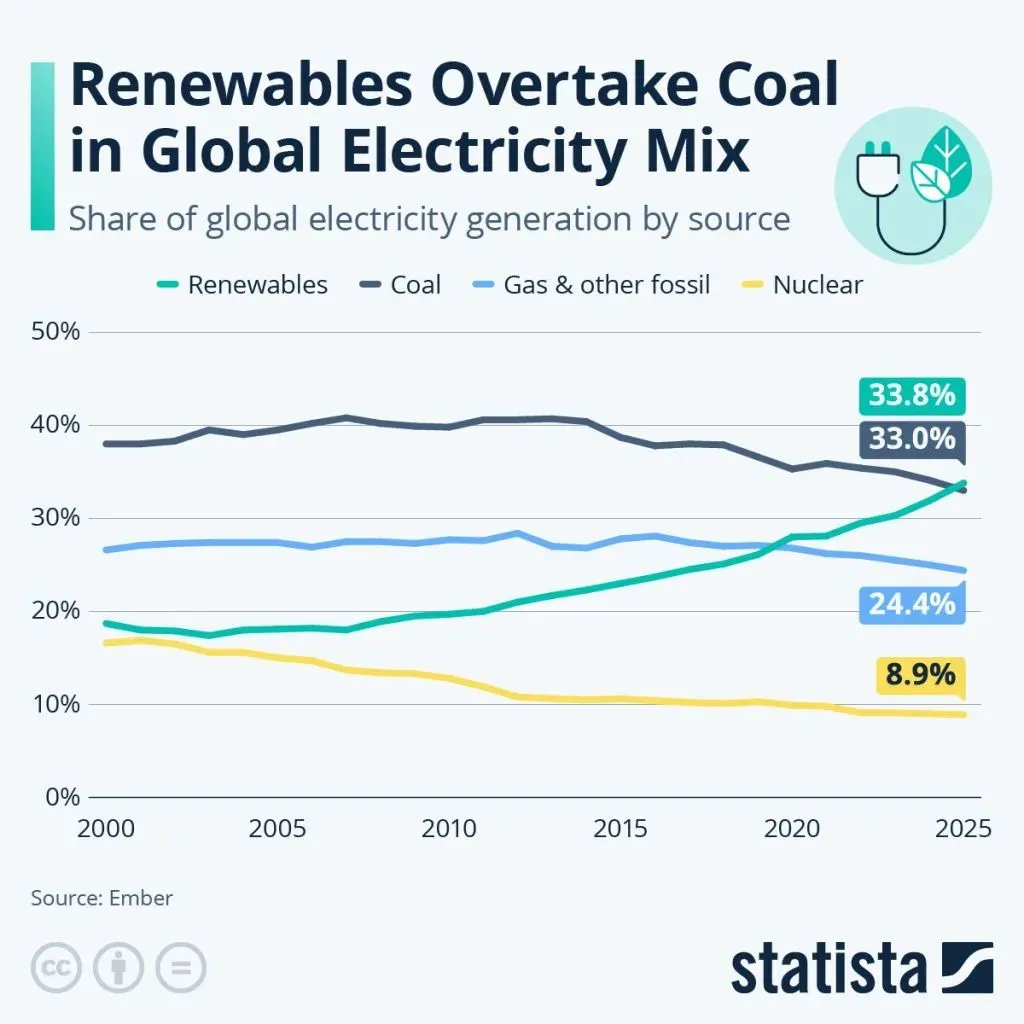
The trend reflects a steady but uneven rise of renewables over the past twenty‑five years, from less than 19% in 2000 to nearly 34% in 2025.
Growth was relatively modest in the early 2000s, with the share hovering below 20% until 2010, then accelerating markedly over the past decade as wind and especially solar power expanded rapidly.
In 2025, this momentum strengthened further, with the entire increase in global electricity demand met by clean energy sources. Solar power alone accounted for 75% of the net increase, adding 636 TWh of generation during the year.
Over the same period, the role of fossil fuels in electricity generation has followed a two-phase trajectory. Between 2000 and the mid-2010s, their combined share initially edged up, peaking at around 69% in 2012, as growing global demand was largely met by coal and gas. Since then, however, the trend has reversed.
Coal’s share has seen the most pronounced decline, falling from about 41% at its peak to 33% in 2025, while gas and other fossil fuels have decreased more gradually from roughly 28% to 24.4%.
Despite this progress, fossil fuels still account for a majority of global electricity generation (around 57% in 2025), highlighting the scale of the challenge ahead in meeting climate targets.
Nuclear energy, for its part, has seen a long-term decline in its share of global electricity generation, falling from around 16.6% in 2000 to 8.9% in 2025.
Most of this drop occurred in the early 2000s and 2010s, as aging reactor fleets were retired and new construction lagged, particularly in Europe and Japan following the Fukushima disaster in 2011.