Blog
Quantum dot qubit with high-NA made by Imec


A useful quantum computer, will require millions of connected qubits with high reliability and precise control.
Of the various quantum platforms currently under investigation, silicon quantum dot spin qubits are considered a promising candidate for industrial scaling and are often referred to as ‘the industry qubits’.
Their production process is largely compatible with the production of standard computer chips on CMOS.
Silicon quantum dot spin qubits confine an electron within a silicon nanostructure (the gate layer). The ‘spin state’ of the trapped electron is used to store quantum information. Gaps between the various gates must be minimized to limit environmental noise.
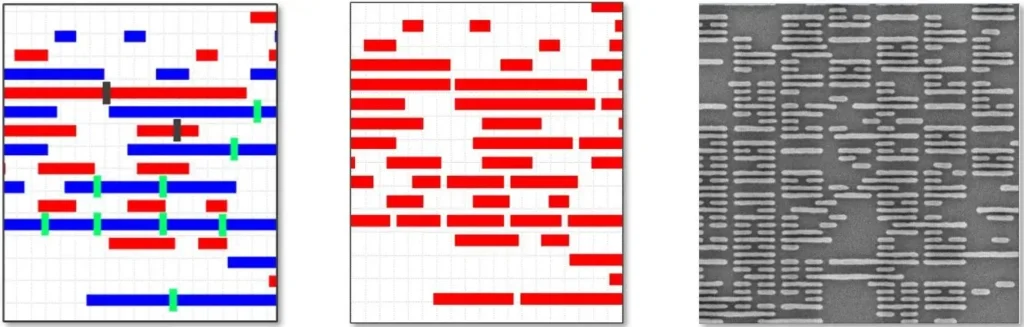
Imec has succeeded in fabricating a functioning network of qubits with gaps of barely 6 nanometers. Thanks to the nanoscale of this hardware component, millions of quantum bits can theoretically be integrated onto a single chip.
“High NA EUV enables the precise patterning of silicon quantum dot qubits. As the coupling strength between neighboring quantum dots increases exponentially with the gap between them, we need to reliably pattern gaps of a few nanometers between the control electrodes of the quantum dots. This is a true engineering feat, thanks to our integration and patterning teams and ASML’s outstanding high NA EUV technology”, says Kristiaan De Greve, imec fellow and program director Quantum Computing.
Quantum dot qubit
This demonstration builds on imec’s previous results with silicon quantum dot spin qubits, which already demonstrated that CMOS-compatible processes can lead to low charge noise and stable qubit operation.
By adding High NA EUV lithography to the production process, the focus shifts from individual demonstration devices in the lab to 300mm fab-compatible, reproducible quantum bits.
While it’s obvious that High NA EUV lithography will be crucial for sub-2nm logic and high-density memory technologies that fuel the rapid growth of advanced AI and high-performance computing, it is now becoming clear that it will also play a pivotal role in hardware for future quantum computing.
See all our Research content.