Blog
QMC PCIe Carrier Supports Flexible Interfacing

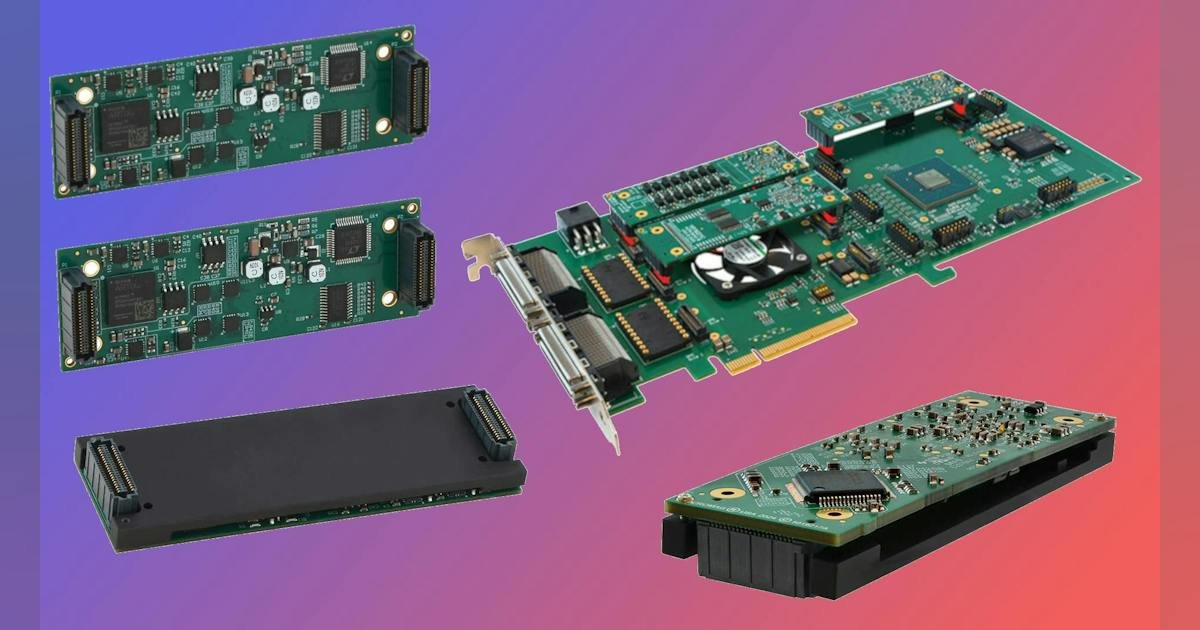
VITA 93 QMC is a small-form-factor (SFF) VITA standard mezzanine module designed for rugged and industrial applications. Its Samtec connectors and standard thermal support makes suits it for defense applications like drones as well as industrial robots. The standard heatsink configuration allows for easy incorporation with conduction- and convection-cooled systems.
The modules require a commercial or custom carrier board like Acromag’s QPCe7340 Series PCI Express (PCIe) Carrier Card (Fig. 1), which has four VITA 93 QMC sockets organized in 3-slot and 1-slot configurations. I/O from each slot is available on the back panel connectors. An FPGA provides individual timing support to each socket.
The three-quarter-length card has a x4 PCIe Gen 3 interface. FPGA and QMC debugging is handled via a standard 14-pin JTAG programming header. Optical isolation is available for two of the slots.
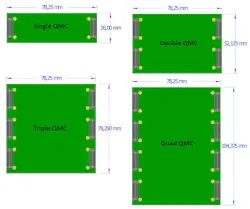
The VITA 93 QMC standard defines four different module formats (Fig. 2). The QPCe7340 supports four single or one double/two single or one triple/one single configurations. Larger modules are used to deliver more I/O connections and throughput as well as to support larger chips like AI accelerators or FPGAs.
Acromag offers a range of VITA 93 QMC modules (Fig. 3). The digital I/O modules have 32 isolated channels or bipolar solid-state relays that handle AC or DC signals. The analog module maintains 20 channels connected to a 16-bit analog-to-digital converter (ADC) with a 1-MHz sampling rate.
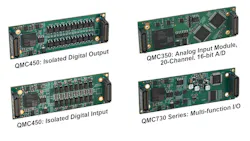
The multifunction module has eight channels with a 16-bit ADC that possesses a 1.264-µs conversion time (791KHz) and a 1,026-sample FIFO buffer. And a four-channel, 16-bit digital-to-analog converter (DAC) features a 7.5-µs output settling time. Each channel is individually configurable. On the digital side, the module has 16 input/output channels with TTL-compatible thresholds. The 32-bit counter/timer can be used for applications like waveform generation and quadrature position measurements.
The modular approach provides developers with a flexible design platform that can be migrated to different form factors. For example, the PCIe carrier board could be used in the lab to design and test a configuration while deployment might use a custom carrier board employing the same set of modules. There are other SFF modules like M.2 or Mini-PCIe, but both lack the rugged connector design, standard cooling support, and bandwidth provided by VITA 93 QMC modules.