Blog
Delicate touch: Tactile sensors help humanoids get a grip

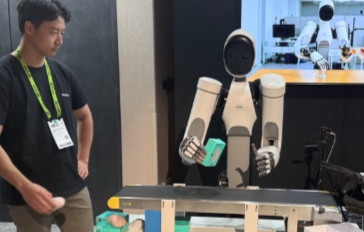
Robotic fingers with tactile sensors are the latest hot focus of researchers and developers of practical, real-world physical AI applications. Many of the more than 70 robotics companies on display at Computex in Taipei in early June showed use of five-fingered robot hands equipped with tactile sensing capabilities.
Just on Wednesday, Bosch executives at an industry event in Germany described a stronger focus on MEMS used in humanoid hands and fingers—everything from the delicate touch to grasp a fragile wine glass or the firmer grip to pick up a heavy coffee cup. The company is already the largest MEMS producer globally and now foresees strong growth because of humanoid touch.
Tech giants such as Intel, Nvidia, and Qualcomm are also working across the entire robotics spectrum where tactile pressure and motion/vibration sensors function alongside powerful processors, software and developer tools that include libraries of AI models that speak directly to robots performing specific tasks—often repetitive ones—designed to be useful in everything from an industrial kitchen to an assembly line.
In one example, Intel sponsored Trossen Robotics at a private Computex venue showing off robot arms equipped with two-finger prongs moving small boxes repetitively. An important training task of late, Trossen officials said, was teaching the robots to hold an object like a scoop used to move food from one place to another, instead of the better-understood task of chopping vegetables, which requires a different gesture by the robot hand. (With AI, humanoids are expected to act autonomously, not through the older approach where industrial robots are teleoperated, and a human translates intent through a controller of some kind.)
Nvidia also staged a private GTC Taipei venue where robotics companies were showing off humanoids that were directed to use five-fingered hands with tactile sensors to do tasks such as moving small boxes. In one example, a humanoid was shown on video display grasping a computer mouse and inserting it into a small box and closing the lid, then setting the box onto a conveyor belt to be placed by another humanoid inside a larger box.
In all these examples, the orchestration of a simple process, such as a humanoid opening and closing a small box, crosses a range of disciplines—from relying on a powerful processor and other hardware, including memory, to process real-time data from pressure/tactile and motion sensors and comparing the data to trained repetitions of various gestures. There is no dominant architecture yet for how tactile sensing works, as multiple sensing approaches coexist across different companies, with each optimized for different use cases. It is still early in the advent of robotic tactile sensing, and some companies see the real opportunity in fusing sensors with AI training data.
Analog Devices late last year described in a white paper how today’s robots are heavily reliant on vision sensing to perform tasks, but the company has engineered another approach where a next-generation sensor prototype has fives times higher resolution than a human fingertip. Instead of vision only, these sensors from Analog will integrate pressure, vibration and temperature into a compact and affordable package, Analog said, enabled by advances in MEMS and semiconductor packaging. https://www.analog.com/en/ai/the-future-of-tactile-sensing.html Analog said its work is just at the beginning, but the pace of development is accelerating.
One live robotics demo at Nvidia’s GTC Taipei held in conjunction with Computex was very impressive. A humanoid RLDX-1 model gingerly and slowly opened a small box and inserted a computer mouse successfully, but then, unintentionally, dropped the box when closing it. The team of engineers at RLWRLD tried at least a couple of times when I was present to get the full demo to work as intended and then sighed audibly when each small error occurred. They simply smiled and quickly tried the demo again, like the best robot designers.
Nearby, Techman Robot also showed off a TM Xplore I humanoid platform that picked up a fan component from inside a padded box using a five-fingered hand, then placed the small fan on a nearby table. Another robot arm nearby picked up the fan and put it in its proper place in a server tray. The humanoid is powered by the Nvidia Jetson Thor module, TM said.
In all these humanoid hand examples, company reps talked about the value of tactile sensors on fingers and the precision that five fingers can provide for fine tasks, including the manipulation of medical instruments.
Robotics investments double
To be clear, even the modest five-finger actions of humanoids are impressive, representing the work of thousands of hours by robot engineers. Even when there are errors in how robots perform tasks, there is lately dramatic improvement being noticed by investors. In 2026, the robotics industry has shown tremendous growth, often by large companies investing in robotics startups.
Recently, Qualcomm, Amazon, Nvidia and Bosch joined other companies in a $1.4 billion series C investment round for Neura Robotics in Germany. That’s just one example. Dealroom recently said robotics companies have raised nearly $56 billion so far in 2026, a record that doubles the previous record raised last year.
China Daily recently profiled PaXini Technology in Tianjin in coastal northern China, noting that the company spent five years making the first 6D hall array multidimensional tactile sensor and now charges less than 1% of the price of equivalent products overseas. The company says 80% of humanoid robots worldwide use PaXini’s sensors, and the company has drastically reduced the price of similar tactile sensors that would have cost more than $14,000 each five years ago and now go for about $27.
The tactile sensors market is fragmented and includes companies not directly involved in robotics only, such a stretchable circuits maker MC10, now part of Medicate Solutions. Tacterion makes flexible sensor mats that detect pressure and location as well.
Robot hand vendors integrating tactile sensors include a range of companies alongside PaXini: Shadow Robot, Schunk, Robotiq and Tesolo.
Analysts who follow the space believe the companies that do the best will integrate sensors and robot hands with AI training loops, and not focus on the standalone components only. Tesla’s humanoid strategy follows this approach by integrating sensors with AI training, compute and manufacturing for roll out in deployment environments.
While it may seem obvious, tactile sensors increase value when embedded in a learning system. Verified Research Insights said the robotic tactile sensing system market was $224 million in 2024 and will reach $622 million by 2032. The analysts there follow 17 key companies:
Tekscan Inc., SynTouch Inc.,Pressure Profile Systems Inc., Tacterion GmbH, OptoForce (OnRobot), Touchence Inc., XELA Robotics, BeBop Sensors Inc. Sensor Products Inc., Weiss Robotics GmbH, Interlink Electronics Inc., Peratech Limited, Shadow Robot Company, Piezo Technologies, RoboTouch Technologies, GelSight Inc., and TacSense Inc.
Bosch’s latest focus
The increased focus on humanoids and tactile sensors in hands and fingers is partly borne out of a decreased demand for components for the automotive sector. Earnings for the auto components market has declined among some major suppliers, including Bosch, which first reported problems in late 2025.
On Wednesday at the Bosch Connected World 2026 conference in Germany, CEO Stefan Hartung and board member Tanja Rueckert outlined opportunities in humanoids, specifically around a human-like sense of touch. Tiny MEMS sensors that Bosch makes can allow a robot hand to tell the difference between holding a glass or an egg, the company claimed in a press release. “With the advent of humanoid robotics, the demand for Bosch components and solutions is increasing,” Hartung said. Bosch holds the market lead in MEMS.
Bosch is not necessarily focused on the making of humanoids, but on being the leading supplier and partner for the “brain and nervous system” of automation and robotics, according to Ruekert, in a statement.
“Humans have 4 million touch sensors,” Hartung added. “If we were to build robots with just as many sensors, then four years’ worth of worldwide sensor production would barely be enough for 12,500 robots.” Bosch noted his comment indicates the immense potential for automation and robotics and cited a Yole Group forecast showing the MEMS market to grow 4% annually and reach $19 billion by 2030.
In addition to investing in Neura Robotics with other major companies, Bosch has a partnership with the startup that includes a provision for thousands of Bosch factory workers to wear sensor suits to glean training data for Neura robots.
Bosch’s comments on the role of its MEMS and the many sensing humanoid demonstrations at Computex backed by major players such as Intel and Nvidia clearly show a strong push for the humanoid tactile sensing tech heading into the second half of 2026.