Blog
ST notches market lead for in-car sensors

With Europe’s GSR2 regulation mandating Driver Monitoring Systems in new vehicles sold in Europe starting in July, the market is hot for in-cabin image sensors.
No longer are these sensors a luxury car feature, meaning they will be required across a far larger number of vehicles down the price stack.
STMicrosystems has staked a claim to success in sales of DMS and Occupant Monitoring Systems, claiming it has sold 10 million-plus in-cabin image sensors over the past four years to Tier 1 system suppliers who in turn sell to carmakers. ST calls these image sensors SafeSense by ST, with ST providing the eyes to see in-cabin, with software makers Tobii, Smart Eye and others providing the brains.
“The in-cabin sensing market is picking up. Having sold 10 million sensors from ST puts us in the market leader position,” said Sebastien Teysseyre, ST’s Auto Image Sensor Leader, in an interview with Fierce on Tuesday. Most of the 10 million CMOS image sensors sold are inside vehicles on the road already, he said, deployed with all the major carmakers.
About 40 million such sensors have been sold in recent years, according to ST and others. “We have competition for sure,” he added. According to Markets and Markets data, other key companies in the space include NXP, Bosch, Denso and Valeo. ST is a French-Italian company headquartered near Geneva, Switzerland, while its legal holding company is incorporated in the Netherlands.
One reason ST believes it has done so well is that it makes all the components needed for the SafeSense sensors at fabs in France. This gives the company control over component supply and costs, which means faster time to market and the ability to control prices.
Trusted regionally anchored supply chains have become a differentiator for all manner of suppliers in many countries, incentivized partly by a global tariff approach pushed by the Trump administration that insists that American companies manufacture domestically. Producers also want greater control over the supply of components should a war break out with Taiwan or China.
ST is also able to sell into China, the world’s largest automotive market, and Taiwan, Teysseyre said.
Teysseyre also noted that ST has been able to scale up production with single-camera systems that combine visible imaging and infrared sensing to allow full-cabin monitoring that can be deployed across various vehicle segments. This approach allows cost-effective designs desired by carmakers who are able to customize how they use sensors.
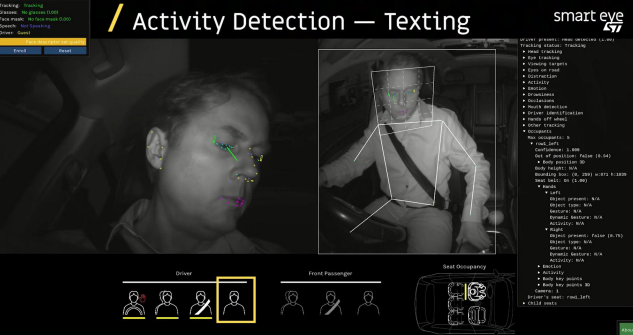
ST’s Driver Monitoring System involves a single infrared camera that is focused on both the face and upper body of a driver to detect drowsiness, awareness and vital signs. IR works best in this setting, ST believes, because it can detect drowsiness and distraction during night driving. It is based on a 940 nm infrared LED.
The system looks at the driver’s face “to avoid any ambiguity” about the driver’s ability to drive, replacing older systems that detect the driver’s hands pressing on the steering wheel. More than 10% of road deaths are attributed to drowsiness, according to ST and others.
The Occupant Monitoring System combines RGB and IR cameras to detect airbag deployment, seatbelt use and the presence of a child who could be left alone in a back seat.
ST’s portfolio of in-cabin images sensors runs from 1.5 megapixel sensors for DMS up to wide 5.1 megapixel sensors for OMS. These provide up to 60 frames per second in full resolution.
DMS sensors are often hidden by carmakers in rear-view mirrors or behind dashboard displays, Teysseyre said. The industry has generally said integrating sensors discreetly in interiors helps avoid consumer discomfort at being constantly watched by a camera.
However, some drivers on Reddit and other social platforms have described using electrical tape to cover the cameras, or adjusting their seat position, to stop unwanted alerts. DMS systems will frequently beep for trivial things like yawning or glancing away briefly, drivers have complained.
Some older DMS systems could be easily disabled, but they are becoming increasingly difficult to override permanently as they become standard features.