Blog
At 14, Shanya Gill dishes on tech and how she built Vigil Inc.

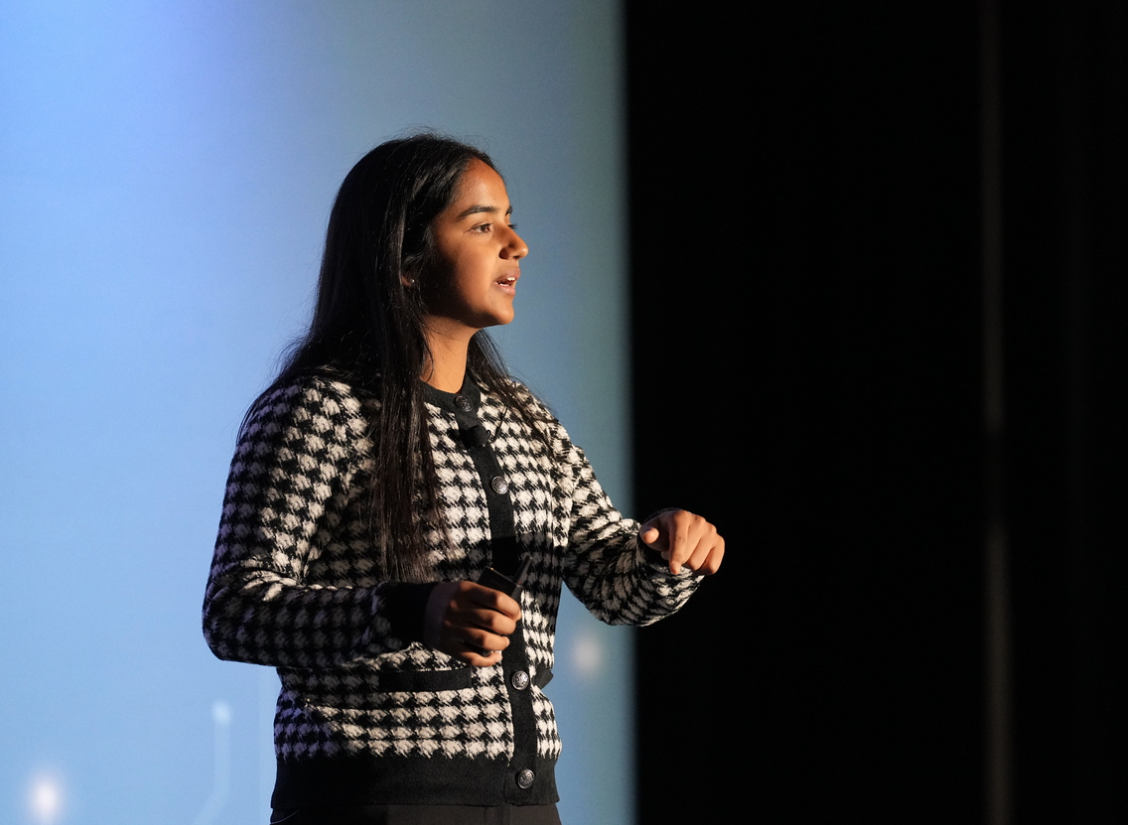
There are multiple benefits to attaining the ripe old age of 14 after founding a sensing company with AI monitoring devoted to helping save lives. Among the benes: an acquired frankness regarding the tech industry and even a sense of humility when crushed with publicity and honors.
Shanya Gill told Fierce Sensors in an interview some of her humble opinions on the future of AI and the workplace and her pet peeves over industry buzzwords. She also outlined the inspiration for her company, Vigil Inc.,and how she cobbled it together. Gill appeared on the Main Stage at Sensors Converge 2026 last week before an audience of developers and other entrepreneurs.
A freshman, she attends Lynwood High School, a top-rated public school in San Jose, Calif., acclaimed for its rigorous STEM academics. She has collected some measure of fame, earning the title of a TIME Kid of the Year honoree in 2024, among other honors. She has since appeared at multiple tech forums to explain how Vigil works by using AI and sensors in a challenge to competitive products like Ring.
Vigil is an AI-powered monitoring system with a camera that uses advanced computer vision to detect events that a user can customize such as “Alert me if someone approaches the front door” or “Notify me if the baby is crying.” Users rely on Vigil’s cloud or their own cloud for intelligence.
The Vigil camera sells for $20 and there’s a $10 monthly service fee. She has so far sold, she estimated, about 100 units. “We started selling one month ago, but it’s not past 100,” she said. Profits are not what drives her, at least not yet.
“I find it fun to do and get a lot of emails from customers that are encouraging,” she said. “I like doing radio shows about it and it’s different and not static. I was never really interested in tech and I feel like I was pretty artsy. What I mostly like about Vigil is just talking to people and working with them. Product development is less interesting… The product does get profit but that’s not really the goal. That’s a by-product of it.”
Saying all that doesn’t mean she doesn’t see a serious value-add to what Vigil does and why it exists. She got inspired to create an early warning system for threats when a restaurant near her home caught fire and burned in the middle of the night. “It made the local news and people were talking about it and the owners are really good people. It made an impact in the community,” she said.
About the same time, Gill was entered in a science fair and began researching smoke and heat in fires. A smoke detector in the restaurant that caught fire would have detected smoke, but not the heat before a fire ignited, which put her on the path of affordable early detection,
“It’s really easy to see fire with smoke, but I wanted to do something with early detection. I went on YouTube to see that thermal cameras can see heat and fires get hot before there’s smoke.” However, she quickly discovered the thermal cameras weren’t affordable enough, and didn’t provide the greatest resolution either.
Then she found VLM (Visual Language Model) which is a kind of AI that understands visual inputs and text, which allows it to see and interpret or describe things and even answer questions about visual content. VLM can be used in Open AI and Gemini. “ A lot of companies do similar things to Vigil, like Blink and Ring, but Vigil uses custom AI,” she said.
Since conception, Gill has had help on software development and product development and ways to bring the product to the market, but much of the work comes out of her own initiative and personal values. She doesn’t like using too much cardboard, so she came up with a plush platypus pouch to hold the camera instead of cardboard packaging.
Pondering AI practices and where AI is headed
AI has helped in developing Vigil as well. “I really rely heavily on AI. At first, I couldn’t write more than a paragraph of code. Now I use Coder/Cursor and it’s great. With AWS, once it was set up with the proper channels, I said, ‘I want to do this and let’s build a plan and do this together’ and if outside code and platforms are needed– it’s kind of hacks.”
Gill is an AI practitioner with obviously plenty of insight into both how to benefit from AI and where the potential perils lie.
“AI came up so fast,” she said. “I remember I used to have to write essays from scratch and now have used it for like four years. I have no clue how big it’s going to get or will it take everybody’s jobs. But possibly it will move slower than people think. So many people have visions of the future that don’t turn out correctly…I really think people will have time to adapt. Yes, people have been laid off due to AI, but I don’t think of it as that big of a change.
“In India, where my family is from, there’s still a lot of farmers. A lot of tech could help them, yet they still rely on hand picking things. The majority of the world is not going to shift that fast. Still people see it moving fast and layoffs have been happening, so I’m not too sure. I don’t know. I haven’t done a lot of research” on the future for AI.
In one example, while being driven to Sensors Converge at the Santa Clara Convention Center, Gill noticed a parking attendant was directing traffic entering the garage to turn left while the attendant stood next to a sign also pointing to the left. “Their job will be taken away, they will be replaced someday, but their job as a human was useful. When you really need a driver to turn, you might need a person standing there.”
Someday, in a world of self-driving vehicles, the arrow might be enough of a direction to move traffic, but that day is not here yet. “I feel like AI is headed in a good direction but has some shortcomings and is affecting people differently. I don’t know how that is going to change. You can’t tell big corporations to stop. They won’t listen,” she said.
‘These companies, I just hear buzzwords’
Gill has had some negative reactions to the many interactions she’s had with tech executives at public forums, mainly along the lines of how a company founder is expected to speak and what she is able to comprehend. Fierce asked Gill her general reaction to being in the tech scene at live events and virtually and got this unexpected response:
“With tech in general, these companies, I just hear buzzwords. It might be me, but I can’t comprehend their buzzwords. On their web pages, you can’t really understand what they are doing. They say, ‘Yeah, yeah, we’ll make this.’ One guy even told me, ‘I advertise what people want and yet I give them what they need.’ I think some companies don’t know what they are doing. I probably don’t understand them totally so that’s like a user error on my part.
“I think people care a lot more about who you are and what you stand for and what the company is and stands for. Whatever you are building is a direct reflection of who you are. In the beginning, I tried to seem really professional and that didn’t reflect who I was. It wasn’t me. I feel like I’m pretty loud and my voice really carries.
“I shifted to working in email and working personably with people and really having the product reflect me making something. I feel it’s more rewarding and people like it a lot more. At conferences, I earlier would have a script and try to memorize it because you don’t want to blank out. But it didn’t feel normal with the script and I didn’t connect to that. If you are boring, your product is boring.”
So much humility and so much truth. Wise beyond her years, Gill heads off this week to classes and homework, and grappling with AI while juggling a speaking calendar at future conferences. One thing is sure for Gill amid all the uncertainty of AI: the future will be busy.