Blog
At SC26, Murata and Hexagon show driver assistance tech updates

What a difference one year makes.
Engineers know well that even as they work hard to create amazing new technologies, geopolitics can interfere. Such is the case in 2026, with the US now in a war with Iran and threats of tariffs and actual global tariffs affecting the tech industry supply chain in complex ways.
Case in point: engineers from Murata and Hexagon showed up for a second year in a row at Sensors Converge 2026 in Santa Clara, Calif., providing an on-road demonstration of ADAS positioning technology and headlight leveling technology to make sure future cars travel safely. Their main audience is Tier 2 suppliers to the auto and larger transportation industry, including trucks and tractors.
A year ago, Murata showed in a similar on-road demonstration at Sensors Converge a new MEMS chip, SCH1633, that has now been adopted in the market for use in automotive and industrial applications, according to a Murata rep. It offers position sensing via an accelerometer and an IMU (Intertial Measurement Unit) and is also used in headlight leveling.
Hexagon has combined that chip with its safety-certified SPAN Enterprise positioning engine software and TerraStar -X correction services. Company representatives said Hexagon is among a small group of companies offering safety certified tech to vehicle manufacturers to help keep cars centered in lanes and in the correct lanes, to ultimately avoid accidents. New in this year’s demo was an integration of Nvidia’s AGX, which acts as an AI brain for self-driving cars, robotics and a range of Edge AI applications.
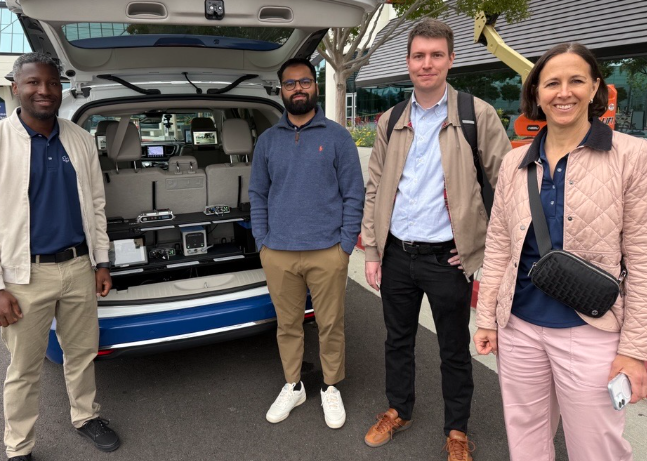
During the on-road demo, the companies used a retrofitted demonstration vehicle with all the tech in the trunk. Vehicle OEMs could decide to adopt all the tech or parts of it, customizing as their needs arise.
Representatives for both Murata and Hexagon said they have adapted to what otherwise could become a bad year because of geopolitics and an uncertain economy by selling into related markets, not only automotive. That means moving to agricultural and trucking markets, not only autos, said Sara Masterson, director of portfolio strategy for Hexagon, based in Calgary, Alberta, Canada.
The adoption rate of Hexagon’s technology for use in ADAS “is lower than expected” when Hexagon started on it about five years ago, she told Fierce.
But Hexagon is adapting well overall, with a wide range of tech beyond ADAS. The company continues to hire young engineers in what is widely seen as a market in desperate need of many more engineers, especially as AI takes hold.
Overall, Hexagon has more than 24,000 workers in 50 countries with recent annual revenues of $5.8 billion in 2025. Meanwhile, Murata had 74,000-plus workers and $10.6 billion in revenues last year.
“We just had 15 interns at our intern day in Calgary,” she said, smiling about the strong talent pipeline in the Alberta province.
That’s the thing about most engineers: they just keep inventing and working, even if the prevailing skies are not particularly bright and the forecast is uncertain.