Blog
Teledyne e2v Begins Production of its 16GB DDR4-X1 Flight Models for Space Applications

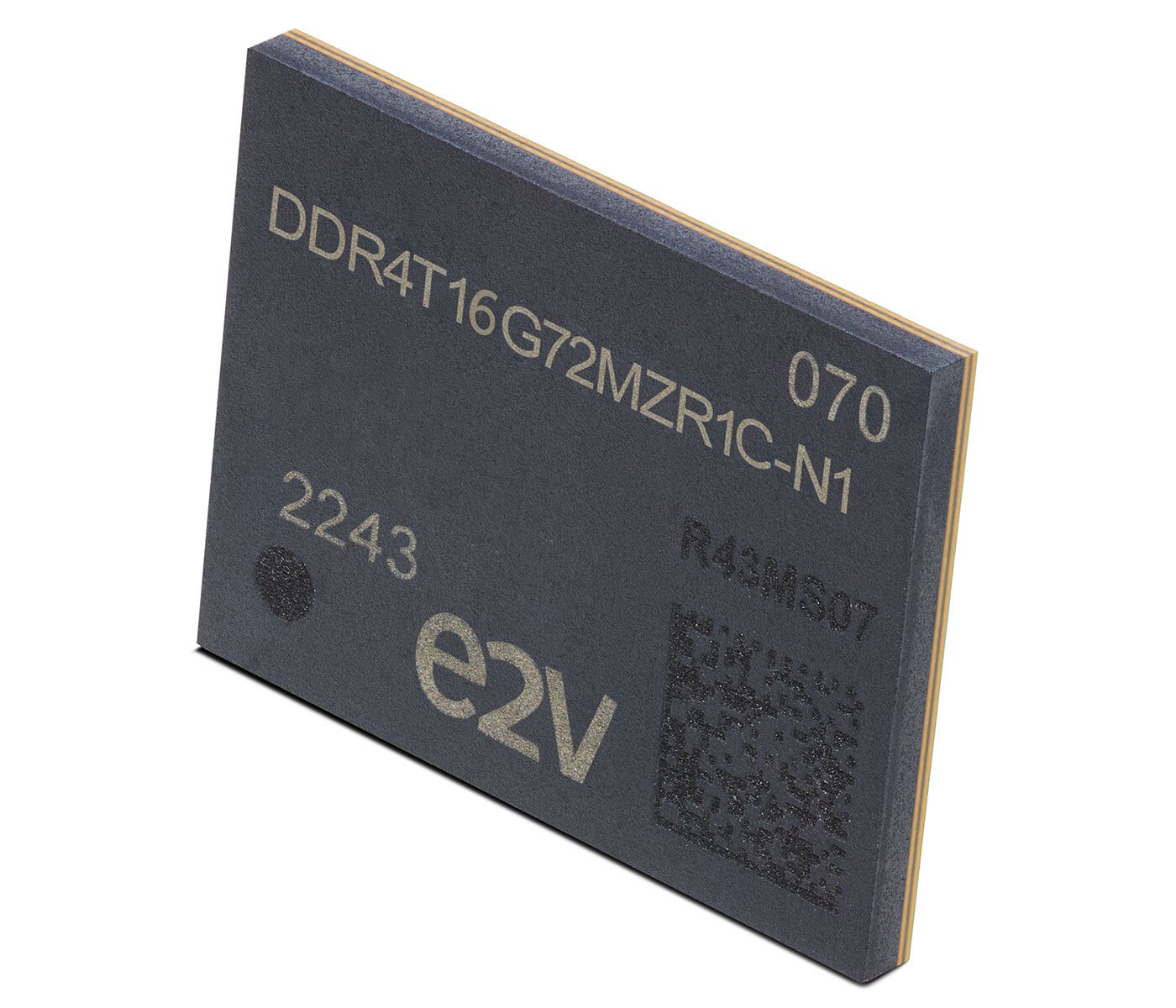
Initial samples of the 16 GB DDR4-X1 Flight Models were delivered to customers in October 2025, allowing early system integration and evaluation. The device supports data rates up to 2400 MT/s, provides single-event latch-up immunity above 43 MeV·cm²/mg, and offers radiation tolerance up to 35 krad TID, enabling reliable operation in mission-critical space environments.
Maintaining the same 15 × 20 × 1.92 mm footprint as other devices in Teledyne e2v’s DDR4 family, the new memory is pin-to-pin compatible with lower-density versions, allowing satellite integrators to upgrade memory capacity without redesigning their boards.
“Reaching production for our 16 GB DDR4 Flight Models confirms that the program is progressing exactly as planned,” said Luca Lo Coco, VP Marketing at Teledyne e2v. “Our documentation, radiation reports, and customer support structure are already in place to support adoption across multiple space programs.”
The 16 GB DDR4-X1 device is also used in Teledyne e2v’s Qormino QLS1046 space computing modules, which integrates a radiation-tolerant processor with DDR4 memory for advanced onboard processing tasks such as AI inference, sensor fusion, and autonomous spacecraft operations.
Teledyne e2v’s DDR4 portfolio also includes 8 GB Flight Models and NASA Level 1 16 GB versions for GEO and long-duration missions, expected to be available in Q3 2026. This portfolio gives satellite designers the flexibility to select the optimal memory density and quality flow for their mission profiles while ensuring compatibility and long‑term continuity.