Blog
ST’s smart IMU bolsters Qualcomm’s monster AI chip for wearables

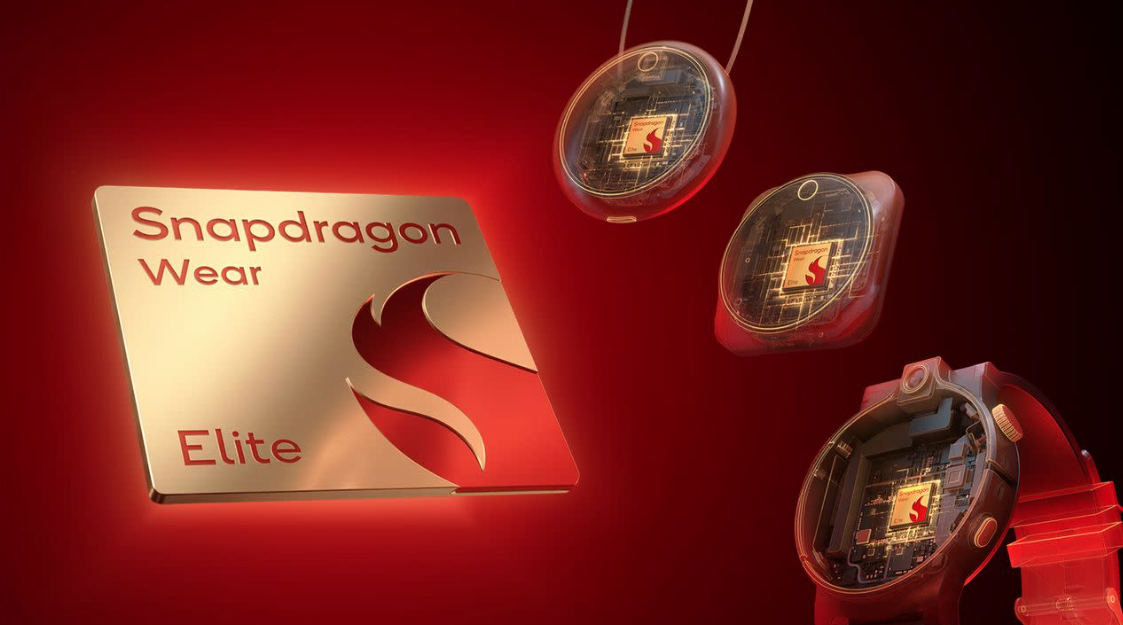
ST Microelectronics just announced its motion sensing and secure wireless tech runs inside Qualcomm’s newly launched AI- based Snapdragon Wear Elite chip, with ambitions to take wearables to the next level.
Qualcomm launched the ambitious platform on Monday at Mobile World Congress in Barcelona, noting it is expected to be used in watches, pins, pendants and other devices. Google, Motorola and Samsung are expected to create products based on the platform in the next few months and Samsung has already said it will be used in the next-gen Galaxy Watch.
Qualcomm’s chip will deliver edge AI with an integrated Hexagon NPU and advanced sensor processing with more than 50 sensors for improved AI perception. Support for satellite-based two-way messaging is included. “This is our next step toward our vision of the Ecosystem of You where intelligence seamlessly travels with the user, learning and adapting to their context across personal devices,” noted Alex Katouzian, a group GM at Qualcomm.
ST’s central proposition is it offers Qualcomm low power AI at the edge, the dominant theme of many emerging edge AI applications. However, ST’s size and reputation in the sensor and semiconductor industry obviously plays a role in the collaboration between the two tech powerhouses. ST, with 48,000 workers and 200,000 customers, grants Qualcomm OEMs access to development tools and global support to speed up time from prototype to mass production.
A chip built for personal AI
Specifically in the Snapdragon Wear Elite platform, ST provides a smart inertial module with machine-learning capabilities to perform pattern recognition of user gestures, activities and context. The module, named LSM6DSV32X, distributes AI compute between the ST sensor and the Snapdragon Wear Elite main application processor to offer plenty of battery life for continuous activity recognition and health monitoring, ST said.
ST claims the LSM6DSV32X also delivers more accurate and frequent tracking, including posture and specialized activity metrics and more responsive interactions—thanks to real time decision-making in the sensor.
In addition to the inertial module, ST makes the ST54L NFC controller with secure element that is embedded in the Snapdragon Wear Elite. This enables multiple contactless services such as secure payments, transport tickets, access control (think digital car keys) and cellular network connections. ST’s NFC is an Android reference design.
“Snapdragon Wear Elite transform the wearable experience through always-on intelligence and superior connectivity,” said Diono Bekis, SVP and GM of wearable AI at Qualcomm. “STMicroelectronics’ ultra-low power sensing and security elements are a natural complement to our platform. Together we are pushing the boundaries of what next-generation wearables can achieve in the age of personal AI.”
Simone Ferri, executive vice president of the MEMS sub-group at ST, said ST’s pre-validated reference designs and software in the new device helps OEM’s “accelerate time time to market, simplify integration and deliver always-ready, smart wearables.”
ST’s LSM6DSV32X is a 6-axis IMU, featuring a 3-axis digital accelerometer and a 3-axis digital gyroscope. Power consumption is listed on ST’s specs at 0.65 mA in high performance mode. The IMU is 2.5 mm x 3 mm x 0.83 mm, helping device makers offer slimmer wearables. It supports adaptive self-configuration to allow it to automatically reconfigure in real time based on detection of a specific motion pattern or the output of a specific decision tree without any intervention from the host processor.
Qualcomm said in press materials that its Snapdragon Wear Elite is built on 3nm architecture with the Hexagon NPU supporting billion-parameter models at the edge. It includes a 5x bump in single-core CPU performance and a 7x faster Adreno GPU compared to prior models. The entire platform supports multi-day battery life, but Qualcomm did not specify how much other than to add that advanced power management enables 30% longer day of use over the prior generation. Rapid charging brings a device up to 50% in about 10 minutes. At one point in its materials, Qualcomm said the platform provides more than 50 sensors for rich contextual data, but did not describe the sensors of mention ST. A block diagram of the platform includes a sensor hub among 14 major components.
As satellite-based two-way messaging catches on, the platform supports NB-NTN where cellular and Wi-Fi are not available in collaboration with partners including Skylo. Other connectivity provided in the platform includes 5G RedCap, Micro-Power Wi-Fi, Bluetooth 6.0, UWB and GNSS.
Qualcomm’s Snapdragon Wear Elite has been in development for three years and builds on its existing WQ5 and AR-series platforms. Samsung has reportedly confirmed it will use the Snapdragon Wear Elite chip in its next-generation Galaxy Watch.