Natalie Vock, a well-known Valve contractor and Linux graphics driver developer, recently debuted a new patch that enabled better VRAM management on Linux for GPUs with low VRAM. When we originally covered the set of kernel patches, we noted that it could cut VRAM usage in half in some applications, potentially making certain aging graphics hardware viable for gaming where it may not have been before the patches. Aside from some early tests by Vock herself, not much other data was available at the time to draw any conclusions about the potential performance improvements. Now, thanks to
NJ Tech on YouTube, we have some idea of how the patch could improve performance on a GPU like the AMD Radeon RX 6500 XT, which has a mere 4 GB of VRAM. The YouTuber tested the GPU across nine games, including some heavy hitters, like Crimson Desert, Hogwarts Legacy, and Cyberpunk 2077 in CachyOS, which was the first Linux distribution to package and release Vock’s kernel patches in what it calls GPU Booster. In the current GPU market, it would be nice to have a silver bullet to make low VRAM GPUs viable, but the results are far more varied than that, with some games seeing no improvement and others seeing up to 100% increases in FPS.
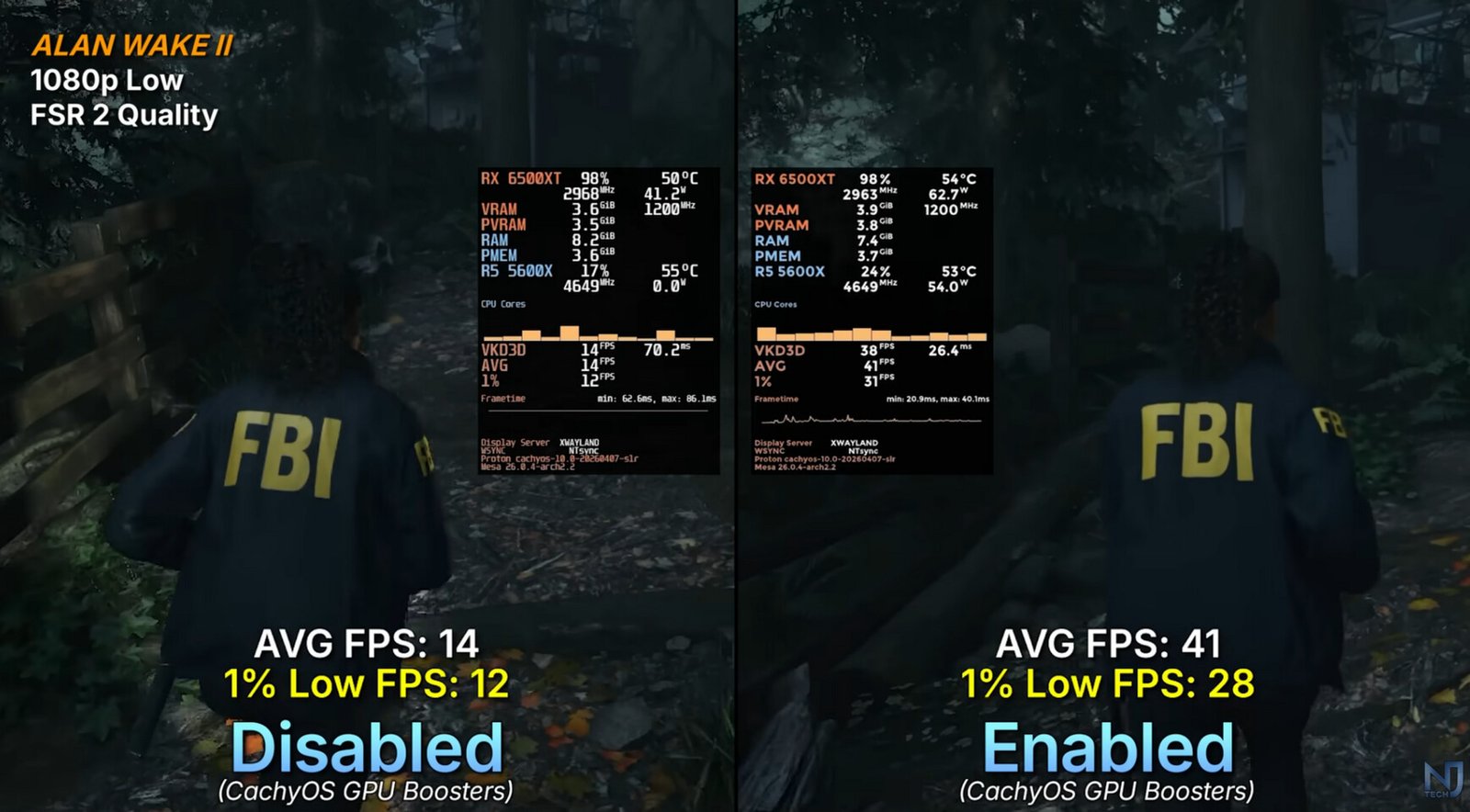
In Alan Wake II, VRAM use is actually increased, but there’s a more than 2× increase in FPS, going from 14 FPS to a very playable 42 FPS average. In Resident Evil: Requiem, VRAM use is identical, but there’s a 16% FPS increase, and in Silent Hill f, the story is similar, with identical VRAM utilization but marginal performance increases. Crimson Desert saw a decrease in VRAM usage, but there was no measurable performance increase as a result, as was the case with Hogwarts Legacy and Cyberpunk 2077, both of which saw reduced VRAM usage but an increase of 1 FPS average in the former and identical performance in the latter. The Last of Us Part 2 actually saw a 1 FPS drop in both average and 1% low FPS, but it seems as though there was just too much graphics memory pressure for Vock’s VRAM patches to mitigate the issue. Death Stranding 2 and Marvel’s Spider-Man 2 also saw little to no improvement despite reduced VRAM utilization in the former. The full video by NJ Tech follows.