Blog
News live: PM warns world in ‘volatile’ period as he announces extra 200m-litre diesel shipment; rising mouse numbers reported in regional Australia | Australia news

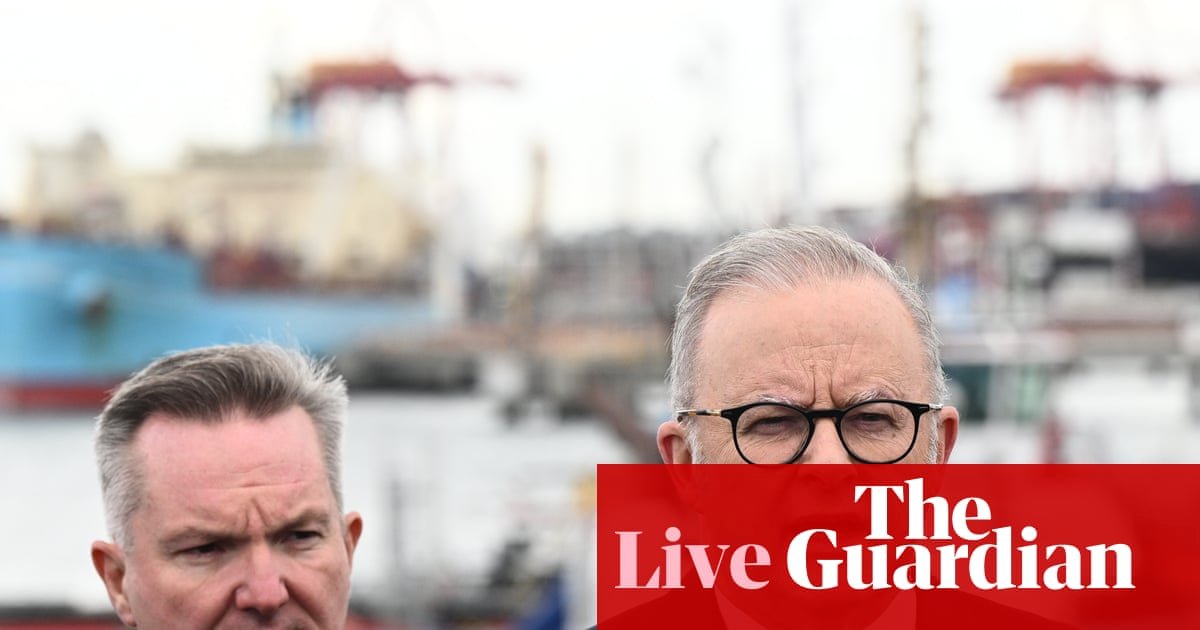
World experiencing ‘volatile, turbulent period’, Albanese warns
Albanese said the government was continuing to work against an extremely volatile political climate. He added:
What we can do here in Australia is to do everything we can to secure supply … that is precisely what we are doing.
This is an extremely volatile period for the entire world. There is no getting away from it. And Australia is not immune from the consequences. …
This is a volatile, turbulent period in the world. We have been very upfront about that. We are not trying to pretend that is not the case.
Key events

Ima Caldwell
A spokesperson for the National Tertiary Education Union (NTEU) has addressed the crowd outside Sydney’s Downing Centre court. He said:
This has to be the line we draw, NTEU members unanimously agree that governments can’t decide where we protest … we stand with you that charges must be dropped ….
The union movement will continue to protect freedom of speech.
The New South Wales premier, Chris Minns, has argued that because the anti-Herzog protest was also covered by a major events declaration, charges would still stand for those who did not comply with police directions.
Advocates for protesters who were charged at the demonstrations have criticised Minns’ comments.
Ima Caldwell
Protesters rally at Downing Centre demanding anti-Herzog protest charges be dropped
A group of at least 40 protesters gathered on the steps outside Sydney’s Downing Centre court this morning to stand in solidarity with those facing charges from the recent demonstrations against Israeli president Isaac Herzog’s visit.
The rally called for the state government to scrap its anti-protest laws and drop all charges against the demonstrators. There were at least five uniformed police officers standing to each side of the group.
An array of symbols were on display, including the Palestinian, LGBTQI and National Tertiary Education Union flags. Other protesters held signs that read: “RESIGN CHRIS MINNS, SCRAP THE ANTI-PROTEST LAWS” and “DROP THE HERZOG PROTEST CHARGES.”
There was a sign at the front of the protest area that reads: “Sanction Israel now, Scrap the anti-protest laws, GLOBALISE THE INTIFADA.”
Last Thursday, the NSW court of appeal ruled in favour of the Palestine Action Group and Blak Caucus, finding an anti-protest law that gave police the power to restrict marches was unconstitutional.
The now defunct law, known as the public assembly restriction declaration (Pard), was introduced after the Bondi beach terror attack last year. Protesters could not use the “form 1” system to legally march in police-designated areas for up to three months after a terrorist attack.
After Thursday’s court finding, NSW police commissioner, Mal Lanyon, said officers were reviewing the charges against the anti-Herzog protesters.
World experiencing ‘volatile, turbulent period’, Albanese warns
Albanese said the government was continuing to work against an extremely volatile political climate. He added:
What we can do here in Australia is to do everything we can to secure supply … that is precisely what we are doing.
This is an extremely volatile period for the entire world. There is no getting away from it. And Australia is not immune from the consequences. …
This is a volatile, turbulent period in the world. We have been very upfront about that. We are not trying to pretend that is not the case.
New shipments of diesel to give Australia ‘an extra buffer’, Bowen says
The energy minister, Chris Bowen, said the new diesel would serve as “extra supply to give us an extra buffer”, with the additional fuel focused on the regions.
The new shipments will come to Australia by the last week of May or the first week of June. Another 61 ships, laden with fuel, are now at sea on their way to Australia.
Albanese announces shipments of additional 200m litres of diesel
Prime minister Anthony Albanese just announced the government has secured an additional 200m litres of diesel.
That figure includes four cargoes of diesel coming from South Korea, Brunei and Malaysia. Albanese said at a press conference in Sydney:
We will continue to use every measure at our disposal to make a difference. … What we can control is how we respond and we are responding by throwing everything at it.
Farmers promised more fertiliser imports
Australian farmers are being promised more fertiliser imports under a deal struck between the federal government and two major companies, aimed at securing supplies in response to a global bottleneck, AAP reports.
The federal government has reached an agreement with chemical companies CSBP and Incitec Pivot, to underwrite the financial risk of importing fertiliser from overseas.
The deal was struck using the government’s strategic reserve powers – designed to shore up supplies of crude oil, fuel and fertiliser, which have been impacted by the closure of the strait of Hormuz.
Much of the world’s fertiliser usually travels through the key waterway, and the Iran war has sent prices for the crucial agricultural commodity soaring.
Under the new agreement, government funds will effectively be put up as insurance for importers who are facing rapid, volatile price changes because of the war.
Reversal on co-payments for showering and dressing help came after listening to older Australians, aged care minister says
Sam Rae, the minister for aged care, said the system for older Australians needed to be “sustainable for generations to come”, saying government reform was centred on creating a robust program.
Rae spoke to RN Breakfast, saying the government had listened to older people when it decided to reverse controversial changes that have required some co-payments for “independent support” for home care, including help with showering and dressing. The change, which costs some older Australians up to $50 an hour for basic care, began in November. The co-payments will no longer apply from October this year.
Rae said:
We’ve always said through this generational reform process that we’d listen to older people and we’d respond to their experiences. … What they’ve made clear is that they want showering and dressing.
We’ve got a $40 billion aged care system … and it needs to be sustainable for generations to come. And that’s what this reform process has been about. … We can’t be in a situation where we’re making a promise to the people of Australia about the dignity that they’ll receive through the aged care system if we can’t deliver on it and we can’t keep it sustainable.
Mouse numbers reportedly increasing across regional Australia, agriculture minister says
Julie Collins, the federal minister for agriculture, said the government has been hearing reports of an increase in the number of mice around the country.
Collins said Australian farmers were some of the “best on the planet”, but admitted there is a lot on their plates already with the effects of the war in the Middle East. Collins told RN Breakfast this morning:
Obviously, you know, the more things that are impacting our farmers, the harder it is for them to keep farming.
… They’re very innovative and they’re able to deal with a whole range of issues. This war is an additional issue. And then, when you talk about things like additional mice, obviously, impacting, they’re also dealing with that too. And we know that there’s a lot on their plate. What we want to do is keep them farming.
Thousands of traffic fines linked to AI cameras withdrawn in WA
Officials in Western Australia have withdrawn thousands of AI-camera traffic fines for seatbelt misuse in the six months since the technology went live in the nation’s largest state, Australian Associated Press reports, but the government will press ahead with more of the controversial devices.
More than 53,000 seatbelt infringements worth more than $29m have been issued to Western Australian drivers since the cameras went live in early October.
The state’s transport department has withdrawn about 2,050 of those, meaning about $1m in fines have been waived.
But WA police and road safety minister, Reece Whitby, told ABC Radio yesterday that the cameras were saving lives and the system was working.
These new safety cameras have actually changed [driver] behaviour … on our roads. We’re seeing offences being picked up at a scale we’ve not seen before because the cameras actually look down into the [vehicle] cabin. That’s a good thing.
Less than 4% of all seatbelt fines issued had been withdrawn, he said, and the vast majority of fines are accurate.
A total of 3,381 fines were appealed and about 60% of those were cancelled.
Drivers are unhappy about the cameras with some caught multiple times for the same offence.
The road safety commissioner would conduct a review of all infringements issued across the state, Whitby said, but AI traffic cameras would continue to be rolled out.
Greens say community has ‘no confidence’ proposed savings from NDIS will help disabled Australians
Jordon Steele-John, the Greens’ spokesperson for disability inclusion, said there is “no confidence” in the community regarding proposed savings from the NDIS, set to be revealed by health minister Mark Butler today.
Steele-John told RN Breakfast this morning:
People cannot understand, quite rightly, in my opinion, why a government facing a budget, which is ultimately always about choices, would choose to cut their services rather than make the gas exporters pay their fair share of tax, tax Gina Rinehart or Clive Palmer a bit more, or maybe … buy one fewer submarine from Donald Trump rather than take away their ability to connect with their community or get the absolute basics they need to live.
Steele-John went on to say disabled people and their families are “sick of being used as political footballs”.
We’re in a situation right now where the state government is saying we cost too much. The federal government is saying we cost too much. And in the middle are disabled people and our families who will end up receiving less services and support. We will end up without the supports that we need to live.
And while we’re on the subject of a tax on gas exports, check out more on the views coming out of Labor’s environment action network (Lean).
Pocock calls for government to put ‘Australians ahead of gas companies’
Jordyn Beazley
Independent senator David Pocock has said a 25% tax on gas exports is not a “radical idea”, and has urged the government to put “Australians ahead of gas companies”.
Speaking on ABC’s 7.30 last night, Pocock said:
We’re one of the biggest gas exporters in the world, and yet we feel poor every time gas prices go up internationally. And then we look at Norway, and they’ve got a $3 trillion sovereign wealth fund. Australians know that this just comes down to political leadership, political courage, to actually put Australians ahead of the gas company.
Pocock said he is not “demonising the gas industry”, adding that “we need this industry for the transition” to renewable energy. He said:
This is gas that belongs to all Australians. And a 25% gas export tax would not only raise $17bn in a normal year, probably far more, when we see the kind of windfall profits that we’re likely to see, but it would actually reduce the price of gas for Australian manufacturers, businesses and households, and that is a very good thing at the moment.
Labor changes course on aged care funding

Tom McIlroy
The health minister, Mark Butler, will detail savings from the NDIS on Wednesday, as well as new arrangements for care services like showering, dressing support and continence management.
Labor is backing down from elements of its aged care reforms, removing out-of-pocket costs for non clinical services in the Support at Home scheme.
The government has faced criticism from advocates for elderly people, experts and aged care providers, who said these personal care services are essential for people’s independence and ability to stay at home.
The minister for aged care, Sam Rae, said the changes will be effective from 1 October this year.
Showering, dressing, continence care – these aren’t optional extras. They’re the basics of ageing with dignity, and no older Australian should miss out because of cost.
Older Australians, their families and providers told us these services needed to be protected. We’ve listened, and we’re acting.
Fourth man charged over alleged kidnapping and murder of Chris Baghsarian
NSW police have charged a fourth man over the alleged kidnapping and murder of Chris Baghsarian.
The 85-year-old disappeared from his North Ryde home on 13 February and his remains were found on 24 February near a golf club in Pitt Town.
Police do not believe he was the intended target of the kidnapping but was taken in a case of mistaken identity.
Three people have already been charged with Baghsarian’s murder.
In a statement issued early Wednesday morning, police said they arrested a 19-year-old man on Tuesday morning at Mt Druitt police station.
He was charged with murder and take/detain in company with intent to ransom occasion actual bodily harm.
The man was refused bail to appear in Mt Druitt local court today.
Welcome
Good morning and welcome to our live news blog. I’m Martin Farrer with the top overnight stories and then Nick Visser will be your guide through the morning.
Today the health minister, Mark Butler, will detail major changes to the NDIS including significant funding “savings”. The government says the savings, in part, from the national disability insurance scheme will go to funding improved aged care including showering and dressing.
And there has been a development in the case of the alleged kidnapping and murder of 85-year-old Chris Baghsarian earlier this year, with a fourth man arrested and charged.