Blog
Politics live: Australia always preferred secondhand Aukus submarines, defence secretary says | Australia news

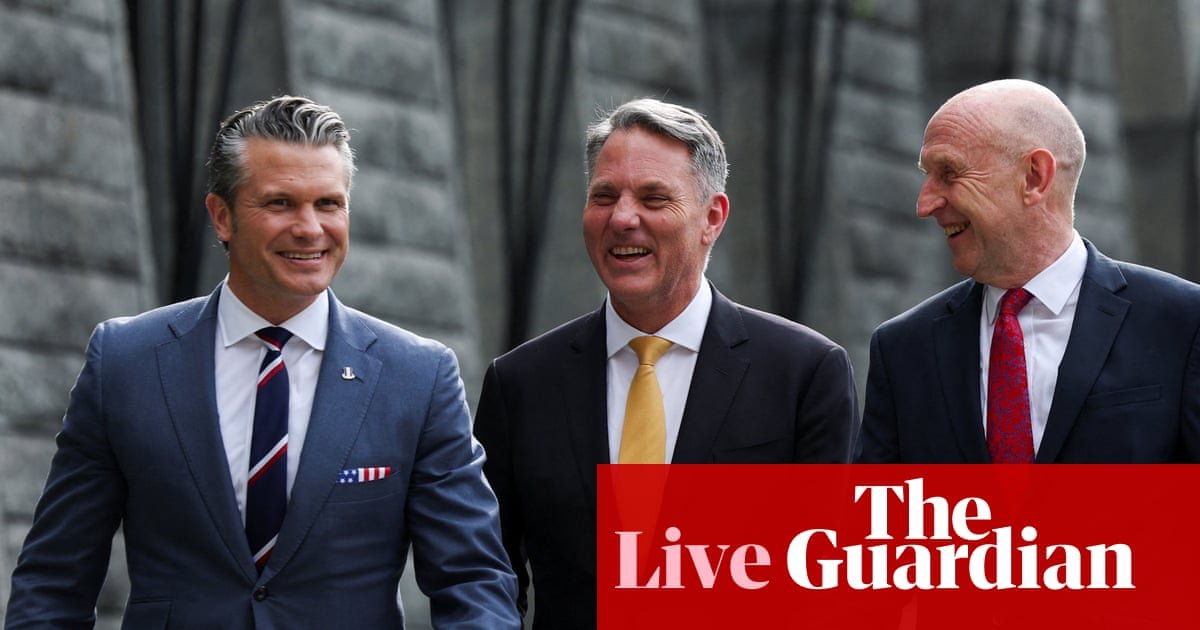
Australia always preferred used submarines, defence secretary claims
Dan Jervis-Bardy
Australia’s preference was always to receive second-hand nuclear powered submarines under the Aukus deal, defence officials have revealed, prompting the Coalition to question if the original arrangement was “imposed” on the Albanese government.
The defence secretary, Meghan Quinn, was grilled at Senate estimates on Tuesday night about the announcement that Australia would buy three used Virginia-class submarines from the US rather than a combination of new and old vessels.
Under questioning from the shadow defence minister, James Paterson, Quinn said it was a “joint idea” from Australia and the US to rework the deal.
Pressed on which country proposed the alternative plan first, Quinn said:
Australia’s position is that we would have always … had a preference for three in-service [submarines].
A surprised Paterson asked why the Albanese government accepted the original deal if that wasn’t its preference.
They imposed a new submarine on us and said you must take a new submarine even if you want three in-service?
Quinn replied:
This is a joint exercise over many decades, working collaboratively with an alliance partner to deliver a capability which is significant and is very important for Australia’s national defence. So there are many reasons why three in-service [submarines] would be simpler, lower-cost through the training of staff, the sustainment arrangements, the maintenance requirements, and all of those considerations.

Key events
Government distances falling house prices from tax changes
Katy Gallagher says that she knows tax reform is hard, and is trying to distance the proposed changes to capital gains tax and negative gearing from cooling and falling house prices around the country.
Facing public backlash over the reforms, the government has focused its messaging around doing the “right” thing rather than the “easy” thing – which is the line Gallagher is using too.
Gallagher says there’s a lot of support for maintaining and protecting the status quo, “but we don’t think that’s the right approach to take with all the information we have”.
I’m not really a commentator on house prices … the tax reform that we have announced, the Treasury expects that it will have slightly about 2% slower growth on house prices. But there are other factors that contribute to house prices and auction clearance rates. For example, some of the interest rate increases that we’ve seen in recent months.
Why are we hearing that it was Australia’s preference to receive three second-hand subs now?
The finance minister, Katy Gallagher, says Australia will be getting three nuclear submarines from the US as promised, but can’t say why we’re only now finding out that it was Australia’s intention in the first place to receive three used ones.
This all came out over the weekend, when the defence minister, Richard Marles, revealed that Australia won’t receive one new and two used submarines as previously stated, but three second hand ships. Since then, everyone’s been asking ‘what changed’, but it was then revealed at Senate estimates that it was the government’s preference in the first place for all to be second hand.
On the ABC’s RN Breakfast, Gallagher is asked why the public wasn’t told that in the first place. She doesn’t really say.
These estimates are obviously going through the budget, but this is something that we’ve been talking about for a long time. This is a capability that Australia needs. We’re going through discussions with the US and the UK as we progress AUKUS, but this is a capability that we are needing and we’re needing it through the AUKUS partnership. So we’ll continue to talk through AUKUS. Estimates will continue.
Asked about Ed Husic’s call for a rethink of Aukus, Gallagher echoes her colleague, Penny Wong, and says “he’s entitled to his view”, but adds that the public remarks are not a surprise:
I don’t think it’s particularly surprising that Ed’s talking publicly. He does on a number of matters. He’s entitled to his view. He’s made that clear. But the government remains committed to the agreement that we signed up to in opposition and that we are implementing in government.

Cait Kelly
Fair Work Commission sees surge in claims
At the end of April, the Fair Work Commission had 44,039 application claims for this year, just 36 claims under the total amount received in the 2024-25 financial year.
This is a 70% surge in workload over the past three years, with unfair and unlawful dismissal both seeing a sharp increase.
The Department of Employment and Workplace Relations said the increase may be the result of claimants using AI, with workers able to quickly fill out claims online.
Asked why the Dept thought the claims had exploded, the DEWR deputy secretary, Greg Manning, said:
I don’t think we have a view separate from the commission. Other than to say I think there’s a range of factors.
We’ve discussed the ability for unrepresented litigants to use AI to write claims that, clearly, the commission says that’s an issue for it. We have no reason to doubt it.
There are issues that go to greater awareness; there have been discussions around paid agents. There’s a business model of certain people who can assist applicants to make certain claims. Again, that’s something which the commission has taken some action to.
I think generally, there’s some demography [aspects]. There are more people in work than ever before. There’s a range of factors.

Josh Taylor
Chaney said:
AI companies should be able to unlock the majority of global content with a handful of individual deals – in the same way that every other industry licenses copyrighted content.
Government could further work to facilitate this process for the remainder of the copyrighted content, either directly or through a centralised mechanism.
AI companies are reluctant to enter into licensing agreements, claiming they will have to sign many agreements to cover all bases, while the creator sector is arguing against any weakening of copyright law to allow AI to train in Australia.
Chaney calls for AI regulation, circuit-breaker in copyright fight
Josh Taylor
Independent MP Kate Chaney has released a discussion paper calling for stronger regulation of artificial intelligence, and a circuit-breaker in the standoff between AI companies and creators over training AI data on copyrighted material.
Chaney surveyed her constituents in the electorate of Curtin, and it is understood she has met with a number of stakeholders in the development of the proposals.
The paper says the federal government has implemented “very little actual policy” on AI, and the growing community backlash against AI is due to worry “that this new industry will steal jobs, supercharge online deepfakes and scams, breach their privacy, and use up energy, land and resources – all for the profit margins of international AI companies.”
Among her proposals, Chaney suggests including AI in new digital duty of care legislation that is planned for social media platforms, extending the under-16s social media ban to AI chatbots, beefing up privacy law, and more resources for AI institutes, and taxing international tech and AI companies.
Chaney also says the current stalemate on copyright is a “lose-lose” situation, with creators not being rewarded, and AI companies reluctant to train AI locally and risk breaching the law.
Chaney’s paper suggests the government could progress the issue by “facilitating and accelerating the negotiation of licensing agreements between AI companies and rights holders.”
Government open to ‘elevation of relationship’ with Solomon Islands
Penny Wong has moved to the other side of the ABC offices, to the ABC AM studio, where she’s trying to be very diplomatic over the push for a new treaty with the Solomon Islands.
The new prime minister, Matthew Wale replaced former PM, Jeremiah Manele, who was ousted from power in a no-confidence vote earlier this month. The contest was widely seen as a choice between Solomon Islands continuing close ties with China, or a rebalancing relations toward Australia and western allies.
The foreign minister says the government will be “led by the priorities that [Wale] articulates as Prime Minister”, but plugs the deals Australia has made with other neighbours in the region.
You’ve seen us through this term and the last term engage in building trust with Pacific nations and developing transformative relationships and agreements with him, such as the Papua New Guinea Alliance … So, yes, of course, we are open to the elevation of the relationship and will be led by his priorities.
It’s in our interest to have secure arrangements throughout our region that contributes to Australian security.
Asked if the government would be disappointed if there’s no agreement on forming a new treaty, Wong says “I don’t like hypotheticals”.
We welcome him. We want to work with him. It’s a new government, it has a very clear agenda, and we want to work with that government to deliver that agenda.
Trump’s call opposing planned Israeli attack on Beirut ‘significant’: Wong
Penny Wong says she won’t comment on President Donald Trump’s reportedly colourful call with Israeli prime minister Benjamin Netanyahu, but says that his expression of opposition over plans to bombard or attack Beirut was “significant and important”.
Wong says the government has made clear its opposition to attacks on Lebanon and has voiced those concerns with Israel.
She adds that the ceasefire should have included Lebanon from the beginning.
I’m not going to comment on what President Trump said, other than to say it was significant and important that the US made clear its opposition to mr. Netanyahu’s plans to bombard or to attack Beirut. We oppose Israel’s escalation in Lebanon. We’ve made our views about Prime Minister Netanyahu, Netanyahu’s agenda quite clear. You saw that prior to the last election, and he had some things to say about us. We have a clear view about in this circumstance about the escalation, which we do not support.
Asked about the new sanctions on Israeli entities and individuals over settlements in the West Bank announced yesterday, Wong says the Israeli settlements are “an obstacle to peace and inconsistent with progress towards a two-state solution.”
‘Individuals will have their views’, Wong brushes off Husic’s Aukus call
The foreign minister, Penny Wong, has brushed off concerns from Labor MP Ed Husic, who has called for a rethink of the Aukus pact, and says the government still believes the deal with the US and the UK is the best course
Wong is in the hot seat this morning doing the media rounds, and she starts at the ABC’s News Breakfast.
She says the former Coalition governments kept “changing course on submarines” and left a capability gap in Australia’s defence force.
I understand individuals will have their views, but obviously I speak as a member of the cabinet and the government, and we believe it is in the best interests of our country for this project to continue to proceed … We believe chopping and changing will only set the country back.
Asked about the growing criticism within Labor’s inner and outer ranks – including former Labor MP Peter Garrett, Wong says that Labor is the “only political party that has an open debate in front of the media.”
Good morning

Krishani Dhanji
Good morning, Krishani Dhanji here with you for another busy sitting day – thanks to Martin Farrer for getting us started.
Debate on the government’s bill to change capital gains tax and the tax offset will continue today, with the opposition calling for the bill to be split. We’ll also be keeping a close eye on estimates – with Defence and the submarine agency set to front senators this morning.
The Solomon Islands prime minister, Matthew Wale, will attend parliament today for talks with Anthony Albanese. There are reports this morning from Nine newspapers that Albanese will use the time with the new prime minister to begin discussions on a treaty agreement and revive a policing deal.
There’s plenty happening so let’s get stuck in!
University changed wifi terms to monitor for ‘breaches of policies’, report finds

Caitlin Cassidy
The University of Melbourne (UoM) changed its wifi terms of use allowing the network to be monitored by the university to help detect “suspected unlawful behaviour” or “breaches of university policies”, a new report into campus free speech has found.
The final report, released on Wednesday, was the result of a people’s inquiry into campus free speech on Palestine, initiated in 2025 by students and academics with support of the Greens. It had 150 written submissions and three public hearings.
An investigation found the UoM breached Victoria’s Privacy and Data Protection Act when it used its wifi network to surveil students and staff holding a pro-Palestine protest. It quietly introduced new terms of use in January, despite the state’s deputy information commissioner describing the surveillance as a “breach of trust”.
A spokesperson for the UoM said it was the university’s “responsibility to foster a secure and respectful environment, while upholding compliance with our policies”.
The wireless terms of use were revised after community feedback and reissued in January 2026 and now include more information on how wireless network data may be used.
The report found there had been widespread restrictions on free speech and academic freedom since pro-Palestine encampments were established in 2024, including disciplinary action, protest crackdowns and surveillance.
The Greens deputy leader and patron of the inquiry, senator Mehreen Faruqi, said the findings were “chilling”.
The harsh measures to silence dissent are quite reprehensible when universities should be upholding academic freedom and free speech.
Bart Shteinman, executive officer of the Jewish Council of Australia, which participated in the inquiry, said universities were facing a “rightwing culture war”.
Australian troops will be sent to Poland to train with Ukrainians

Dan Jervis-Bardy
Australian troops will be sent to Poland in coming weeks to train Ukrainian soldiers in the latest effort to support its fight against Russia’s illegal invasion.
Australian Defence Force personnel have since January 2023 been based in the UK helping to train Ukrainian soldiers in basic infantry tactics, leadership and military skills.
But in coming weeks, the ADF personnel will be shifted to Poland as part of a Norwegian-led operation, bringing Australian troops closer to the conflict zone.
Making the announcement last night, the defence minister, Richard Marles, said:
Australia is continuing to adapt our contributions to Ukraine to ensure our support remains practical, relevant, and aligned with their most urgent needs.
ADF personnel trained more than 3,650 Ukrainians in the UK under Operation Kudu.
Since the start of Russia’s full-scale invasion in February 2022, the Australian government has provided more than $1.7bn in support for Ukraine, including $1.5bn in military assistance.
Australia always preferred used submarines, defence secretary claims
Dan Jervis-Bardy
Australia’s preference was always to receive second-hand nuclear powered submarines under the Aukus deal, defence officials have revealed, prompting the Coalition to question if the original arrangement was “imposed” on the Albanese government.
The defence secretary, Meghan Quinn, was grilled at Senate estimates on Tuesday night about the announcement that Australia would buy three used Virginia-class submarines from the US rather than a combination of new and old vessels.
Under questioning from the shadow defence minister, James Paterson, Quinn said it was a “joint idea” from Australia and the US to rework the deal.
Pressed on which country proposed the alternative plan first, Quinn said:
Australia’s position is that we would have always … had a preference for three in-service [submarines].
A surprised Paterson asked why the Albanese government accepted the original deal if that wasn’t its preference.
They imposed a new submarine on us and said you must take a new submarine even if you want three in-service?
Quinn replied:
This is a joint exercise over many decades, working collaboratively with an alliance partner to deliver a capability which is significant and is very important for Australia’s national defence. So there are many reasons why three in-service [submarines] would be simpler, lower-cost through the training of staff, the sustainment arrangements, the maintenance requirements, and all of those considerations.
Welcome

Martin Farrer
Good morning and welcome to our live politics blog. I’m Martin Farrer with the top overnight stories and then Krishani Dhanji will be your guide.
Australia’s preference was always to receive second-hand nuclear powered submarines under the Aukus deal, the defence secretary told Senate estimates last night. More coming up.
And Australia is going to send ADF troops to Poland to help train Ukrainian fighters. More on that, too, soon.