Blog
Imec develops first narrow band receiver IC to comply with NBA

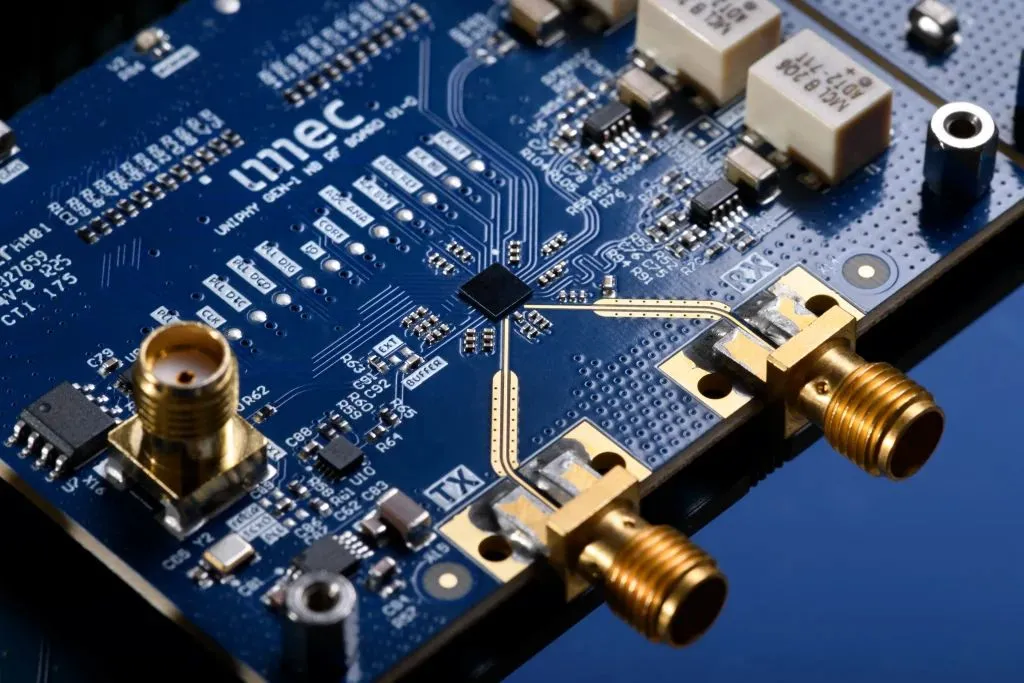
Imec’s implementation supports a fourfold increase in ranging distance, and marks a key step toward reliable, scalable, and energy-efficient UWB deployments in dense wireless and interference-rich environments.
Impulse-radio ultrawideband (IR‑UWB) technology is gaining strong momentum, driven by its integration into smartphones, wearables, automotive platforms, and IoT devices.
Yet, limitations in range, scalability, and robustness – particularly in dense wireless, interference-rich environments – continue to constrain its full potential.
The IEEE 802.15.4ab UWB standard, expected to be published later this year, marks an important step toward overcoming these limitations.
A key concept introduced in this standard is narrowband assistance (NBA). It allows combining narrowband signaling (in the 5–6GHz frequency range) for device discovery, synchronization, and coordination with UWB’s precise ranging and localization.
Leveraging the narrowband link, the system can operate more efficiently, better support multi-user scalability, and maintain reliable communication at lower signal levels and over longer distances.
The NBA mechanism, however, introduces stringent dynamic-range and blocker-tolerance requirements: to enable the required link budget, the narrowband receiver must exhibit a very low noise figure, allowing it to detect weak signals.
At the same time, it must maintain robust operation in the presence of strong Wi-Fi interferers operating in overlapping or adjacent frequency bands.
Implemented in a 22nm CMOS process, imec’s design features a novel second-order transimpedance amplifier (TIA) with precisely controlled filtering.
It suppresses strong out-of-band interferers – such as nearby Wi-Fi signals – early in the signal chain, while preserving the desired signal and maintaining a low noise figure.
Complementing this, the architecture integrates a high dynamic-range clip detector that continuously monitors the receiver’s operating conditions. When strong interference is detected, the system dynamically switches to a more robust mode, activating additional filtering and gain control to prevent distortion. In low-interference conditions, the receiver remains in a low-power mode, ensuring energy-efficient operation.
“These innovations deliver a step-change in receiver performance,” said Anoop Bhat, senior researcher at imec. “Our low-power design – consuming less than 6mW – achieves a 9dB improvement in dynamic range over state-of-the-art implementations, maintains a low noise figure of 3.2dB, and tolerates Wi-Fi blockers around –32dBm. By preserving sensitivity to weak signals under strong interference, the RX enables reliable narrowband-assisted UWB, supporting a fourfold increase in ranging distance.”
“Building on this, we also demonstrated the first full transceiver architecture compliant with IEEE 802.15.4ab – delivering up to a 32x improvement in ranging performance through combined receiver, transmitter, and IEEE 802.15.4ab standard innovations.”
Imec’s work paves the way for a new class of applications that require secure, precise, and low-latency relative positioning and synchronization in dense wireless environments.
Potential use cases of narrowband-assisted UWB include robot-to-robot coordination, or AR glasses interacting with their surroundings.
“As a next step, we are exploring how this NBA architecture can be extended to other low-power wireless systems, including future evolutions of Bluetooth – such as Bluetooth Higher Bands,” added Mitra Gilasgar, portfolio manager low-power wireless at imec. “In parallel, we engage with industry partners to accelerate the IP transfer and integration of this technology into commercial platforms.”