Blog
Microsatellite market measured by Polaris Market Research| Electronics Weekly

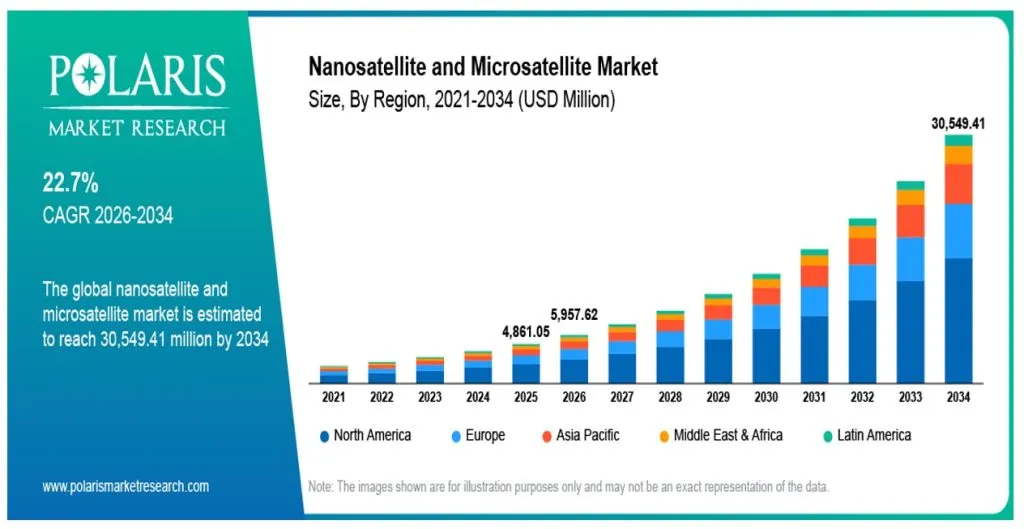
According to new findings published by Polaris Market Research, the nanosatellite segment dominated. This was with a 76.41% revenue share in 2025, reflecting its lower cost and versatility for academic research, technology demonstrations, and remote sensing applications.
In terms of the commercial end-use, 47.1%, was driven by geospatial analytics, supply chain monitoring, and asset tracking services.
Basically, the company identifies the main drivers as demand for Earth Observation services, the shift to large-scale constellations, and private capital flooding into the small satellite ecosystem.
Microsatellite market
 It outlines why small satellites are getting increasing attention:
“The appeal of nanosatellites and microsatellites lies in what they represent: democratized access to space. Traditional large satellites can cost hundreds of millions of dollars to build and launch. By contrast, nanosatellites — typically weighing between 1 kg and 10 kg — and microsatellites — ranging from 10 kg to 100 kg — offer a dramatically faster, leaner, and more agile path to orbit.”
“These compact platforms enable rapid production cycles, lower launch costs, and flexible deployment in satellite constellations, making them ideal for a wide spectrum of missions including Earth observation, broadband connectivity, IoT data relay, maritime surveillance, environmental monitoring, and military reconnaissance.”
Electronics
From an electronics perspective, Polaris highlights the role of miniaturised processors, advanced MEMS sensors, and compact power systems. And, increasingly, onboard AI processing.
As component costs continue to fall, and performance continues to climb, the microsatellite market – and demand for such small-satellite hardware – will expand accordingly, it concludes.
You can download a sample of the Report of Nanosatellite and Microsatellite Market from the Polaris website (bottom).
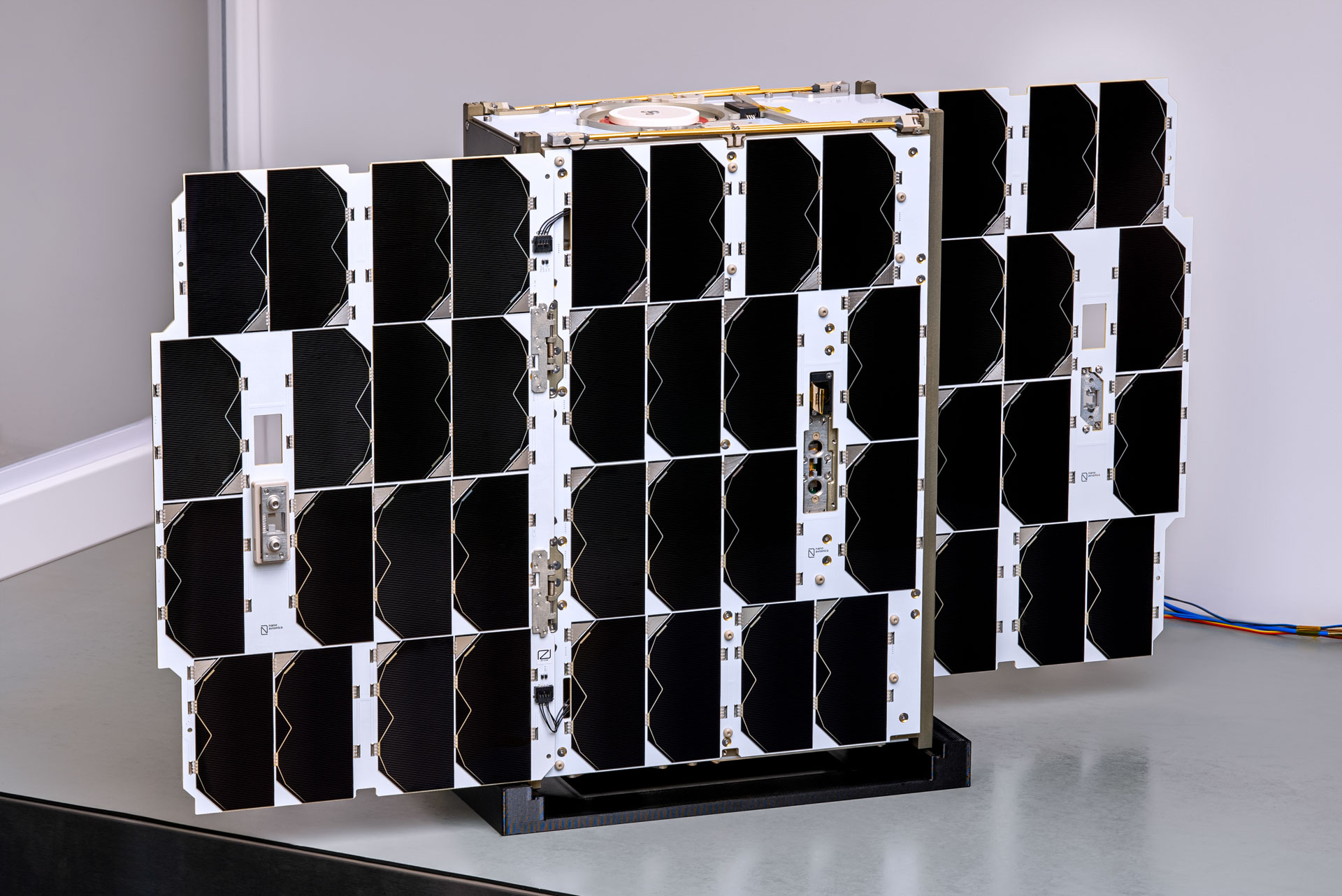
Image: Polaris (top) and Kongsberg NanoAvionics 6u nanosatellite
See all our Space content.