Blog
Most Read – TI fabbing in-house, Sony sensors, DRAM revenues

And there’s also Sony and TSMC signing an MoU for manufacturing next-generation image sensors, and why DRAM revenues are projected to nearly triple in 2026…
As usual, for maximum suspense, let’s take them in reverse order as according to Google Analytics:
5. TI looks for 95% in-house fab by 2030
TI plans to fab 95% of its ICs in-house and package 90% of them by 2030, said Luke Lee, president of TI Japan, Taiwan, Korea and South Asia. Last year, TI said it would spend $60 billion plus to build seven fabs in Texas and Utah. It also has fab in Japan, Germany and China, and -packaging plants in Taiwan, the Philippines and Mexico.
4. Intel Foundry: The Last Chance
The author Damnang2 has penned an authoritative piece on Substack about the hill Intel has to climb to catch TSMC. Here it is: “In Q4 2025, Intel Foundry posted revenue of $4.5 billion alongside an operating loss of $2.5 billion. CEO Lip-Bu Tan admitted…”
 3. Price rises spread to analogue, discretes and passives
More companies will be raising semiconductor prices rises, reports TrendForce, quoting multiple sources. According to eTime, TI will raise prices on July 1st and according to Sina increases could range from 15% to 85% on lines including digital isolators and PMICs. TI raised prices twice last year, says Sina.
2. Sony and TSMC hook up for fab-lite
Sony and TSMC have signed a non-binding MoU to form a strategic partnership for the development and manufacturing of next-generation image sensors. Under the proposed partnership Sony and TSMC intend to establish a joint venture, with Sony being the majority and controlling shareholder, to set up development and production lines in Sony’s new fab in Koshi City.
 1. DRAM market in structural change, says IDC
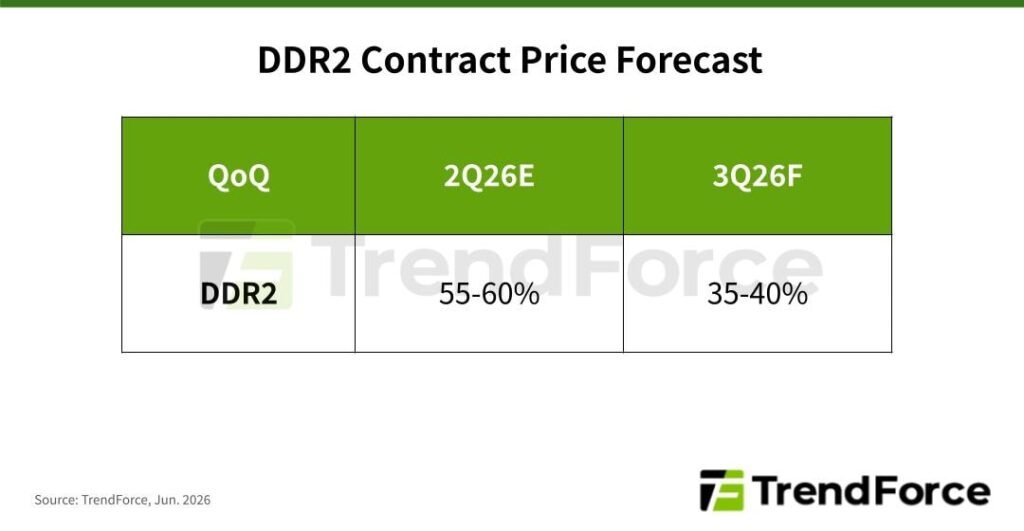
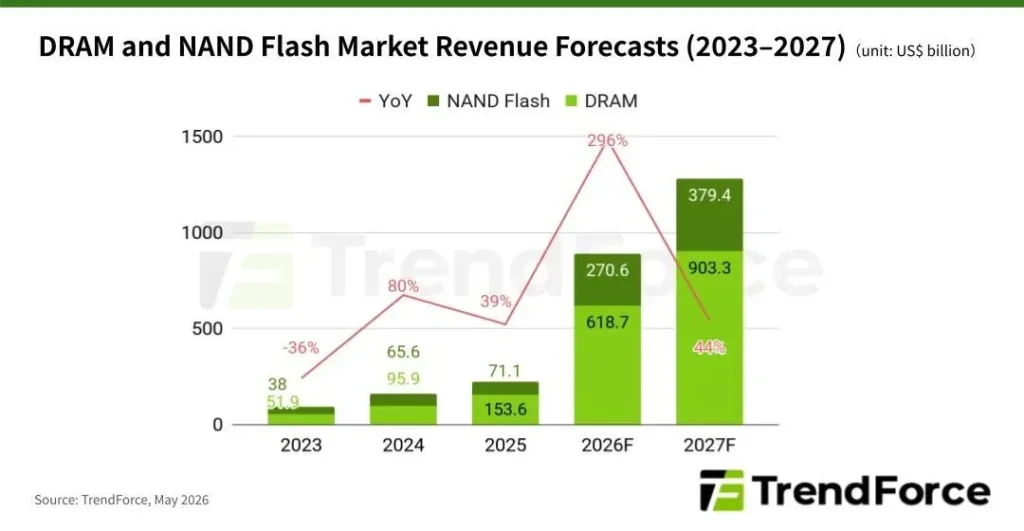
DRAM revenues are projected to nearly triple in 2026 – up 177% year-over-year to $418.6 billion, reports IDC. IDC reckons this it not just a cyclical upturn in the traditional boom-and-bust memory cycle but a structural change for the industry. HBM capacity is already pre-committed through 2026, with forward allocations stretching into 2027.