Blog
We stopped clicking, and AI became the Internet

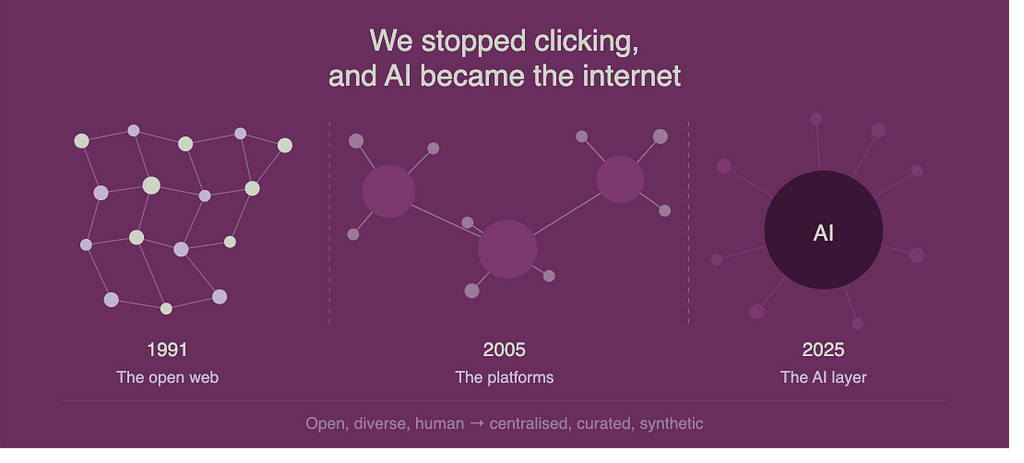
On convenience, abdication, and the quiet erosion of the open web. The internet isn’t dying. That’s the problem.
In 2026, over half of all web traffic is generated by bots, not humans (Computing, 2026). The most damning part is not the rise of the bots. It is that most of us did not notice when the internet stopped being… ours.
The early 1990s. You typed a command, pressed enter, and suddenly — information. Not what your library had. Not what the evening news chose to show you. Everything. Or at least, the closest thing to everything that had ever existed in human history.
For those who remember Archie and Veronica — the earliest search tools, long before Google was even a thought — or the raw, strange communities of IRC, there was something almost sacred about it. You were navigating knowledge. Meeting strangers on the other side of the world who cared about the exact same obscure thing you cared about. I used to talk about always on as something revolutionary. A permanent, universal library. A global conversation.
It was magic.
I was right that it was revolutionary. I was completely naive about what that revolution would ultimately serve.
How we got here
Thirty years is a long time. Long enough to build an infrastructure of knowledge, habits, and regulations. Long enough to forget what you were building it for.
The early internet carried a foundational promise: openness. Net neutrality — the principle that every bit of information travels equally, that no voice is technically privileged at the network layer over another — was not a regulatory footnote. It was the architecture of digital democracy. The Voltairean bargain made digital: you defend the right of people to say things you disagree with precisely because that is the only way to protect the right to say anything at all.
For a while, it held.
Then came the workaround. Private commercial platforms stepped in as curators. And unlike editors at a newspaper, who at least operate with some transparency about their perspective, these new curators were algorithms. Optimised not to inform, but to capture attention. Not to diversify thinking, but to monetise it. Not to serve the reader, but to extract from them.
Research consistently found that algorithmic exposure to opposing political content often hardened, rather than softened, existing positions — the backfire effect most pronounced among users already embedded in ideologically homogeneous networks (Bail et al., 2018). Bots amplified the signal because scale was cheap. Spirals of silence took hold: people holding nuanced or minority positions self-censored for fear of pile-ons, shrinking the visible range of views and narrowing the very debate the platform was supposed to enable.
We built the most powerful communication infrastructure in human history. We handed it to engagement metrics.
That damage is still unfolding. But something larger just happened.We stopped clicking
We stopped clicking
A click was never just a click.
It was a handshake — between a reader and a writer who had no idea the other existed. It was the signal that said: this is worth making, this is worth publishing, this is worth maintaining. The economic foundation beneath every independent journalist, every niche expert, every specialist site that survived on the attention of a small, passionate audience.
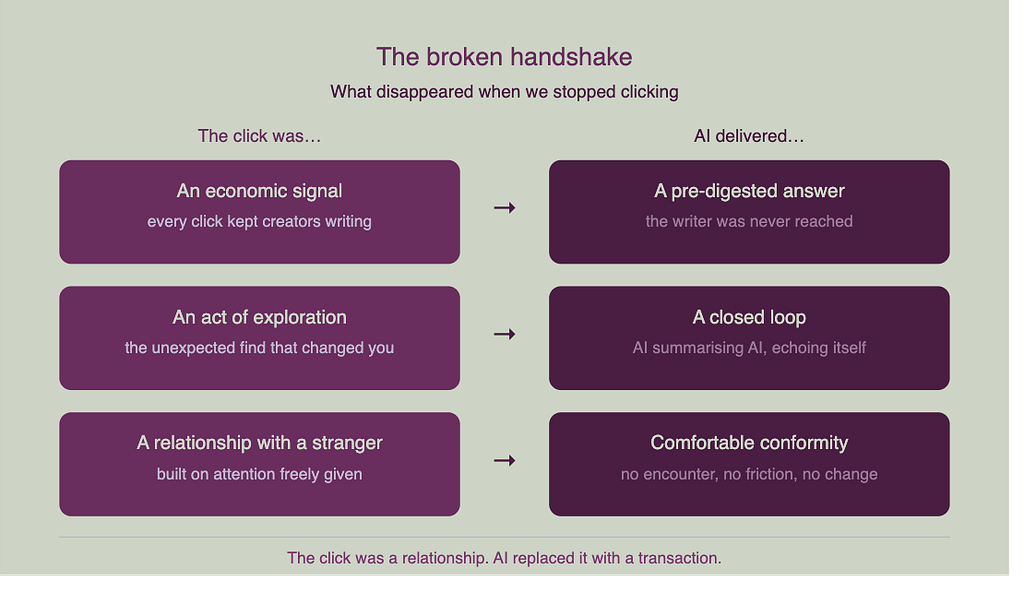
It was also an act of exploration. The wrong turn. The unexpected article. The author whose name you had never heard who changed how you thought about something. The internet rewarded wandering. AI does not. AI often compresses exploration into answers.
When an AI assistant answers your question before you have had time to ask it properly, all of that disappears. You receive a pre-digested summary of sources you will never read, written by authors you will never encounter, filtered through a model whose training data, biases, and internal reasoning are largely opaque. And increasingly, you do not question this. Because it is fast. Because it is convenient. Because the answer is right there.
SparkToro’s analysis of zero-click search found that well over half of all Google searches now end without a click to any external site — a figure that has grown significantly as AI-generated summaries have expanded. When Google’s AI Overviews appear, clicks to underlying pages drop by roughly a third. Among those who have adopted AI search tools, around 44% already consider it their primary or preferred source of information, according to McKinsey-affiliated research from 2025 — a share that rises further among daily users. Among Gen Z users in the US, around 31% now start their searches using AI platforms rather than a traditional search engine, according to a SEMrush-based analysis — a generational shift whose trajectory points in one direction only.
AI‑driven bot traffic grew roughly eight times faster than human web traffic in 2025, according to HUMAN Security’s 2026 State of AI Traffic & Cyberthreat Benchmark Report. These are related but distinct phenomena: one measures the overall balance; the other measures the acceleration. Both point the same way.
We have outsourced our curiosity. And we are calling it progress.
Displacement, not collapse (which is worse)
There is a temptation to reach for apocalyptic framing here. The internet is dead. Human content has been buried. Resist it — not because the situation is fine, but because precision matters more than drama.
The evidence is more troubling in a subtler way.
A Graphite analysis of 65,000 English-language articles found that 86% of articles ranking in Google Search, and 82% of sources cited by AI systems like ChatGPT and Perplexity, were still human-written. The open web is not dead. It is still producing the content that matters most — the content that gets found, cited, and trusted.
But here is precisely why that should worry us.
AI systems are built on the accumulated labour of human writers, researchers, and journalists. They train on that labour, summarise it, and present it as answers — intercepting the traffic that once sustained the people who produced it. Publishers lose visits. Revenue follows. The incentive to invest in original reporting, specialist expertise, and long-form inquiry quietly weakens. AI-generated content fills the gap — not at the top of the attention pyramid yet, but at the base, and rising. A 2025 arXiv preprint by Dirk Spennemann estimated that at least 30% of text on active web pages is now synthetic, with the real figure likely nearer 40%. Europol’s 2022 risk projection suggested up to 90% of online content could be synthetically generated by 2026 — not a census, but a warning that marks the direction of travel.
This is the closed loop at the heart of the problem. AI summarises human sources. Those summaries become content. Other AI systems summarise that content. What circulates is no longer knowledge but the echo of knowledge, a simulacrum— the shape of an idea without its substance.
The problem is not that AI content has taken over human attention. Not yet. The problem is that it is eroding the economic and behavioural conditions that make high-quality human content viable in the first place. That is a displacement, not a collapse. And displacement is harder to see coming, harder to reverse, and in the long run, just as damaging.
We are filling the foundations of the internet with the echo of itself — and hoping nobody notices until the structure gives way.
What we are actually losing
The greatest risk is not efficiency. It is not even accuracy.
It is diversity.
Human diversity. Diversity of thinking. The capacity to form an idea, sit with it, be challenged by it, and change it. The discipline of reading something that unsettles you rather than confirms you. The patience to follow a thread of curiosity somewhere you did not expect.
Think of it this way. SparkNotes tells you what happened in the book. It cannot tell you why a particular sentence stopped you cold, or what it felt like to encounter that idea for the first time. The internet we are building is increasingly a world of SparkNotes: accurate summaries of things that once required presence. The summary replaces the source. The echo gradually replaces the voice.
But there are things that AI does well. For someone navigating a complex topic in a second language, for a student without access to expert mentors, for anyone who has ever felt excluded by the density of specialist knowledge — AI-mediated answers are a genuine leveller. Accessibility matters. Speed matters. These are not trivial benefits.
But convenience and diversity are not the same thing. And at scale, they increasingly trade against each other.
We are building systems extraordinarily good at delivering what we already think we want — and calling it personalisation. But personalisation at this scale is another word for narrowing. Every AI summary that resolves your question before you have had time to explore it, every algorithm that surfaces the familiar and suppresses the strange — each is a small act of erosion against the open, generative, genuinely democratic experience the internet once made possible.
When the same handful of foundation models mediate what billions of people read, the variation that makes knowledge valuable gets filtered out: the dissenting voice, the unconventional framing, the argument that takes time to understand. A more convenient internet is, structurally, a more conformist one.
Your attention is the asset. The product is you. This was already true of social media. It is becoming true of AI — and the extraction is less visible, more intimate, and harder to refuse.
Designing in the monoculture
If we are the product, what does it mean to be its designer?
It is both the most powerful and the most uncomfortable position to occupy. Designers and product managers are not observers of this shift — we are inside it. We use the same AI tools we are building into our products. We experience the same zero-click summaries, the same recommendation loops, the same convenience that quietly trains us to expect answers before we have finished forming questions.
We are, simultaneously, building the cage and living in it.
That dual position means we have something most critics of AI do not: direct, embodied experience of what these systems do to thought. We know what it feels like when a tool makes a decision for us. We know the subtle atrophying of the instinct to explore when the answer arrives too quickly and too cleanly. We built this. And we are among the first to feel its weight.
So what is design’s role today?
Not neutrality. Design has never been neutral: every layout, every default, every summary that appears before the source is a choice about what the user sees, thinks, and can reach. In a monoculture, a neutral design confirms the monoculture. The diversity that has been quietly eroded — of voice, of perspective, of the unexpected encounter that changes how you think — does not restore itself through algorithmic fairness metrics or accessibility checklists. It restores itself through deliberate acts of opening: designing for discovery where the algorithm wants the shortcut; designing for friction where frictionlessness serves the platform rather than the person; designing systems that return agency to the user rather than extracting it.
Systems thinking has always asked us to look beyond the immediate interaction and consider the larger ecosystem a product inhabits. Who benefits when a user never clicks through? What happens to the economy of ideas when your AI experience is so seamless that nobody ever reaches the original voice? These are not edge-case concerns. They are the central design questions of this moment — and they belong at the start of the brief, not in the ethics review at the end.
The open web is being shaped, one product decision at a time, by people with exactly the tools to understand it. That is not a small thing.
The Net Neutrality we need now
The original idea of net neutrality protected the pipes. Every packet travels equally. No provider may favour one voice over another at the infrastructure level.
That principle won some battles. But the infrastructure that now shapes what we see, what we believe, and what we can imagine is no longer pipes. It is models. Foundation models, deployed at scale by a handful of companies, that function as the new infrastructure of our information ecosystem — and that carry no equivalent non-discrimination obligations.
What would AI neutrality actually require? Non-discrimination in access, latency, cost, and quality of service — the same obligations that once applied to broadband providers, now applied to model providers. But more than that: source transparency. When an AI system answers your question, you should have the right to know where that answer came from, whose labour produced it, and whether that labour was compensated — the way academic papers cite their sources rather than bury them. A right to reach the original. A right to the handshake the click once guaranteed.
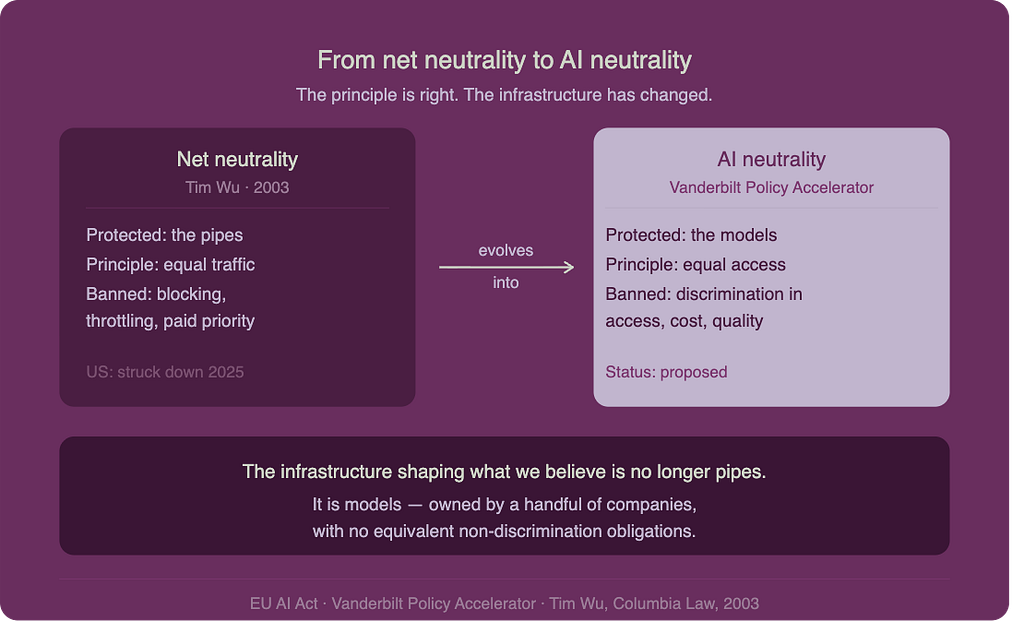
The Vanderbilt Policy Accelerator has recommended non-discrimination obligations for model and API providers. The EU AI Act mandates transparency requirements for AI-generated content. These are necessary beginnings. They are not yet sufficient.
Because the problem is not only what AI systems do. It is what they replace. And what they replace — the open, exploratory, economically sustainable web — cannot be rebuilt by regulation alone. It requires a cultural shift in how we relate to information: who we credit, what we click, what we choose to seek rather than accept.
A simple act of refusal
Individual acts matter. They are also not enough — and we should be honest about that.
Turn off your notifications. Not as a productivity hack — as a refusal. Every notification is a micro-seizure of your attention, redirecting you from what you chose to focus on toward what the platform decided you should see. The battle for your attention is not metaphorical. It is the entire business model of the modern internet.
Follow the link. Read the original. Encounter the author. Ask what you are not being shown. Every click that reaches a source is a small economic signal: this is worth making. In a zero-click world, that signal has become an act of resistance.
Practise critical ignoring: the conscious choice not to engage with content designed to provoke a reaction rather than generate a thought. Read slowly. Long articles. Things that require you to hold complexity in mind for more than thirty seconds. The capacity for sustained, nuanced thinking is not a luxury. It is the core competency of being human in a world designed to erode it.
But do not stop there.
The systemic answer to displacement is not in our personal habits alone — it is in the architecture of what comes next. AI neutrality legislation. Source transparency requirements. Economic remedies for creators whose work trains the systems now intercepting their audience. The right to the original, enshrined rather than assumed. These are not abstract policy questions. They are the structural equivalent of what net neutrality once was: a decision about what kind of information ecosystem we want to live in, and who gets to shape it.
The internet, at its best, was a condition for something larger — participation, agency, the ability to contribute to the conversations that shape the world. That is still possible. But only if we understand that the click we stopped making was not a trivial act of convenience.
It was a relationship. A contract between creator and reader. A signal that kept the open web alive.
We stopped sending it.
The next time an AI gives you an answer, ask yourself: who does this serve?
Author’s Note: The thinking, research, and arguments in this article are entirely human. AI reviewed form and structure only.

We stopped clicking, and AI became the Internet was originally published in UX Collective on Medium, where people are continuing the conversation by highlighting and responding to this story.