Blog
Texas flooding gets the AI & Sensor early warning treatment

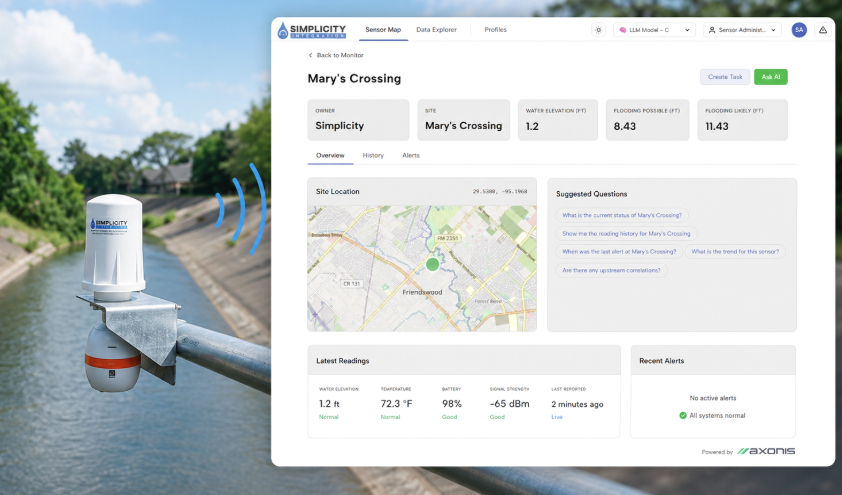
Early flood warnings in Texas are being aided with AI and sensors, giving first responders and residents more time to find safety during catastrophic events. The state has faced dozens of flooding deaths over decades.
A system installed in April in Galveston County focuses on gathering sensor data from fragmented sources and then creating a single operational picture to trigger alerts through warning lights, sirens and even road barriers.
Axonis and Simplicity Integration announced Tuesday that the early warning system has now gone live, just in time for spring rains and flooding. It is also Texas Flood Awareness Week and, coincidentally, a severe storm system is moving across the state this week, traveling from West to East. Once heavy rains hit the Texas Hill Country, they are expected to march down the atmospheric corridor towards Houston and Galveston, according to weather forecasters.
Residents in the Gulf Coast are now able to subscribe to highly localized alerts for specific flood-prone locations, rather than relying on broader county-wide warnings that can be easily ignored. According to Simplicity Integration, several of the monitoring systems were installed in a single day. The two companies are working to use the system in the future for other critical infrastructure monitoring.
“What’s been missing is a way to turn all the signals coming from the edge into something people can actually use in the moment,” said Alison Reese, COO and co-founder of Simplicity Integration, in a statement. “Communities already have sensors, weather data and infrastructure in place, but those pieces aren’t connected in a way that supports real-time decisions.” Reese said the Axonis Decision Intelligence system is envisioned for other existing systems throughout Texas and other Gulf Coast states.
Axonis CEO Todd Barr said there’s no bottleneck from data. The concern is moving from data to decision “fast enough to matter.”
The cost of the system was not disclosed, but Reese said Simplicity Integration’s goal is to make the technology solution accessible to all municipalities and other organizations regardless of budget. A spokesperson told Fierce the company will work with organizations of all sizes to create solutions that are “financially realistic and scalable for their unique needs.”
Early in May, the University of Texas at Arlington announced receiving a $4 million grant from the governor to create a real-time flood system focused in the Hill Country. It is designed to give residents more time to react to emergencies. The grant followed the loss of 130 lives over a period of years in Central Texas due to flooding. Over the Memorial Day weekend in 2015, 20 people statewide died in floods, including 13 killed in Wimberley, Texas, when the Blanco River flooded.
Central Texas is hilly and flood waters travel quickly. UTA is working with Rice University on the project, which is designed to use radar-derived rainfall data fed into hydro models to forecast flood water depths at specific locations. Predictive modeling will be used to forecast how deep the water will be and where it will go.