Blog
Sponsored Content: How YMIN’s SLA Series Hybrid Supercapacitors Prevent Thermal Runaway and Meet Emerging EU Safety & Environmental Standards

At the same time, the introduction of the EU Battery Regulation (EU 2023/1542) has created unprecedented compliance challenges for products entering the European market. Engineers are actively seeking an energy storage solution that can deliver sufficient energy density while fundamentally eliminating safety risks and meeting increasingly stringent environmental regulations.
Shanghai Yongming Electronic Co., Ltd. (“YMIN”) has introduced the SLA Series Hybrid Supercapacitors as a direct response to these industry challenges. Built around the concepts of intrinsic safety and environmental compliance, the SLA series provides the industry with a highly reliable, high-value alternative energy storage solution.
1. Intrinsic Safety and Environmental Compliance: The Core Breakthroughs of the SLA Series
The core value of the SLA series lies in its complete elimination of thermal runaway risks through advanced material selection and structural design. Unlike conventional lithium batteries, which inherently carry risks of fire or explosion under extreme conditions such as nail penetration or overcharging, the SLA series demonstrates intrinsic safety performance in rigorous third-party testing.
- Extreme Condition Validation:
Under severe test conditions including nail penetration, crushing, short circuit, and overcharging, SLA series products neither catch fire nor explode. Their failure mode is a safe open circuit, fundamentally eliminating safety hazards. The products have also passed UN38.3 certification, supporting air transportation. - Breaking Through EU Battery Regulation Barriers:
This is a critical advantage. Under EU regulations, SLA series products are officially classified as capacitors rather than batteries. Therefore, they are exempt from the complex compliance requirements of the new EU Battery Regulation (EU 2023/1542), such as carbon footprint declarations and due diligence obligations. This significantly simplifies export certification procedures and helps customers save substantial time and costs. - Environmentally Friendly Throughout the Product Lifecycle:
All materials used in the products are free from heavy metals such as lead, mercury, and cadmium, as well as halogens. The products comply with RoHS and REACH standards. In addition, the manufacturing process follows the ISO 14001 Environmental Management System, ensuring environmental sustainability throughout the entire lifecycle, from production to disposal.
2. Verified Performance Data: Why Is the SLA Series Safe and Environmentally Friendly?
The safety and environmental advantages of the SLA series are built upon clear technical principles and rigorous testing validation.
- High- and Low-Temperature Performance Comparison:
Within a wide operating temperature range from -20°C to +85°C, the SLA series demonstrates significantly better capacity retention than conventional lithium batteries. As shown in the figure below, under a low-temperature environment of -20°C, the SLA series still maintains over 85% of its capacity, while conventional lithium batteries retain only around 60%. Under a high-temperature environment of 85°C, the SLA series still achieves approximately 90% capacity retention, whereas conventional lithium batteries decline to below 65%. These results fully demonstrate the SLA series’ outstanding adaptability and reliability under harsh environmental conditions. (Click image to enlarge.)
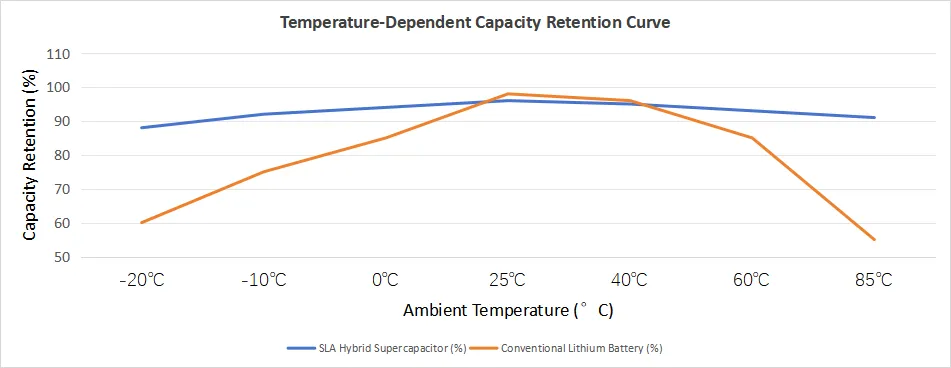
Figure 1: High and Low Temperature Performance Curve — SLA Series vs. Conventional Lithium Battery (Capacity Retention Comparison from -20°C to +85°C)
- High-Temperature Float Charge Life Test:
Under an 85°C environment and 1,000 hours of rated-voltage float charging, the SLA series exhibits a capacity degradation of no more than 30%. In contrast, conventional lithium batteries undergo rapid aging under the same conditions, with a sharp capacity drop. The SLA hybrid supercapacitor demonstrates significantly stronger anti-aging capability, maintaining stable operation for a much longer period under identical conditions, with substantially superior lifespan and reliability compared to lithium batteries. (Click image to enlarge.)
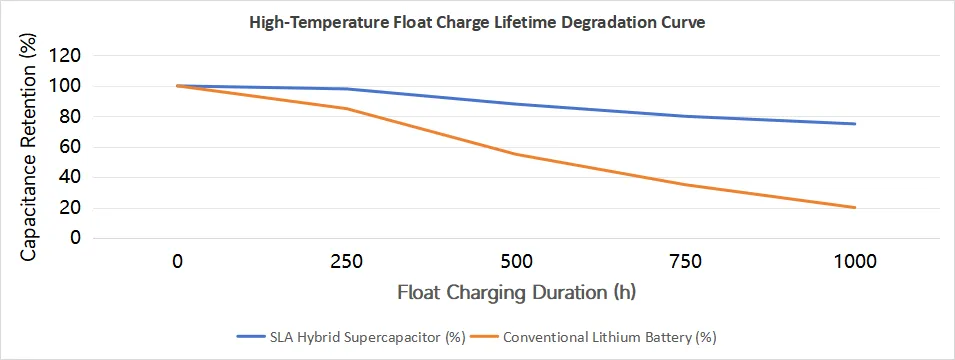
Figure 2: High-Temperature Float Charge Lifetime Comparison Curve — SLA Series vs. Conventional Lithium Battery
- Self-Discharge Performance Comparison:
After 30 days of storage under high-temperature and high-humidity conditions, the SLA series maintains a voltage retention rate of approximately 99%, while conventional lithium batteries retain only around 94%. This characteristic gives the SLA series a significant advantage in long-standby applications, making it a reliable choice for backup power systems, power-loss hold-up scenarios, and devices requiring long-term idle storage. (Click image to enlarge.)
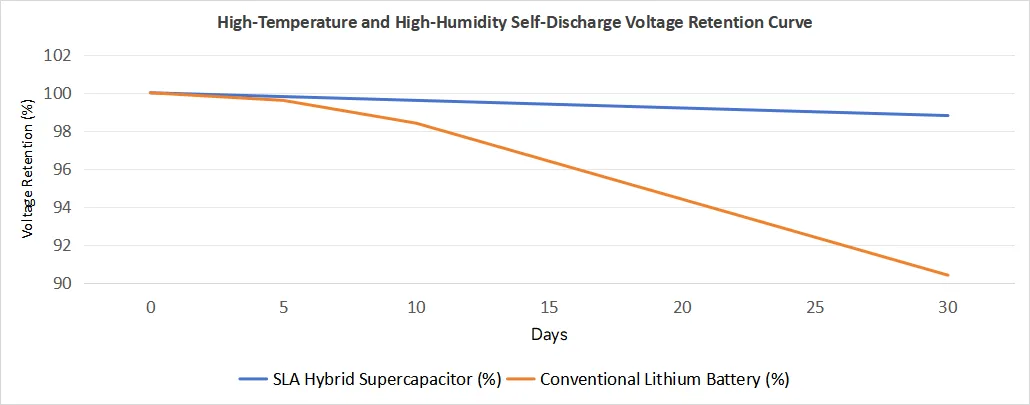
Figure 3: Self-Discharge Comparison — SLA Series vs. Conventional Lithium Battery (Voltage Retention over 30 Days under High-Temperature and High-Humidity Conditions)
- Humidity and Mechanical Testing:
Under extreme conditions of 40°C and 95% RH, after 1,000 hours of testing, the product shows no leakage or swelling, with capacity degradation also controlled within ≤30%. After vibration and shock testing, no electrical abnormalities are observed, and the structural integrity remains intact. - Failure Mode Comparison:
Compared with both conventional lithium batteries and standard electrolytic capacitors, the SLA series adopts a safe open-circuit failure mode, with no fire, no explosion, and no electrolyte leakage—achieving true “fail-safe” behavior. In contrast, lithium batteries often experience thermal runaway upon failure, accompanied by fire, explosion, and release of toxic gases. Standard electrolytic capacitors, on the other hand, typically fail in short-circuit mode or by leakage, which can lead to PCB corrosion and system damage.
3. Technical Mechanism Explained
The safety and environmental performance of the SLA series is rooted in its unique engineering design:
- Safety Mechanism:
The product adopts a lithium-ion intercalation hybrid dry electrode technology, combined with a high-stability electrolyte and a tightly sealed three-in-one structure consisting of a sealing cap, current collector pin, and aluminum casing. A key design feature is the absence of MnO₂ cathode material, which eliminates the risk of oxygen release caused by MnO₂ decomposition and thus prevents combustion hazards. In addition, an internal safety vent is designed to automatically activate under overpressure conditions, releasing internal pressure in a controlled manner without spray, fire, or ignition. - Environmental Mechanism:
All raw materials comply with RoHS and REACH certifications and contain no hazardous substances. The manufacturing process is also aligned with ISO 14001 environmental management system requirements.
4. Key Models and Application Mapping
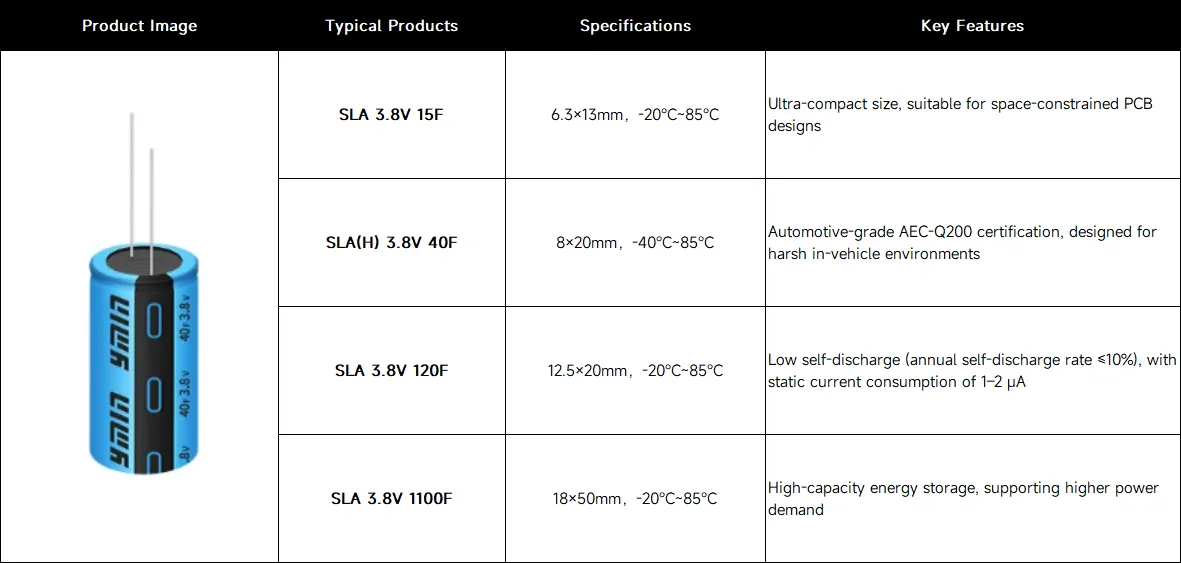
To address different application scenarios, YMIN offers multiple SLA series flagship models, all of which share the same safety and environmental advantages described above. The following table summarizes the recommended models and their key specifications (click table to enlarge):
5. Real-World Application Cases: Validation of Safety and Environmental Value
The safety and environmental characteristics of the SLA series have been validated in multiple demanding, high-reliability applications. The following are three representative cases:
Case 1: Automotive Dash Cameras
Pain Point: Automotive environments are highly demanding, with operating temperatures ranging from -40°C to +85°C. Conventional lithium batteries are prone to swelling, leakage, and even fire under high temperatures. During power loss events, the system must quickly save critical video data, but limited cycle life and rapid high-temperature degradation of batteries can lead to failure at critical moments.
Solution: The SLA (H) series is used as a backup power source during power-off events, providing sufficient energy at the moment of vehicle shutdown to complete safe storage of the final video frame.
Customer Value: The solution has been mass-deployed in multiple mainstream dash camera models and has passed automotive-grade reliability validation, ensuring zero loss of critical data.
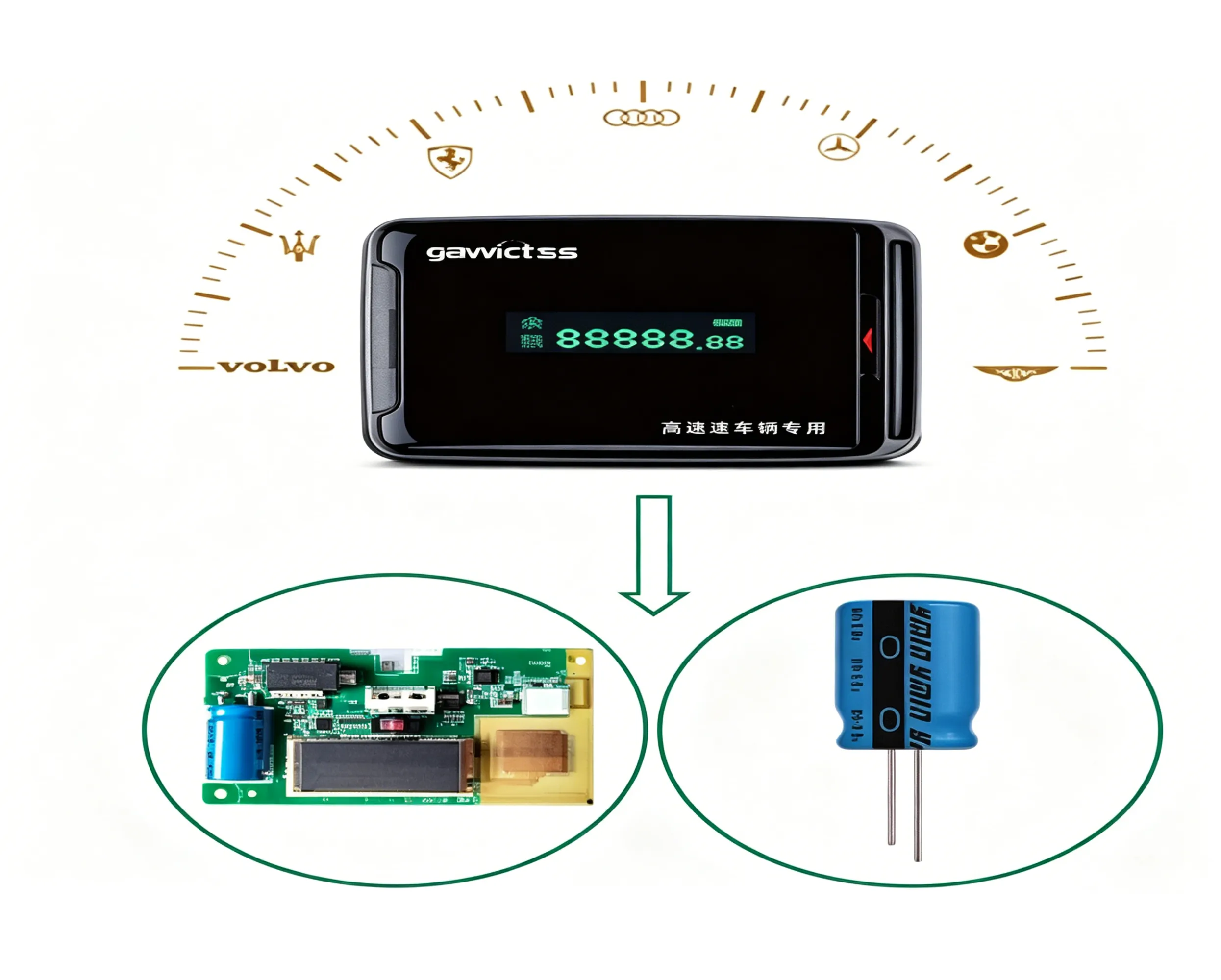
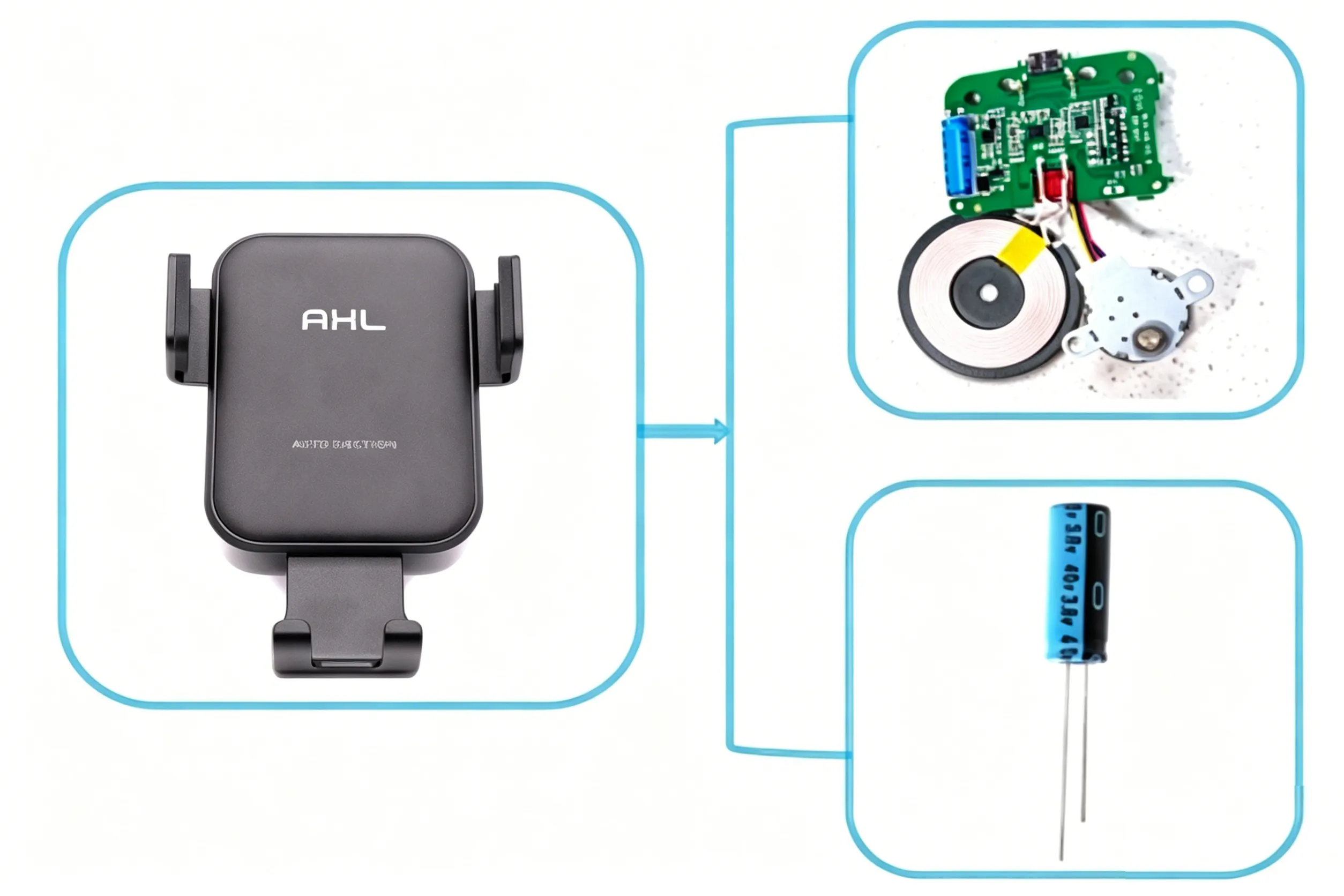
Case 2: Automotive Wireless Charging Phone Holder
Pain Point: The automatic clamping and power-off memory functions of the phone holder require a short-duration backup power source. Conventional batteries have limited lifespan and experience significant performance degradation under high temperatures during summer vehicle exposure. In addition, safety risks such as swelling and potential thermal events reduce overall product reliability.
Solution: The SLA series is used to replace traditional lithium batteries, providing short-term power support for the holder’s power-off memory and automatic clamping mechanisms.
Customer Value: High safety performance with no risk of fire or explosion, compliant with automotive safety requirements, and enabling direct air transportation. Performance degradation under high-temperature conditions is minimal, making it well-suited for complex in-vehicle environments.
Case 3: Standalone Smart Gas Alarm
Pain Point: In gas leakage scenarios, any electrical spark or ignition source can trigger an explosion. Conventional batteries carry risks of leakage and short-circuit-induced fire. Standard supercapacitors have relatively low energy density and cannot meet long standby requirements.
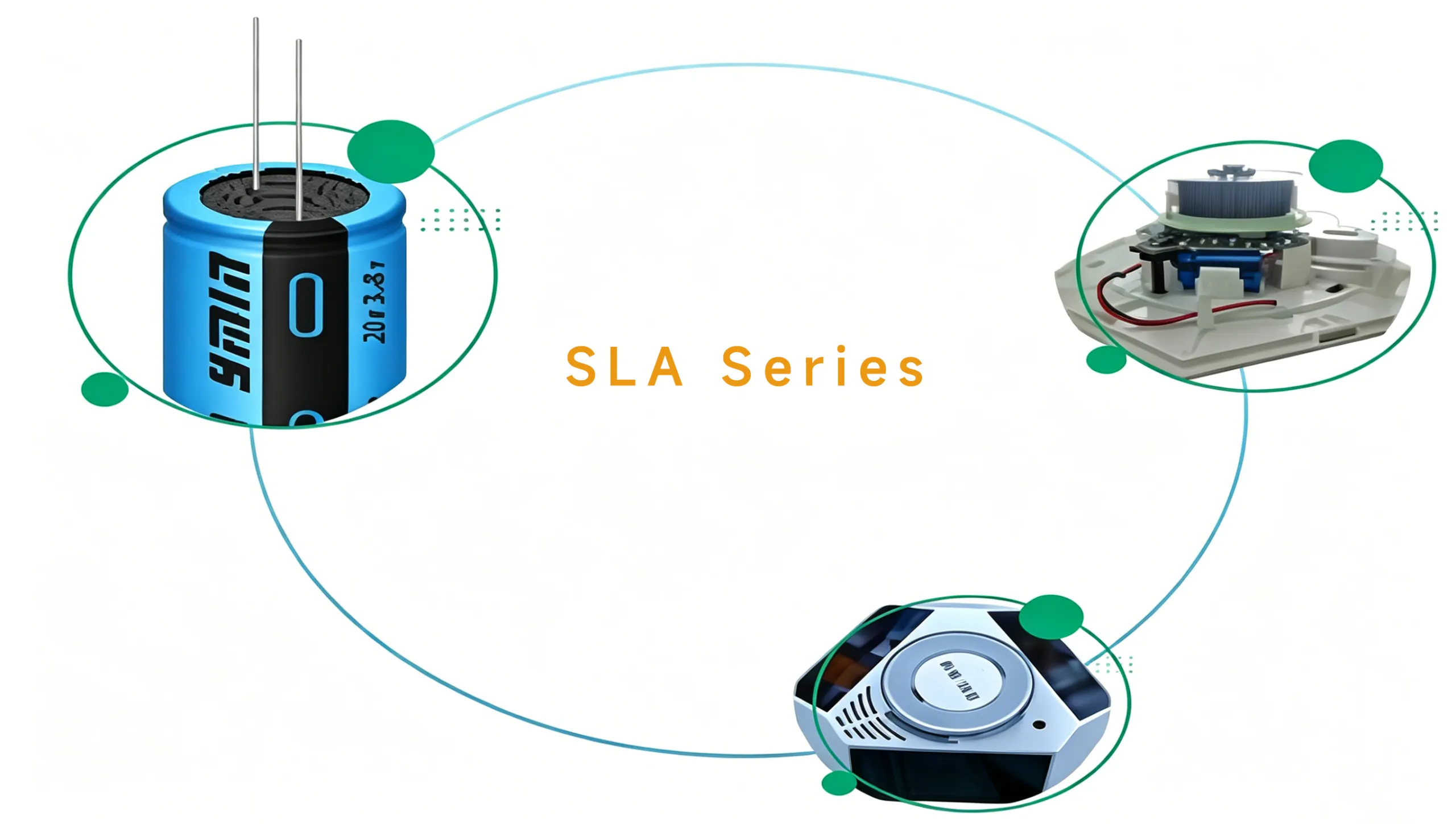
Solution: The SLA 3.8V 120F is adopted as a replacement for the 1520-type composite capacitor. With an annual self-discharge rate as low as 10% and ultra-low static current consumption of 1–2 µA, it significantly extends standby duration.
Customer Value: Fully sealed structure with no electrolyte leakage; safe open-circuit failure mode that does not generate electrical sparks; cycle life exceeding 250,000 cycles, enabling maintenance-free operation over the product lifetime; materials free of toxic or hazardous substances, making it suitable for both residential and industrial applications.
6. International Certifications and Commercial Services
The YMIN SLA series has obtained multiple internationally recognized certifications, providing strong support for global deployment:
Safety Certifications: UL810A (component safety certification), UN38.3 (air transport safety certification)
Environmental Certifications: RoHS, REACH
System Certifications: ISO 14001 (environmental management system), IATF16949 (automotive quality management system)
Automotive Certification: SLA (H) series is qualified under AEC-Q200 automotive-grade standards
In a context where safety and compliance are becoming core competitive factors, the YMIN SLA hybrid supercapacitor series offers engineers an ideal solution combining intrinsic safety, environmental compliance, and strong performance. It is well suited for both demanding automotive environments and entry into regulated markets such as Europe.
For detailed datasheets, sample requests, or technical validation, please contact the YMIN engineering team.
Official Website: https://www.ymin.cn/ E-mail: ymin-sale@ymin.com