Blog
Perovskites could be used for optical devices

“They are ‘smart materials’ that can be tuned to respond to a stimulus in a way we can control,” said Marina Leite, professor of materials science engineering at UC Davis. “Their chemistry is very different in a way that can be beneficial for creating devices we couldn’t build before.”
Perovskites all have the general structure ABX3. As crystals they can be pictured as a central atom within an octahedron (two pyramids attached at the base) of six atoms, inside a cube with atoms at each corner. They have a range of applications in optoelectronics and advanced solar cells.
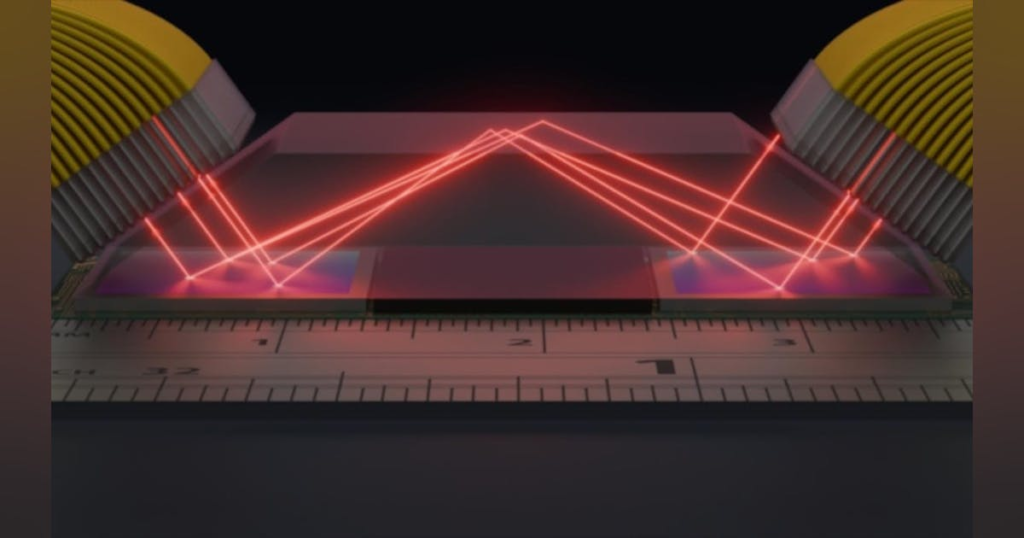
Mansha Dubey, a graduate student working with Leite, shone lasers onto perovskite crystals and measured the response of the crystal lattice with an X-ray probe and found that the exposure to light changes the lattice structure in a way that is rapid and reversible.
“There is a dramatic change in the lattice when you shine light on it, a unique phenomenon that you don’t see with silicon or gallium arsenide,” Leite said. This photostriction effect is reversible and can be repeated again and again, she said.
By changing the composition of the perovskite, researchers can engineer the wavelengths of light absorbed and emitted by the crystal. Perovskites of distinct composition have differing degrees of physical response to light at frequencies above the bandgap. The effect is tunable both by light frequency and power, Leite said.
“It’s not a binary on/off effect; it can be a scaled response, like a dimmer, depending on the light you shine on it,” she said.
Leite foresees that this photostriction effect in perovskites could open up new ways to design devices tuned or switched by light, such as sensors or actuators.
See all our Perovskite content.