
Blog
Integral Temperature-Sensitive Resistor Stabilizes Photonic Device’s Drift

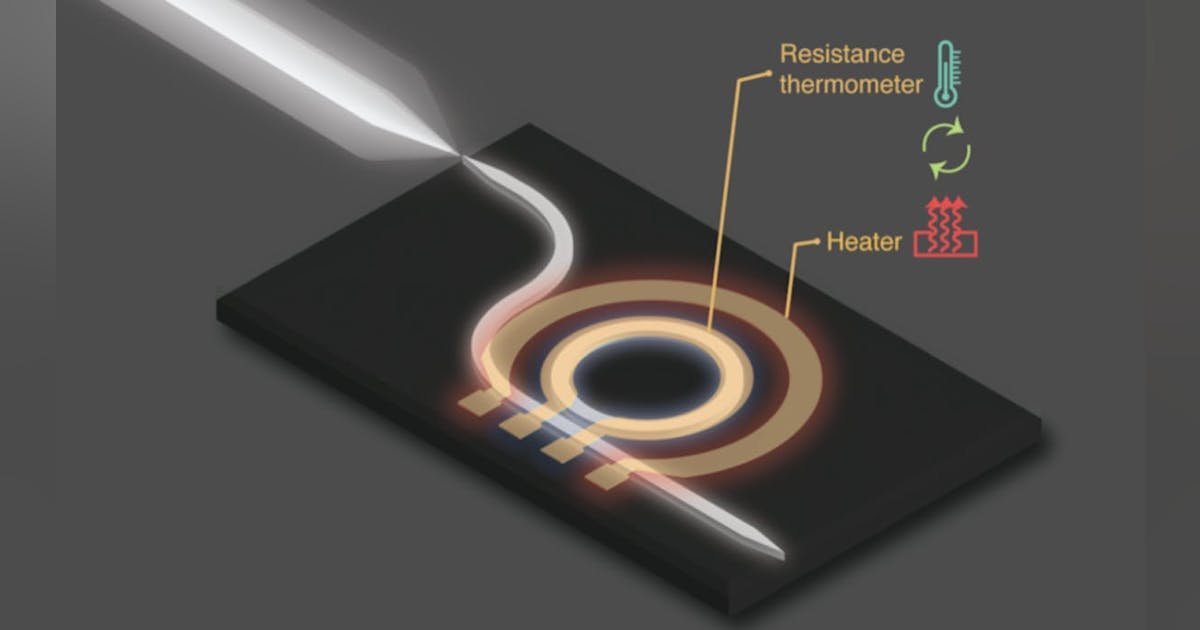
Electro-optical and photonic devices have made great progress in their level of integration and performance. However, they do have one troublesome characteristic (as do their all-electronic counterparts): Their frequency stability is very sensitive to temperature variations and shifts. This is especially challenging when their wavelength (frequency) stability must be maintained to a few nanometers and smaller.
Among the solutions are external optical sensing via probing or the use of a Peltier heater/cooler to maintain temperature consistency, among other techniques. Of course, an integrated, self-stabilizing or drift-cancelling approach would be preferred.
Double-Duty Platinum Resistor
Now, a team at Columbia University has come up with a clever scheme to leverage an already available structure on a photonic device for dual use. For over a decade, many such devices have incorporated a thin film of platinum into their fabricated design. The platinum acts as a resistor — controlling the voltage applied to the resistor changes the resonance wavelength within the photonic structure.
This on-board, thin-film metallic resistor is routinely used to thermally tune photonic devices to the desired resonance frequency. But it can also measure temperature and in turn help “close the loop” for temperature stability. This simple, admittedly somewhat obvious idea, which has apparently been overlooked until now, may eliminate the need for bulky and costly external temperature sensors.
By frequency locking a commercial distributed feedback (DFB) laser to such a cavity, the team demonstrated a crucial component of optical communication networks that require compact light sources. They were able to keep the laser within a picometer of the desired wavelength for over two days.
Resistor Acts as an Integrated Resistance Thermometer
Their approach relied on a thin-film metallic resistor placed directly above the microcavity acting as an integrated resistance thermometer, thus enabling unique mapping of the cavity’s absolute resonance wavelength to the thermometer’s electrical resistance (Fig. 1). (For some reason, the researchers never use the term platinum RTD — resistance temperature detector — a widely used, highly sensitive, and accurate alternative to the thermocouple.)