Blog
Perfect Orion splashdown caps record Artemis II mission around the Moon

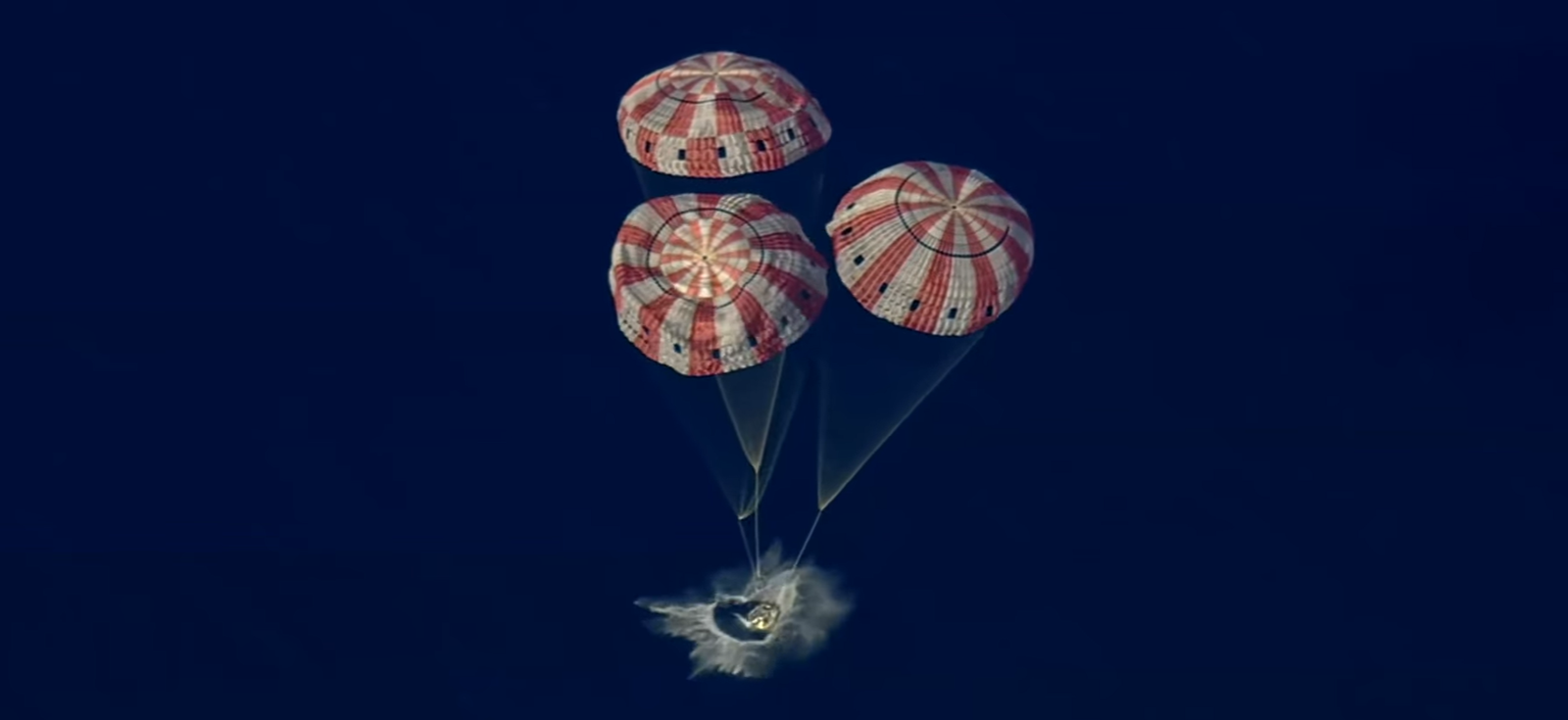
After a record-breaking, 10-day journey around the Moon, the crew aboard the Artemis II Orion spacecraft splashed down in the Pacific Ocean off the coast of San Diego at 8:07 p.m. EDT Friday.
The Artemis II flight crew, comprised of Mission Specialist Christina Koch, Mission Specialist Jeremy Hansen, Pilot Victor Glover and Commander Reid Wiseman, awaited departure from the spacecraft to be carried by helicopter to the nearby USS Murtha for medical evaluations. They were quickly declared in excellent medical shape. Shortly before splashdown, 11 parachutes were deployed to slow the craft’s descent after it entering the atmosphere where temperatures reached 5,000 degrees on the heat shield.
The hallmark of their mission took the four astronauts in a loop around the Moon, where they snapped thousands of photographs of the Moon’s far side. When there, they traveled on the sixth day to the mission’s farthest distance from Earth at 252,756 miles, setting a new record for human spaceflight previously set by Apollo 13 in 1970.
Sensors had an important role in the mission with custom radiation sensors arrayed around the interior of the spacecraft and CMOS image sensors deployed in digital cameras to record details of the lunar surface and an eclipse. Scientists will examine the data collected from the radiation sensors and special AVATAR chips with human tissue from each astronaut.
RELATED: Artemis II: Image sensors in digital cameras capture stunning Moon pics
RELATED:Sensors on Orion will monitor solar radiation to keep crew safe
Teams are also poring over the images and associated audio data collected from the flyby, with part of their goal to help find future sites for lunar landings and erection of a lunar habitat. A crew from Artemis IV is currently scheduled to land on the lunar surface as early as 2028.
The Artemis II mission was nearly flawless with one ironic exception of a problem with the toilet used by the crew, and then later the waste collection tank. One attempt to rotate the spacecraft to point the waste disposal nozzle into the sun to melt ice blocking the nozzle didn’t take. Later, NASA officials said the tank’s blockage could have been due to a biological reaction causing a film that developed inside the tank and blocked up the discharge. NASA decided to do testing to determine blockage in the tank after landing.
(NASA Live screenshot)