
Blog
Oh, but there’s one more thing

The value of design in the AI era
The response to the previous articles in this series surprised me, not because the argument was received well, I had hoped it would be, but because of what people in the community asked for next. Across the comments and messages that came in, one question kept surfacing in different forms: fine, design is the paradigm, designers are the problem-solution theory builders, the Inversion Error is real, but what do we actually do on real projects, with real briefs, and real clients who think AI is the senior designer in the room?
That question deserves a careful answer. And the answer, it turns out, has been sitting in plain sight for thirty years, hiding inside one of the most quoted and least examined statements in the history of the technology industry.
In 1995, Steve Jobs sat down with journalist Robert Cringely for a PBS documentary called Triumph of the Nerds. For years, that interview tape was thought to be lost. When it finally resurfaced, one passage stopped me cold. Asked what he thought of the dominant tech company of its time, Microsoft, Jobs, after a short reflection but without hesitation, answered:
“The only problem with Microsoft, is they just have no taste. They have absolutely no taste. And I don’t mean that in a small way. I mean that in a big way, in the sense that they don’t think of original ideas, and they don’t bring much culture into their products.” (Jobs, 1996).
Those who saw the interview might remember the statement, but I think that few followed the argument to its logical conclusion, particularly in the face of another looming era of big tech disruption.
What the previous articles established
This article is a fourth installment in a series examining what the current disruption in AI means for designers: not as tool users but as the discipline most structurally equipped to address the problem AI is posing. The series began with a structural diagnosis arguing that the leading AI systems we are told will be replacing designers, have been built upside down, without a foundation. They have extraordinary symbolic capability at the top and an absent embodied base at the bottom of cognitive development, where a human would develop their intuitive understanding of the world. I called this deficiency the Inversion Error: a structural failure in which AI systems can generate statistically plausible outputs with complete fluency while remaining architecturally incapable of the physical ground truth, spatiotemporal coherence, and operational reversibility that design practice requires.
The second article documented that diagnosis empirically, running a structured test across three leading AI systems, the Spaghetti Table Protocol, that produced reproducible evidence of three distinct architectural failures: no stable spatial reasoning, no felt sense of physical constraint, and no ability to trace a causal sequence backward through time. The third article connected those failures to the AI safety literature and proposed an architectural remedy: the Parametric AGI Framework, built on three engines that would restore the Enactive base that current systems structurally lack.
The diagnosis pointed toward not a submission, not a retreat, but an opportunity. If AI systems are structurally incapable of grounding their outputs in embodied physical reality, and if design’s native cognitive mode is precisely the kind of problem-solving and spatial reasoning that AI lacks, then designers need to not just be in the loop but stay above the loop. Designers cannot be reduced to humans learning to better prompt the system. The designer’s role is to be the More Knowledgeable Other (MKO) — the human collaborator who supplies what the AI cannot generate from within. Problem-solution theory building, in the formulation introduced by Peter Naur, is the intellectual act of constructing a theory of the problem coherent enough to generate a solution space worth exploring. AI can search that space, but it cannot construct the theory itself. That is the designer’s first irreducible contribution.
But there is a step before the theory: someone has to decide which problem is worth theorizing in the first place. And that step, the one that precedes all the methodology, all the frameworks, all the Human+AI collaboration protocols, is the one that requires “taste.”
What did Jobs actually mean by “taste?”
The Microsoft critique was not about visual design or about the quality of the interface, the font choices, or the color palette. Jobs was making a more fundamental claim about the quality of ideas, and he was specific: Microsoft had no taste because they did not bring the humanistic cultural perspective into their products. Instead of thinking original ideas, they executed the obvious ones.
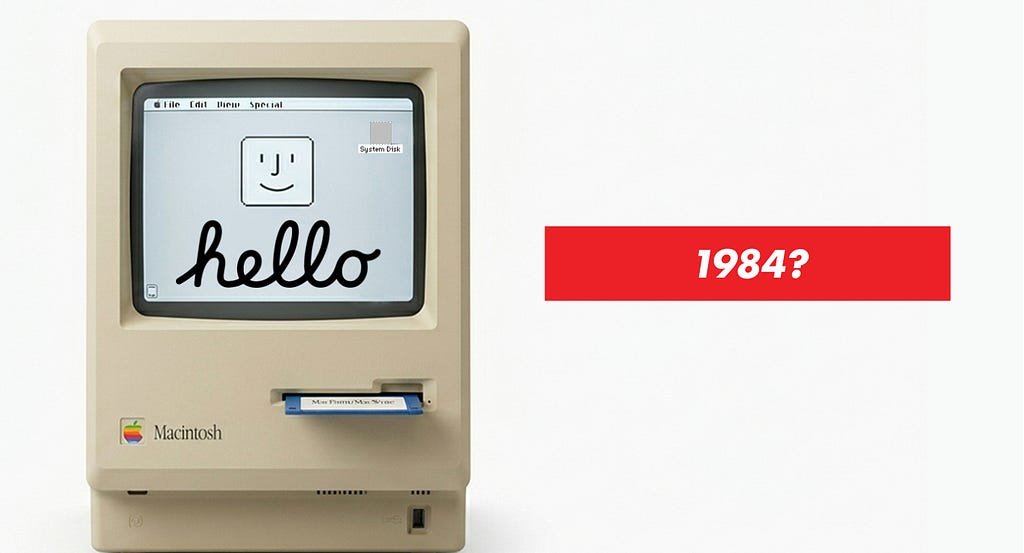
Proportionally spaced fonts, Jobs explained, come from the craft of typesetting and the art of beautiful books. That is where ideas come from. If it weren’t for the Macintosh OS, Microsoft would have been far more reluctant to prioritize typographic quality in its interfaces. The Mac had proportionally spaced fonts because Jobs attended classes that had no practical application to computers. This was the reason he hired a graphic designer — Susan Kare — to join the Apple team in 1982. Kare was, in addition to creating Mac’s famous icons, the primary architect of the system’s typography. The icons and the fonts were part of Mac OS because they were beautiful, because they were interesting, and because they elevated the user experience. They were also outside the domain of computing entirely.
Taste, in Jobs’ formulation, was not a preference but dedication and a discipline. Taste “comes down to trying to expose yourself to the best things that humans have done,” he commented, and then trying “to bring those things into what you’re doing.” Taste requires deliberate cultivation through immersion in high-quality work across fields. Jobs, who was deeply steeped in the 1960s counterculture described the prerequisite of taste as “grokking,” a term borrowed from science-fiction author Robert A. Heinlein in whose 1961 novel Stranger in a Strange Land this Martian word meant “to drink.” It metaphorically refers to understanding so thorough that the observer and the observed become one. In understanding the problem so deeply that form and function can become inseparable, designers transform core human needs into great products, balancing the thousands of details and trade-offs that follow the first sketch. And it is what makes the difference between a product with a spirit and one that is, as Jobs would put it with characteristic bluntness, merely AI slop.
In offering a similar conclusion from a different perspective, economist and complexity theorist Brian Arthur has crafted one of the best definitions of engineering design:
“Articulate utterance in technology requires deep knowledge of the domain in question: a fluency in the vocabulary of components used; a familiarity with standard modules, previous designs, standard materials… a ‘knowingness’ of what is natural and accepted in the culture of that domain. Intuitive knowledge, cross communication, feeling, past use, imaginative knowledge, taste — all these count.”
Good design, Arthur argues, is “like good poetry … in the sheer rightness of choice from the many possible.” Domain knowledge and culture are the raw materials of taste in design. Arthur’s framing clarifies something Jobs left implicit: taste is a deep form of knowledge. It is not based on explicit, propositional knowledge — not the kind you can look up or prompt for. It is the accumulated, cross-domain, culturally embedded knowingness that tells a practitioner what is right and what naturally fits in a given problem space. It is the reason two designers looking at the same brief will see entirely different problems worth solving. And it is exactly what the current generation of AI systems cannot deliver.
The taste test
Roberto Verganti’s research into Italian design-driven companies such as Alessi, Artemide, and Kartell, produced one of the most underappreciated insights in the design and innovation literature. These companies did not succeed by conducting surveys of what users wanted. They succeeded by making bold proposals. By radically redefining what a product could mean for people, they created markets that did not previously exist. The iPhone did not just improve the Blackberry or the Nokia mobile phone; it redefined how a portable communication device could fit within someone’s life. The Wii did not improve the game console. It redefined who a game console was for and what could be done with it. Verganti calls this design-driven innovation: the radical innovation of product meanings rather than product features. At its center is a vision of a product or service that audiences cannot articulate but came to love the moment they encountered it.
How do design-driven companies develop such visions? Not by running focus groups. They do it by cultivating deep, sustained relationships with what Verganti calls “key interpreters” — architects, anthropologists, artists, researchers, and others working at the leading edge of socio-cultural change — and by immersing themselves in a collective research conversation about how the meaning of things in people’s lives is shifting. Taste, at this scale, is an institutional research practice, not a personal gift.
Savas Dimopoulos, Professor of Physics at Stanford and one of the most cited scientists of his generation, once described the discriminating faculty at the heart of creative work in terms that translate directly to design practice. What differentiates the best practitioners, he argued, is the creative ability to discern between what is a reasonably good idea and what is a beautiful idea worth spending time on. The distinction rests on three simultaneous conditions: the unmet need must be sufficiently resonant that it matters, sufficiently difficult that it has not yet been addressed, and sufficiently timely that the moment for addressing it has genuinely arrived. All three conditions must hold at once. A resonant idea whose moment has not come is premature. A timely idea that is not genuinely difficult is not worth a serious practitioner’s investment. The discrimination Dimopoulos describes is not a feeling. It is a structured judgment. And it is inseparable from domain depth. One cannot know whether a problem is genuinely hard without knowing the domain well enough to have already considered and rejected the obvious solutions.
Taste cannot be reduced to a checklist that can be copied by computer systems. True taste is based on an ability to ask diagnostic questions that delineate the boundaries of a unique problem-solution space, drawing on the T-shaped deep domain knowledge and transdisciplinary breadth that no client brief can fully supply and no prompt can retrieve. While theory building is the cognitive act of constructing a coherent account of the problem space from which solutions can emerge; taste is the evaluative faculty that guides that act at every choice point. One cannot build a great theory without taste, but taste is not the same as the theory. The theory is the output. Taste is the judgment that shapes it.
Taste is an integral part of the design paradigm. It is one of those elusive things that make the solution obvious once a designer has proposed it. It is what sets the design field apart from other disciplines. Taste is the designer’s human judgment faculty in its role as MKO — exercised not once but continuously across the three phases where the design process is most vulnerable to collapse: problem definition, solution generation, and solution selection. It is what distinguishes a designer operating as a theory-builder from a designer operating as a specification-executor.
Before the first sketches are drawn, taste is what helps us to decide which problem is worth ideating in the first place. The mobile phone industry in the mid-2000s had framed its problem as: How do we competitively outmatch each other by adding more features? Jobs, Ive, and the Apple team did “think different” to ask: What could a personal communicator be when the computer hosting your entire music library in your pocket exceeds the capability of the desktop of ten years ago? That reframing was not inspiration but the cultivated judgment of people who had spent years absorbing ideas from domains that had nothing obvious to do with phones. The phrase — “an iPod, a phone, and an internet communicator” — uttered by Jobs in the keynote address at Macworld on January 9, 2007, — was not simply a marketing line, it was a statement of the problem theory. The problem theory that design judgment produced determined every design decision downstream.
During ideation, taste guides which creative probes are worth running and which are not. At Apple, iPhone teams ran parallel tracks on scroll wheel versus touchscreen and touchscreen versus the physical keyboard. The keyboard was dropped not because the touchscreen tested better in a focus group, but because it was incompatible with the theory of the product. They experimented with glass screen versus plastic. That debate was settled when the touch screen on Jobs’ prototype got scratched by the car keys in his pocket. In each case, the informed intuition spotted the incompatibility before the data could confirm it. During implementation, taste is what protects the theory from the pressure of “reasonable” compromises.
The first iPhone shipped without copy-paste, without MMS, without third-party apps. Each omission was a choice to protect the core value proposition and quality of the product rather than dilute them.
The discipline of knowing which trade-offs preserve the vision and which ones dissolve it, is taste at its most demanding and most invisible. It is defined by three things. First, taste is not a preference but a form of knowledge cultivated through deliberate exposure to the best things humans have done across disciplines, accumulated over years, irreducible to a quick database query. Second, taste is the ability to discriminate between a good idea and a beautiful idea worth spending time on: the right problem, at the right level of difficulty, at the right moment. Third, taste allows designers to make bold proposals rather than check boxes on a list of specifications. It asks not what the user currently wants but what a product could be that the user has not yet imagined.
Why AI as MKO fails every question on the Taste Test
The Taste Test is not designed as an AI critique but rather a reality check on the claims made for this nascent technology. It is a reminder to the design community about what design actually does. It is also a proposal to define our field properly before someone else defines it for us. Let’s evaluate the current AI models based on five dimensions of genuine design taste.
On the domain question: AI systems have statistical familiarity with multiple domains without having knowingness. The difference is the difference between having read every book about a culture and having lived inside it. Arthur’s “knowingness” accumulates through practice, failure, and the kind of cross-domain intuition that comes from genuine immersion. It is not a retrieval problem that any amount of training data can resolve.
On the culture question: AI systems draw inferences from within their training distribution. Since they have access to vast quantities of cultural output, they are more than capable of retrieving useful products from culture, but they cannot bring culture to a product in the way Jobs meant. The calligraphy shaped Jobs’ embodied cognition in ways that are hard to predict. The future co-founder of Apple took part in the classes in a way that helped to form his sensibility, develop a set of values, and a half-formed vision of what computing could become. The connection between the calligraphy and the Mac was made by an indirect route of human creativity. It was made by a mind that had been cultivating its own taste for years. AI has no such mind and no such history of direct experience.
On the judgment question: AI systems have no sense of timing. Dimopoulos’s third condition — that the moment has arrived — requires a theory of the present that no AI system possesses. Current models have a knowledge cutoff. They have no theory of the present moment. More importantly, while they can gather available data within their training set to list the ingredients of the “adjacent possible” for a field; they have no sense of what to do with this kind of information. They also have no sense what the culture is ready to receive. That judgment that determines the product-market or problem-solution fit requires being in the world, now, with a practitioner’s feel for what is meaningfully shifting within the social, cultural, economic, and technological trends. To paraphrase Jobs, they have no ability to surf the waves of socio-technical change.
On the proposal question: AI systems optimize and interpolate within existing meaning categories. The training data is, by definition, a record of what has already been articulated by people. Verganti’s Italian design innovators did not succeed by studying currently successful products and doing more of them. They succeeded by proposing new meanings their interpreters had sensed but their customers had not yet been able to articulate. That act of vision — of seeing what a thing could mean before the culture has named it — is structurally unavailable to a system whose knowledge is bounded by what has already been said.
On the craftsmanship question: AI systems can generate details at scale, but they cannot make taste-informed trade-offs. Every detail delegated without the designer’s judgment is a place where taste leaks out of the system. The outputs remain plausible but they lose spirit. Jobs’ description of Microsoft’s products as “third-rate” was precisely a description of this condition: technically functional, culturally vacant, made without the relentless refinement that keeps a vision alive through execution.
I’d like to be clear on what the thought experiment Taste Test confirms. It does not confirm a need to resist or fight AI. But neither does it confirm the call to become better prompters. What it confirms is that AI models can be extremely useful in the design process as long as designers retain their MKO role.
What this means in practice
This article was inspired by the question that came in from the design community after my last post: How do we operationalize designer as MKO in real everyday project work?
The first practical implication is about articulating the value proposition of senior level designers. The client who is weighing whether to hand the creative brief to an AI tool or an agency using one is not asking a philosophical question about human creativity. They are asking questions about value proposition and competitive business advantage. Roger Martin gave us the business case for this two decades ago. Integrative thinking — the capacity to hold opposing models simultaneously and generate a resolution that neither model could reach alone — is the source of durable competitive advantage. The Taste Test is its operational definition. Design capacity for exercising judgement based on taste is the source of durable competitive advantage over rivals who optimize within a single frame.
Roberto Verganti gives us more ammunition when he shows that the companies which lead and in fact create their markets are not the ones that respond to demand and need for efficiency. They lead with effectiveness of solutions that propose new meanings their competitors never imagined. Both arguments point to the same conclusion: designers, unlike AI tools, do not contribute at the execution level — we contribute at the strategic level where problem-solution spaces within which execution takes place are constructed.
The value proposition worth articulating is not “look, I can use AI tools effectively.” Every junior designer, every non-designer, and even every client can learn to prompt. The senior designer’s irreplaceable contribution is the judgment that precedes the prompt and evaluates what comes back from it. It is the theory of the problem that defines which solution space is worth searching. It is the taste that selects which probes are worth running, recognizes when the results are drifting away from the vision, and holds the core value proposition intact through the pressure of implementation. Without that judgment at the center of the Human+AI system, the AI goes on wild goose chases in spaces nobody has defined and optimizes toward a peak nobody has chosen. While the outputs will be statistically plausible, the form will follow nothing.
I am not suggesting that the designers who make this case, make it defensively. We state this unique value proposition by demonstrating it. We arrive at the briefing session ready with questions about which problems are beautiful enough — simultaneously resonant, difficult, and timely — to be worth investing time and resources into.
We reframe the client’s question before the conversation about tools begins. We show, in the first meeting, what it looks like when the MKO role is filled by a human with cultivated judgment rather than left vacant for the AI to occupy by default. That is not an argument for designers’ relevance. It is a demonstration of it.
References
Arthur, W. Brian. 2009. The Nature of Technology: What It Is and How It Evolves. New York: Free Press.
Jobs, S. (1996). Interview. In R. X. Cringely (Director), Triumph of the nerds: The rise of accidental empires[Documentary film]. PBS.
Author Note
Peter’s previous articles in this series: “Why safe AGI requires an enactive floor and state-space reversibility,” “A designer’s field report on the Iconic blind spot in AI world models,” and “The ground is shaking: Why designers must flip the script on AI” are available on UX Collective.
Author note: The full theoretical framework, grounded in design theory, complexity science, and the epistemology of stochastic search, behind the arguments made in this article, is developed in the upcoming Emerald Publishing book.

Oh, but there’s one more thing was originally published in UX Collective on Medium, where people are continuing the conversation by highlighting and responding to this story.