Blog
NESCA space accelerator backs 13 North East projects

They cover testing for atmospheric interference, using AI and satellite data to prevent crop disease, and improving laser-based space communications. And the projects are split across the three universities participating: Durham, Newcastle and Northumbria.
At Durham University, for example, Dr Perrine Lognoné is working with Telespazio UK to build a first-of-its-kind testing facility. It uses a 7km laser link on the Durham campus to recreate the atmospheric interference that satellite signals encounter, giving UK companies a way to more fully test their technology on the ground.
At Newcastle University, as an example, Dr Kabita Adhikari is working with Craft Prospect to tackle a big farming challenge of crop disease and pest damage. Her project fuses satellite imagery, radar data, and Met Office weather information to monitor fields continuously regardless of cloud cover, using a transparent AI system that can flag threats in plain English. Potentially, this will give farms the chance to act before yield is lost.
And at Northumbria, one of the projects sees Dr Amna Riaz being awarded £64,000 funding for her Gimbal-Stabilised Optical Communications project. This tackles one of the key practical challenges in laser-based space communications – keeping a narrow optical beam precisely locked on its target. Her solution uses a motorised mounting system that automatically adjusts the direction of a laser beam. In other words, keeping it precisely aimed even as the platforms carrying it move. For example, whether a satellite, a drone, a vehicle, or a portable ground station.
Projects
The full list of projects is as follows:
Durham University:
- Development of a bidirectional ground-space optical link emulator for telecom systems turbulence resilience qualification – Dr Perrine Lognoné, with Telespazio UK Ltd
- SpaceWatch: Deployable Ground-based Sensors for Detection, Tracking and Characterisation of Space Objects – Professor Hubert Shum, with OpenWorks Engineering
- Reliable Communications to Small Launch Vehicles – Isabelle Crossley, with Viper RF
Newcastle University:
- Explainable Digital Twin Crop Surveillance Using Multi-Source Satellite, Radar and Weather Data – Dr Kabita Adhikari, with Craft Prospect Ltd
- IRIS — InfraRed Intelligent Surfaces – Dr Toby Hallam
- AutoCube – Feasibility Study of Autonomic Computing for Next-Generation Micro-Satellites – Dr Tomasz Szydlo, with Craft Prospect Ltd
Northumbria University:
- 3D carbon electrodes with conformal nickel–transition metal functional coatings for space-based electrolysis systems – Mike Taverne, with Exotopic Limited
- Intelligent Infrared Sensing Module for Space Application – Dr Jiguang Li, with MConnected Ltd
- Hybrid RF and Optical Communication Systems for Intersatellite Links – Dr Nassima Khorchef, with Filtronic plc
- Gimbal-Stabilised Optical Communications for Multi-Domain Applications – Dr Amna Riaz, with OpenWorks Engineering
- Epoxy-amine-boron polymer composites for enhanced radiation shielding, heat management and flexibility of design – Matthew Unthank, with Boyd Technologies Ashington UK Ltd
- SLIPT-X: Simultaneous Lightwave Information and Power Transfer for Secure Remote Sensing with Drone Activation and Satellite Backhaul – Dr Abderrahmen Trichili, with Connexin Limited (joint project with Newcastle University)
- Multi-Lander Communication Framework for JAXA’s 2031 Mars Exploration Mission Step-1 – Professor Javier Martin-Torres, with AVS Added Value Solutions UK Ltd
NESCA
The accelerator highlights that five of the chosen projects are led by women. And that this is a fitting milestone this week. It marks 63 years since cosmonaut Valentina Tereshkova became the first woman to travel to space.
Note that the latest distribution is the second round of innovation funding.
“Round 2 attracted an exceptional field of applications, and the breadth and technical quality made for genuinely difficult decisions,” said NESCA project lead Professor Vincent Barrioz, from Northumbria University’s School of Engineering, Physics and Mathematics.
“The 13 funded projects span everything from optical intersatellite links to crop surveillance and launch-vehicle communications, each underpinned by an industrial partnership. I’m particularly pleased that five are led by women. It’s a powerful signal that the talent driving the North East’s space sector is as diverse as it is ambitious.”
NESCA receives funding from the EPSRC.
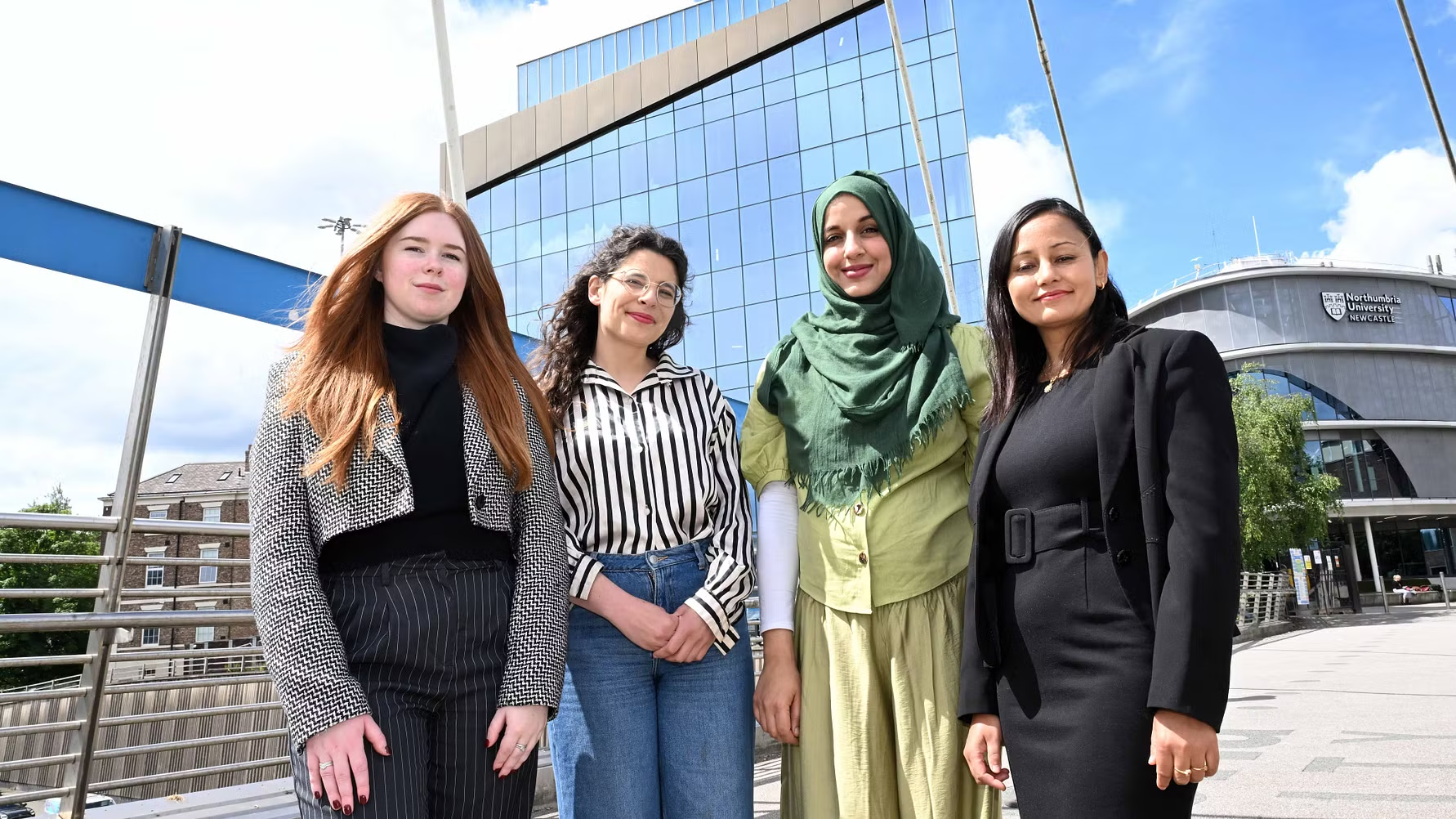
Image: NESCA – (l-r) Isabelle Crossley, Dr Perrine Lognoné, Dr Amna Riaz and Dr Kabita Adhikari. Northumbria University’s new North East Space Skills and Technology Centre (NESST) in the background.
See all our Space content.