Blog
Impact of academia on the UK space sector – report

Space research
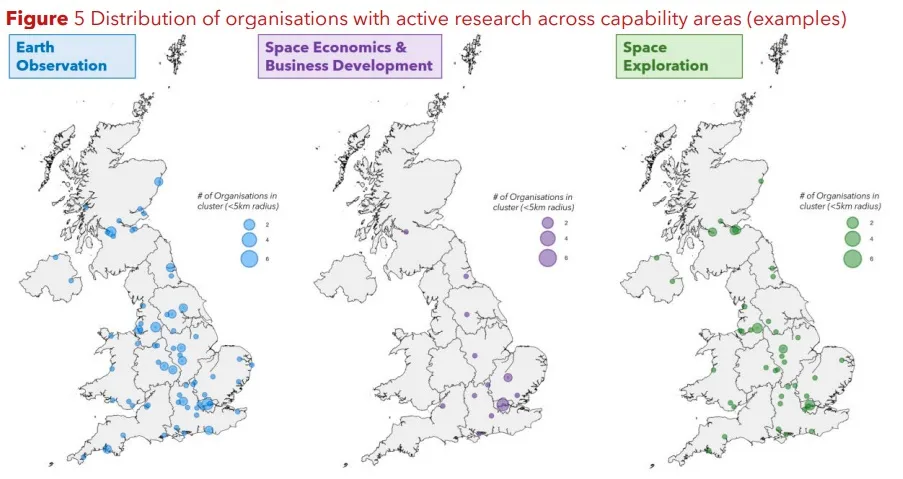
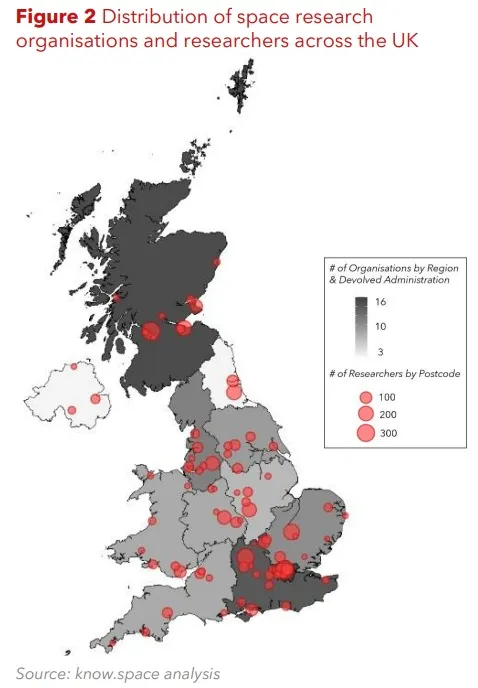
For context, the report – Role and Impact of Academia on the UK Space Sector – states there are 112 space research organisations active in the UK. And within these, there are 5,200 active UK space researchers. Basicially, there are active space researchers in every region and devolved administration of the UK
And it finds that, in total, UK space research receives £260m+ in competitively awarded funding each year.
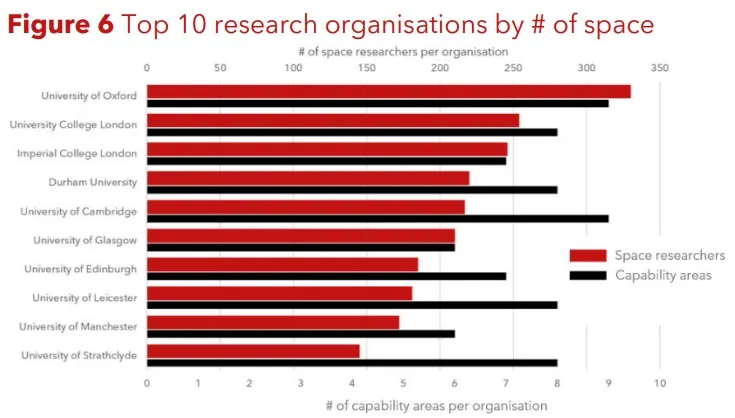
Interestingly, as measured by the number of active space researchers, Oxford University hosts the largest space research community.
And Scotland makes its presence felt as 3 of the top 10 largest space research organisations are located in the country (see below).
Funding
As mentioned, funding is covered in the report. As well as the competitively awarded funding, the report identifies a total of £633m awarded to active, space-related UKRI projects.
The UK Space Agency is another key funder of space research. Internal Agency analysis estimates that of £1.6bn funding from the last five years (2021-25), around 25% of the UK Space Agency’s total annual funding flowed to the UK research base. This was through both contributions to ESA and National programmes.
And, as a result of rejoining Horizon Europe, the report identifies £23m in space-related grants to UK space research, which is around £6m per year. Other sources include MoD, ARIA, and private funding, it notes.
The report states that “sustained long-term funding and expansion of university level commercialisation support are key to realising the future impact of space research.”
Impact
With a long-standing heritage in mission design, the report states that the UK ranks 2nd globally within the top 10% of most cited publications in astronomy and space research (2000-2020).
And it notes “these capabilities can translate into leadership roles in global consortia, such as the 37 UK Principal Investigator (PI) or Co-PI roles across ESA missions since 1975.”
It states
“Space research also leads to real-world impacts on economic growth, productivity, and welfare, including through spinout company creation. Academia often anchors regional
innovation systems, helping companies to validate technologies, attract capital, skills and investment, and build end-to-end supply chains.”
“Of the ~55,000 employed in the UK space sector, around 2/3 are university educated (the highest proportion of any UK sector).”
It also goes on to describe universities as a skills pipeline with their courses and targeted initiatives.
“UK research shapes governance of space and underpins space-derived evidence used to inform global climate policy on Earth. Military equipment that depends on space assets constitutes critical national infrastructure, and UK academia plays a core role in developing and protecting this infrastructure.”
Space South Central
One specific case study covered in the report is the Space South Central cluster.
Beginning as the South Coast Centre of Excellence in Satellite Applications it has since developed with four partner universities. These are: University College London, University of Portsmouth, University of Southampton and University of Surrey. It states the organisation has delivered 5000+ hours of business support for 200+ space-related organisations.
For example, the universities lead the Joint Universities Programme for In-Orbit Training, Education and Research (JUPITER). This is one of several initiatives driven by the cluster. They provide students with industry experience and training, such as in spacecraft engineering.
You can read the full report (PDF) – Role and Impact of Academia on the UK Space Sector – online.
Space Partnership
In 2022, to help grow the nation’s space sector, the UK government announced the formation of Space Partnership.
The body brings together industry, academia and government stakeholders to work together to realise the government’s National Space Strategy. This was first announced in September 2021.
It is co-funded by the UK Space Agency and hosted by the Satellite Applications Catapult.