Blog
Modern Powder Coating for High-Performance Busbar Insulation

Choosing the Right Insulation Approach
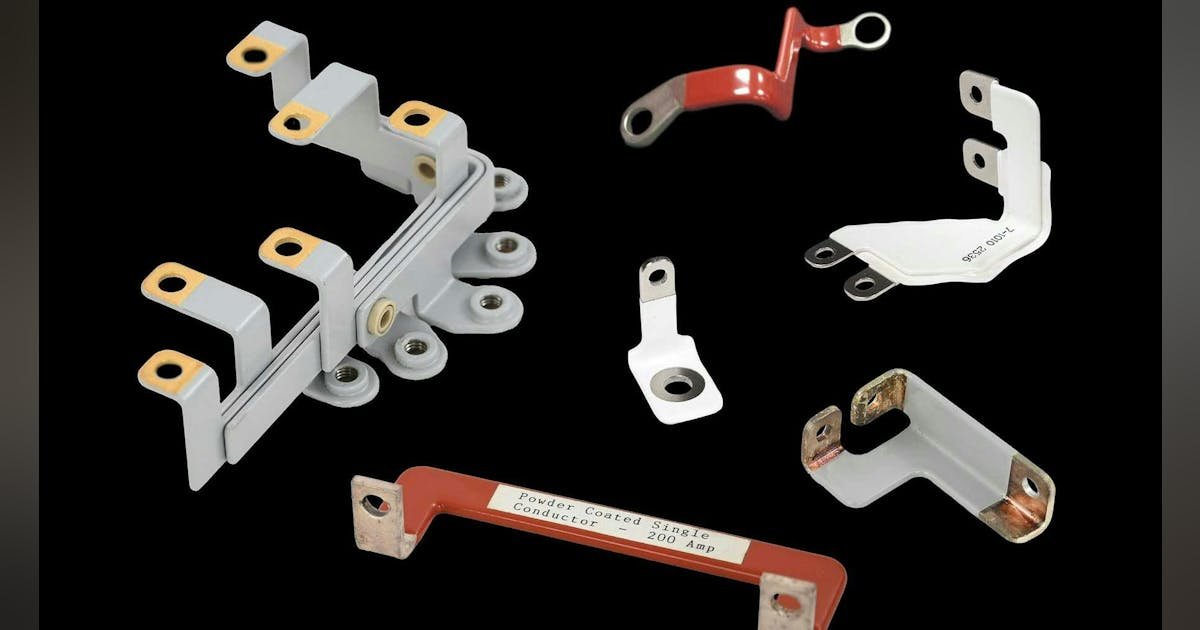
When selecting insulation for a busbar design, engineers should consider the manufacturability, electrical requirements, environmental conditions, and mechanical or geometric constraints. Powder coating is a strong choice when dielectric strength, durability, and geometric versatility are priorities.
Before starting, engineers should consider the manufacturing requirements of the project, such as the masking complexities, lead time, expected production volume, and even the tolerance for reworks.
With electrical requirements, maximum system voltage, required dielectric withstand, AC-DC stress profiles, and clearances and creepage distances will play a critical role in what coating will be ideal. In addition, the number of terminations and bends, thickness tolerance, lamination layers, and mounting surfaces will impact the coating.
When it comes to environmental conditions, manufacturers should rely on the powder suppliers’ technical datasheets for validated performance relative to humidity and salt spray corrosion resistance, altitude/pressure withstand, fungus or microbial resistance, temperature cycling, and thermal shock ratings. There might also be considerations for exposure to oils, fuels, or chemicals.
Bringing It All Together
Powder-coated busbars represent a mature, but continually evolving, technology in electrical system design. As power levels increase and mechanical packaging becomes more constrained, the insulation surrounding a busbar becomes just as critical as the metal inside.
While powder-coated busbars are found across many industries, typical applications include aerospace platforms (aircraft, helicopters, and avionics modules), military vehicles (armored systems and radar installations), electric vehicles, industrial power equipment, residential and commercial breaker panels, and high-density power electronics assemblies. Any system that requires compact, reliable, high-current distribution can benefit from a properly designed and insulated busbar.
By understanding powder formulations, application methods, testing strategies, and design constraints, engineers can specify the busbar insulation system that best meets these demands. No matter the application, powder-coated busbars remain an essential instrument in an electrical designer’s toolkit.