Blog
Kyocera AVX adds to BME MLCCs

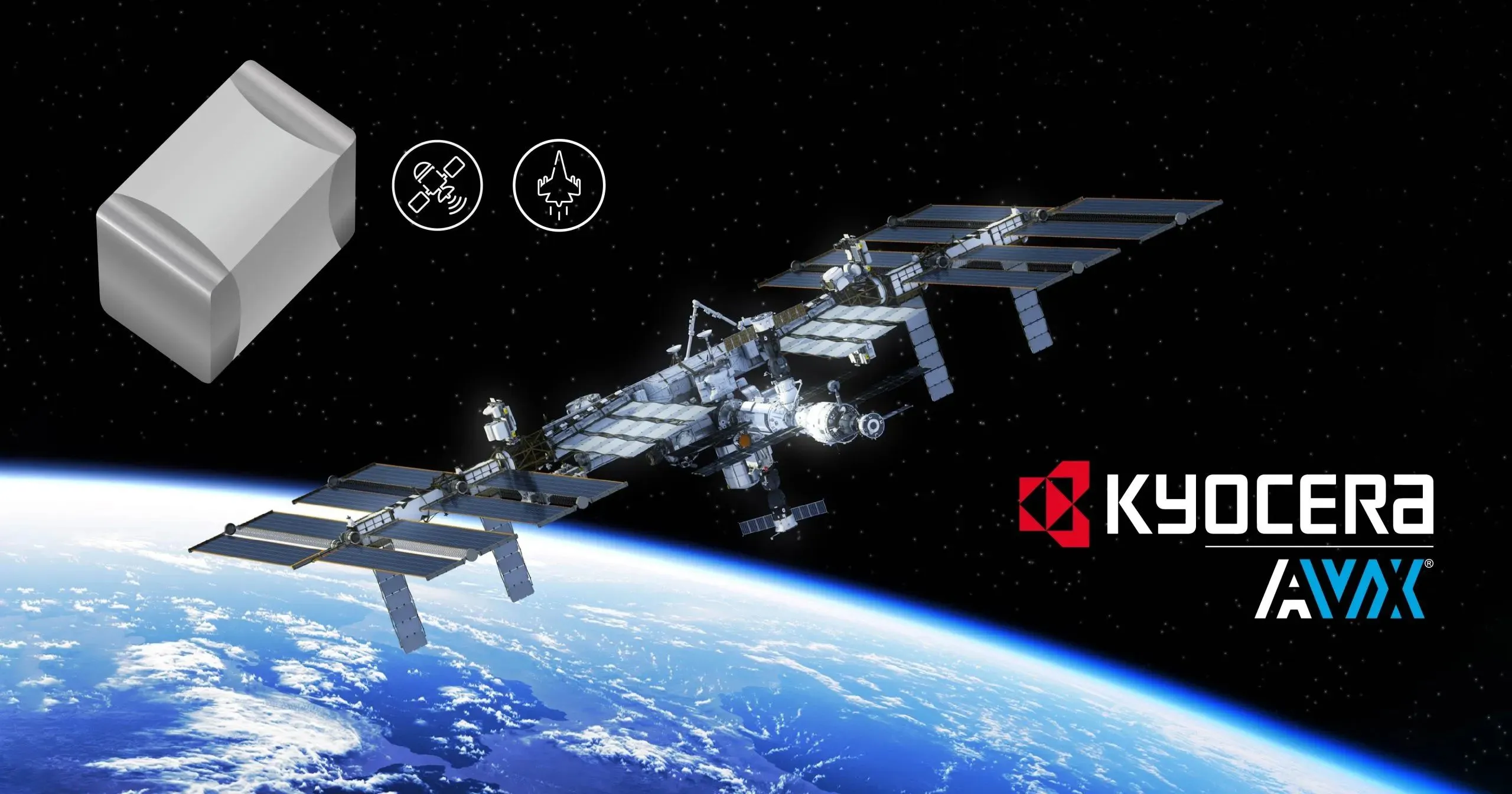
MIL-PRF-32535 BME NP0 MLCCs have higher-CV capabilities than standard surface-mount precious metal electrode (PME) MLCCs qualified to military and aerospace specifications. This effectively reduces the gap between commercial and MIL-SPEC product ranges while meeting “M” and “T” MIL-SPEC reliability levels, providing design engineers with a number of impactful advantages.
Now available in small, high-CV 0402–1210 case sizes rated for 68–47,000pF (±1–10% tolerance) and 4–100V. MIL-PRF-32535 BME NP0 MLCCs enable revolutionary reductions in component size, weight, and count and help aerospace and defense design engineers maximize the efficiency of their PCB layouts.
They also feature KYOCERA AVX’s patented FLEXITERM termination technology, which significantly outperforms standard surface-mount terminations in terms of rugged resistance to the thermomechanical stresses experienced during assembly and operation.
MIL-PRF-32535 BME NP0 MLCCs are approved for use in high-reliability aerospace and defense applications, including filtering, tuning, decoupling, timing, and blocking circuits in land- and air-based military equipment, satellite launchers, and communication, Earth observation, and science exploration satellites.
MIL-PRF-32535 BME NP0 MLCCs are available in standard waffle packaging or supplied on tape and reel. Lead time for M-level reliability parts is currently 18 weeks in the U.S. and Asia and 16 weeks in Europe. For T-level reliability parts, lead time is currently 25 weeks in the U.S. and Asia and 23 weeks in Europe.
Kyocera AVX
For more information about MIL-PRF-32535 BME NP0 MLCCs, see the complete portfolio of high-reliability KYOCERA AVX MLCCs for aerospace and defense applications, including the complementary MIL-PRF-32535 X7R BME MLCCs and DSCC 25007 miniature, high-CV X7R BME stacked MLCCs.
The series covers capacitors in the ESCC 3009041, NASA S311-P838, and MIL-PRF-32535 ranges and uses the same materials as the fully qualified part numbers — just without the final DLA and European Space Components Coordination (ESCC) testing and screening processes and QPD/QPL listings, which significantly shortens lead times.
See also: Kyocera testing solid state batteries in robots