Blog
FuriosaAi developing inference ICs with Broadcom

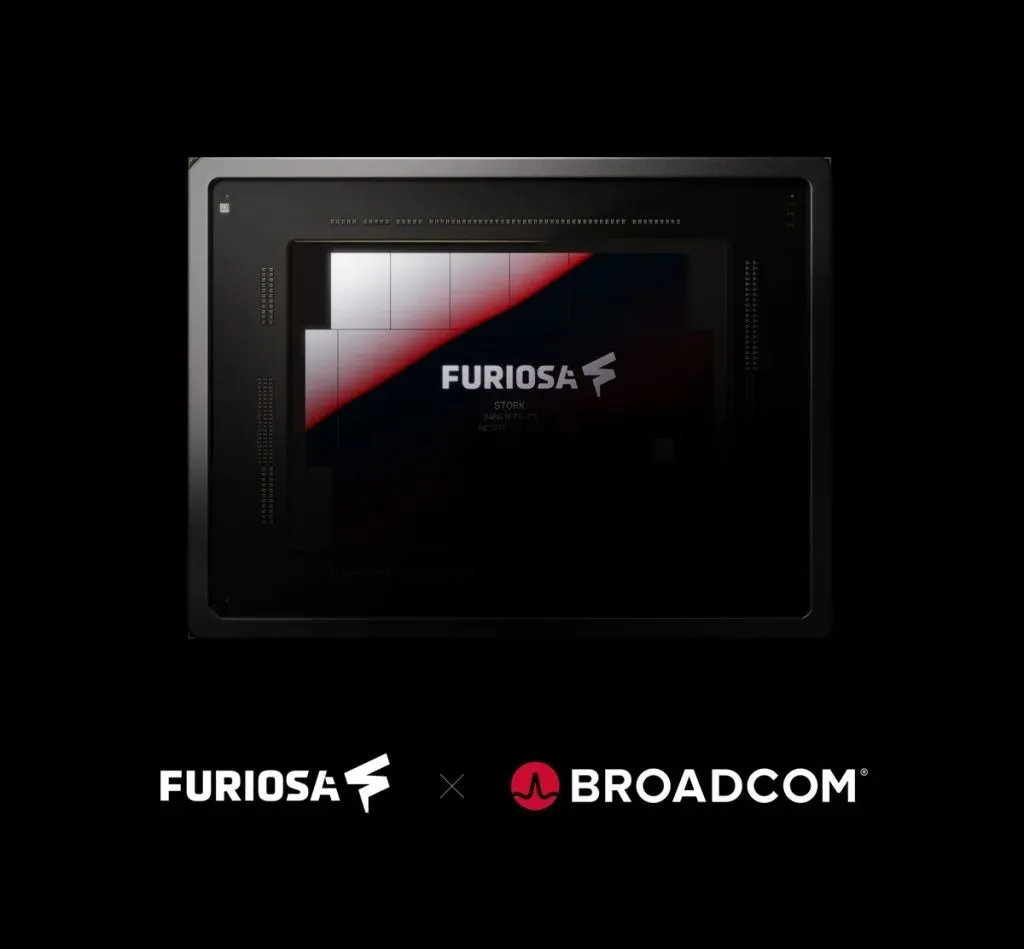
This collaboration evolves Furiosa’s Tensor Contraction Processor (TCP) architecture into a multi-die chiplet system, creating an inference engine engineered for the high-volume token requirements of global hyperscale environments.
Furious and Broadcom are combining Furiosa’s AI architecture with Broadcom’s AI networking products and Ethernet switches to build a unified inference platform combining Furiosa’s architectural innovation and Broadcom’s infrastructure expertise.
The partnership builds on RNGD, FuriosaAI’s data center inference chip. Currently in mass production and fabricated at TSMC’s 5nm process, RNGD is an 180W, PCIe-based accelerator designed for high-performance LLM and agentic AI workloads.
RNGD has been validated in production environments by global leaders including Samsung SDS and LG AI Research, proving the efficiency of the TCP architecture in standard, air-cooled data center environments.
By providing high throughput and low latency within a power-constrained envelope, RNGD establishes the architectural foundation for the significant enhancements being co-developed with Broadcom for the third-generation platform.
“Inference performance is no longer defined solely by raw compute. It is increasingly a function of data reuse and communication efficiency across servers and racks,” said Charlie Kawwas, Ph. D., president of Broadcom’s Semiconductor Solutions Group, “By pairing Furiosa’s TCP architecture with Broadcom’s market-leading XPU Technology and IP Platform, Ethernet scale-up and fabric switches, we are building a platform that addresses the key bottlenecks of large-scale agentic AI.”
Furiosa’s chip will feature a 2nm compute die and HBM4/4E, utilizing Broadcom’s advanced packaging capabilities to integrate multiple silicon dies into a high-performance system-on-chip.
By incorporating Broadcom’s Ethernet and PCIe technologies, the system enables high-bandwidth, rack-scale networking across massive AI compute clusters.
“Bringing together Broadcom’s infrastructure capabilities and Furiosa’s Tensor Contraction Processor architecture and its industry-defining software stack allows us to move beyond the chip level and deliver a comprehensive solution for the token factory era,” said Furiosa Cofounder and CEO June Paik.
“Having proven the performance and efficiency of our architecture with RNGD, our second-generation chip now in mass production with TSMC, we will deliver a third-generation inference solution that offers industry-leading performance per watt for even the largest, most complex frontier AI models and agentic workloads.”
The design is optimized for demanding real-world AI workloads, including intensive post-training sampling. By focusing on high-bandwidth data movement rather than the thread management required by GPUs, the chip will deliver higher performance-per-watt and greater token density than state-of-the-art GPUs.
Furiosa’s hardware is supported by a software stack that enables developers to deploy quickly, meet demanding throughput and latency requirements, and easily switch to new frontier models and new optimization techniques.
While legacy platforms require extensive hand-tuning of kernels for every new model, Furiosa’s SDK leverages a general compiler that automatically maps high-level PyTorch code to silicon. For developers requiring more granular control, Furiosa’s Virtual ISA offers a declarative programming model that provides hardware control without the non-deterministic complexity of traditional GPU programming.