Blog
FDSPP Petri-Pod space laboratory project backed by UKSA

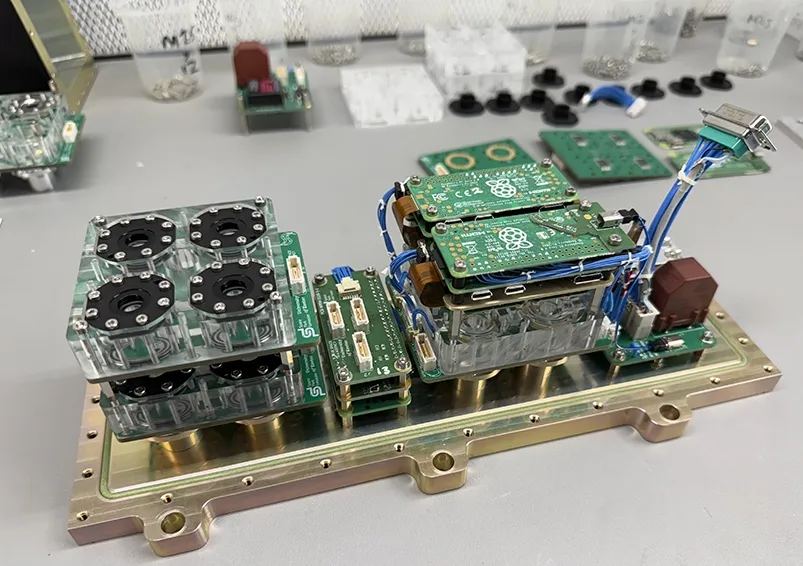
Heading for the International Space Station (ISS), it is described as a miniature space laboratory designed to study how biological organisms respond to the extreme conditions faced by astronauts.
The experiment launched on NASA’s Northrop Grumman CRS-24 Mission from the Kennedy Space Center in Florida on Saturday. And it will enable researchers to conduct tests on dozens of microscopic worms, called C. elegans nematode worms.
The equipment will be controlled remotely from Earth.
FDSPP Petri Pod
The Petri Pod measures 10 x 10 x 30cm and weighs around 3kg, says the UKSA. It contains 12 experimental chambers, four of which can be actively imaged using fluorescent and white light imaging capabilities.
Each chamber provides a miniaturised ‘life support’ environment, by maintaining temperature, pressure and a trapped volume of air for organisms to breathe when exposed to the vacuum of space. The specimens receive food and water through an agar carrier.
Initially, the experiment will spend time inside the ISS. It will then deploy outside on an experimental platform. This will expose it to the vacuum and radiation of space along with microgravity for up to 15 weeks.
Interface
The university of Leicester writes of the FDSPP:
“Inside the unit there is an electronics interface to the spacecraft power and communications bus that utilises the ISS 28Vdc power supply and serial over USB communications. The interface also provides further voltages for the internal subsystems.”
“The experiment will be placed outside the International Space Station (ISS) on an experimental platform following launch exposing it to the vacuum and radiation of space along with the micro-gravity environment.”
Montoring
Photographic stills and time-lapse video will montor the health of the worms in the FDSPP, says the university. Exposure to white light, or by fluorescent stimulation via low powered lasers will capture the data.
These are under the control of onboard microcontroller units, with data stored locally. And also relayed to the Earth ground station. This will be over the ISS downlink communication system. They will also relay temperature and pressure inside and outside of the worms’ containment volumes. And characterise the background radiation by monitoring exposure using a RadFET.
Deep space
“NASA’s Artemis programme marks a new era of human exploration, with astronauts set to live and work on the Moon for extended periods for the first time,” said Dr Tim Etheridge of the University of Exeter.
“To do that safely, we need to understand how the body responds to the extreme conditions of deep space. By studying how these worms survive and adapt in space, we can begin to identify the biological mechanisms that will ultimately help protect astronauts during long-duration missions – and bring us one step closer to humans living on the Moon.”
You can read more about the FDSPP Petri-Pod on the University of Leicester website.
See all our Space content.