Blog
ASRock Edge AIoT Platforms Bring Intel Bartlett Lake to Rugged Industrial AI

The AI landscape over the last decade has shifted from the cloud to the edge. Industries are no longer exploring AI’s capabilities — they’re actively scaling and deploying it to suit their needs.
As large language models (LLMs) and generative AI become smaller and more efficient, they start reshaping the semiconductor, AI, and device ecosystems, according to a report from Arm. It’s also no secret that by processing data loads locally, there’s no need for cloud connectivity, making edge computing faster and more efficient.
AI processing continues to shift from the cloud to the edge, letting manufacturers move those workloads closer to where that data is generated. Consequently, LLMs and other models can make decisions in real-time without the need for physical internet connections.
That, of course, requires ruggedized hardware capable of handling the harsh environments found on factory floors. Vibration, heat, dust, and other variables can wreak havoc on hardware, and as a result, ruggedized hardware is just as important as AI processing power.
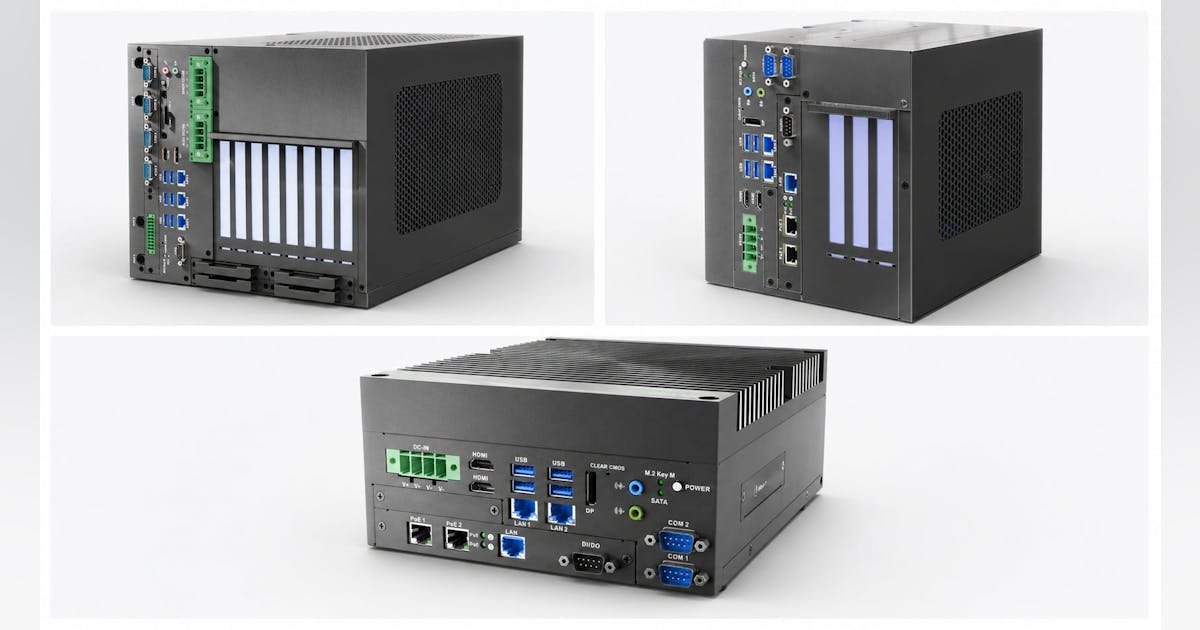
ASRock understands the importance of both edge computing and ruggedizing hardware with its new Industrial Robust Edge AIoT platforms (see figure below), which are driven by Intel’s Core Series 2 Processors with P-cores (Bartlett Lake-S/12P), suiting them for AI processing, real-time industrial control, and scalable deployment. While the new trio takes advantage of the same processor family, they differ in their performance levels, so let’s break them down.