Blog
The Intel Arc G3 Series Inside Story: How Intel Created a Purpose-built Gaming Handheld Silicon That Isn’t a Hamstrung U-Segment Chip

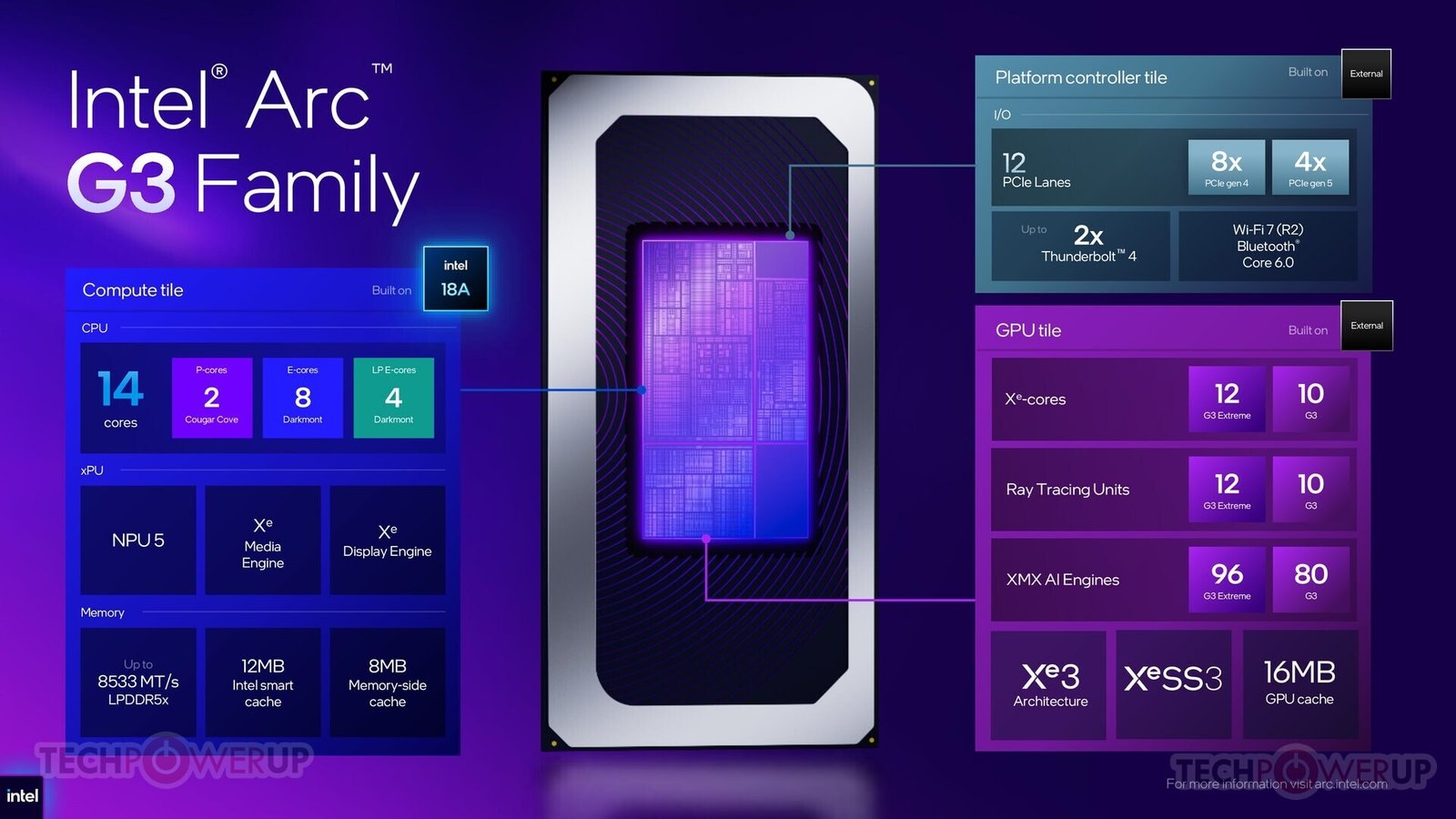
Fitting Panther Lake into a handheld thermal design power (TDP) required more than just tweaking clock speeds. Intel is employing an aggressive silicon harvesting strategy, utilizing “fallout” dies that don’t validate for the full Panther Lake specification. To hit the required power and thermal constraints of a handheld device, Intel has systematically disabled key IP blocks. The Arc G3 cuts the P-core count from four down to just two, drops the number of display engines from three to two, and halves the Thunderbolt capability from four ports to two. This surgical reduction brings the die into a manageable TDP, prioritizing GPU performance and securing supply for the burgeoning handheld market.
Power Management v3.5: The “P-Core Parking” Solution
Perhaps the most significant revelation involves how Intel fixed the aggressive power-sloshing behavior that plagued early Lunar Lake iterations. In previous designs, the CPU and GPU would constantly fight for the power budget sub-frame by sub-frame. This caused massive frequency spikes, oscillation, and noisy frame pacing as P-cores spiked power demand only to rapidly hand it back to the GPU.
With the G-Series, Intel is introducing Power Management v3.5, which implements a brute-force but effective solution: P-core parking. When a handheld device drops to an overall SoC power envelope of 12 W or lower, the scheduler completely shuts off the P-cores. All processing is handed to the E-cores, ensuring the GPU receives a steady and predictable power flow. The result is a drastically smoother frame delivery and eliminated power oscillation.
The XeSS Frame Gen Tax and Endurance Limitations
While Intel touted massive efficiency gains using AI frame generation, noting it takes less than a quarter of the energy of a rasterized frame, they were remarkably candid about its overhead. Injecting multi-frame generation to hit ultra-high refresh rates imposes a significant “tax” on native rendering. For instance, scaling a game to 199 smoothed frames drops the native rasterization baseline from 73 FPS down to 50 FPS.
Furthermore, Intel’s impressive “Endurance Gaming” mode: a feature that can cap frame rates to drop total system power down to a mere 4 W to 13 W in games like Team Fortress 2 currently does not support Frame Generation. Intel is working to bridge this gap, aiming to allow third-party OEMs to integrate these toggles natively into their quick-settings overlays.
Cloud-Powered Shader Compilation
To combat the dreaded shader compilation stutter and long initial load times, Intel has deployed a proprietary cloud-based solution. Because a universal Windows fix is still on the horizon, Intel maintains internal teams dedicated to compiling shaders for new releases. These pre-compiled shaders are uploaded to an Intel cloud network, which the client-side Intel Graphics Software (IGS) silently downloads in the background before the game is even launched. In titles like “God of War Ragnarok,” this approach has reduced initial load wait times by a staggering 26x.
Intel’s Arc G-Series represents a calculated, highly specific approach to portable gaming. By cleverly repurposing fallout silicon, aggressively parking P-cores, and leveraging cloud infrastructure to smooth out software pain points, Intel is building a formidable, purpose-built challenger to the Ryzen Z-series.