Blog
Who draws the in-betweens?

Every line we draw around AI measures the tool. Authorship has always lived in the decisions.
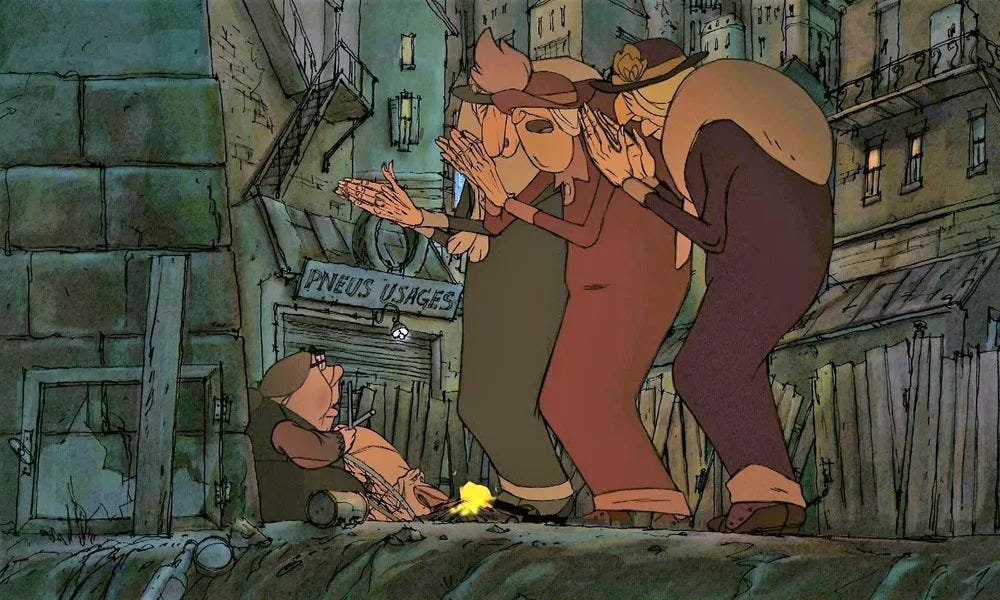
Earlier this month Dior released Christian Dior’s Night in Color, a holiday short directed by Sylvain Chomet, the animator behind The Triplets of Belleville and The Illusionist. A week after release, the internet had already reached its verdict. People had paused, zoomed in, counted the fingers, and decided it was AI.
https://medium.com/media/b0e597b691aae940498b481aa00feecb/href
Chomet and his producer, Aton Soumache, answered in an interview with Variety. Artists drew the characters, they say, the backgrounds and the key poses, and around twenty people worked on the film for seven months. Then came the detail that set everyone off. The team had used automated interpolation, software that generates the frames between keyframes, for what Soumache called “a very small part of the process.” Chomet said it automated the repetitive, mechanical side of animation and left the creative side alone.
A lot of people read that as a confession, but for me it was something else. Until then, I’d mostly thought about AI the way people in my job usually do: as a question of tools, speed and budgets. This was the first time I looked at it through an artist’s eyes. I tried to imagine Chomet reading the accusations, a man who has spent his whole career drawing by hand, being told his film wasn’t his. And I think I understood what must have gone through his head in that moment: what is the difference?
His films have always had in-betweeners. Other people always drew part of his films, following his keys, his timing, his idea of how things should move. So if he drew the keys and a machine filled in some of the frames between them, is the film still his? And if it isn’t, where exactly did it stop being his?
I want to try answering that honestly, by following the lines people usually draw and seeing whether they hold.
The first line: a human hand on every frame
The instinctive answer is that art means a person drew it. But that has never been true of animation, which is why the Dior case is so useful.
For most of its history, hand-drawn animation has worked like this: A lead animator draws the key poses, the drawings that carry the action and the acting. Assistants and in-betweeners fill in the frames between them, sometimes dozens for every second of film. Their names sit far down the credits, when they appear at all, and I’ve never heard anyone leave a cinema praising an in-between. The lead animator’s job is to direct. They decide how every movement should feel, look at every pass, push back on whatever doesn’t work, and keep going until the whole film looks like it came from a single hand.

So the “human hand on every frame” line was already crossed decades ago, by other humans nobody credited. Swapping some of those humans for software leaves the lead animator doing exactly the same job. The keys are still theirs and so is every decision about what stays and what gets redrawn. What changes is speed and cost, and I don’t see how speed makes a drawing less yours. Anyone who animated in Flash in the 2000s used tweens, automated in-betweening under another name, and nobody called it the end of the craft.
To be fair to the critics, some frames really were ugly, and some of the flaws looked a lot like what people have learned to recognize as AI artifacts. Maybe the interpolation produced them, maybe not. But these things on their own prove very little. Chomet explained that extra fingers appear when you’re selling fast movement, and any animator will tell you the same. Smears and multiples are an old trick. If counting fingers were the test, half of classic cartoons from the 1930s would be guilty.

Hand-drawn in-betweens have always had their bad frames too. Pause almost any classic cartoon and you’ll find a face that collapses for a frame or a hand that melts into the next pose. Somebody drew those, worked against a deadline, and nobody checked closely enough. We forgive them because we watch the film, not individual frames. Imperfections in a production people love read as charm, or as the cost of making something. The same imperfections in a production people already suspect read as evidence.
The second line: the machine has to be under control
The more elaborate version of the objection goes like this: Fine, tools have always done part of the work, but those tools were predictable. A generative model isn’t, so using it means accepting whatever comes out.
Animation has a good test case for this: hair and fur. Ever since Sulley’s coat in Monsters, Inc., a whole genre of films has existed partly to show off how good fur simulation had become. Nobody draws those hairs: artists define the groom, density, length and how it moves, and a simulation computes millions of strands frame by frame. The result is about as machine-made as an image gets, but we call it craft, because the artist decided what the fur should be and the software carried it out.

I don’t think generative tools are as far from that as people assume. When I describe a shot to one of the video tools I use, say a rooftop at dusk with a slow push-in on a woman looking at the city, I don’t get a random picture, I get something close to what I described, similar to the way a camera operator brings back something close to your brief. Then the real work starts, because these tools now sit inside an ordinary editor. I can retime the push-in, cut the shot shorter, regrade the sky, rework the sound, and each of those changes does exactly what I tell it to.
Photographers have lived with this forever: on the street you don’t control the light, the passers-by or the clouds, but you choose the moment, the frame and the edit. Nobody says the photo isn’t yours because you didn’t place the pedestrians. Nobody controls everything, not photographers, not animators, not anyone. What matters is whether you shaped the result, and AI doesn’t change that.

The third line: real work takes effort
This is the one I feel most personally, because it’s usually framed as being “on the side” of people like me.
Some of the websites I design are the projects I live for, complex and animated and thought through down to the scroll, and those take weeks because the effort is the point. But creative work has always been tied to commissions and invoices, and next to those projects there’s a steady stream of small sites for businesses that can’t spend much or wait long. Anyone in my industry will tell you that most of the website market runs on templates. Someone buys a theme, changes the colors, fonts, copy and photos, and ships it. Nobody calls that a betrayal of craft. It’s a service sized to a budget.

The same goes for the pieces inside a site. A signup flow or a checkout is a solved problem, built on patterns users expect to behave the same everywhere, and a “creative” checkout is usually a worse one. I’ve never built one from scratch for its own sake, I use a proven component, one made and shared precisely so people like me don’t have to reinvent it, and configure it to fit. If I generate that same standard pattern instead of cloning it, I genuinely can’t see what I’ve stolen, or from whom.
Templates aren’t only a way to do less, either. Used well, they’re a floor. If the checkout, the navigation and the basic layout are already solved, the hours I’d have spent rebuilding them go into the parts nobody has seen before: the interaction that takes three days to tune, the animation that makes a site feel like the brand it belongs to. Generated components work the same way. Starting from something solid leaves more time and energy for going past it.

We’ve also watched this happen before. When Webflow, Squarespace and WordPress spread, designers said they would kill the profession and make every site look alike. They were partly right about the second part: the cheap end of the market filled up with lookalikes. But something else happened that nobody predicted: a whole generation of designers came in through those tools. People who never learned to code, who would never have been hired by an agency, started building sites on their own, and some of them turned out to be very good. No-code didn’t lower the ceiling. It raised it, because more people with taste could finally reach it.
Some work needs artistic value and effort, some just needs to exist and work. The same tools served both, and insisting on effort everywhere mostly makes the small client pay for our self-image.
The fourth line: you need the skill
If effort isn’t the line, maybe skill is. You should at least be able to make the thing yourself.
Ira Glass has a well-known idea about this, often called “the taste gap”. People get into creative work because they have good taste, and for years their work falls short of it. The only way across that gap, he says, is to keep making work until your hands catch up. What I think generative tools do is close the gap from the other side. Say I can’t draw well, but I can sketch the character I want for my game. A tool helps me turn that sketch into a finished design, but it doesn’t get there on its own. I push it, version after version, deciding on the shoes, the hair, the eyes, the marks of its skin, until it looks exactly the way I imagined. The tool lent me its hands, but every decision was mine.

That deciding is the part that matters. As Nielsen Norman Group points out, these tools fill skill gaps, but being able to make something you couldn’t make before doesn’t mean it’s good.
I live a version of this every week: I’d love to promote my work on social media with proper videos, with long cuts, animations timed to what I’m saying, captions that land on the right word, a title card that’s actually mine. I know what good looks like, because I watch plenty of it. What I don’t have is the budget to hire an editor for every post, and the honest alternative to a generated starting point was never a commissioned video, but rather no video at all.
So I start from what the tools give me and work on it. Along the way I’m learning things I never had a reason to learn: what makes an intro hold people past the first seconds, how different montage styles change the pace, where a cut should fall so the point lands. Some editors will get less work because people like me can do this now, and I don’t pretend otherwise. But this particular job was never going to exist, because the money for it was never there. If anything, a self-made video that works is the kind of thing that eventually justifies hiring a professional for the bigger one.
The worry is that skipping the struggle stunts people, the way pocket calculators were supposed to ruin arithmetic. They didn’t. Kids still learn math, and the ones who love it still go deep. Glass’s advice to make a lot of work still holds; you just get more rounds of making, judging and fixing in a year. The constraints don’t vanish, they move up, from “can I draw this hand” to “do I have anything worth saying.”
Cheap making also means cheap failure, and that matters more than it sounds. If one of my videos flops, I’ve lost an afternoon, not a client budget, so I can afford to try the odd idea and see what happens. The same logic works at the top of the industry. Hollywood keeps making remakes because a film that costs two hundred million dollars has to be a safe bet. Lower the cost of making things and you lower the cost of taking a risk, which is usually where the original ideas come from.
The fifth line: it learned from other people’s work
The last line people draw is about where the tools came from. Models were trained on artists’ work without asking, and for a lot of people that settles it.
I’m aware this is an unpopular thing to say, but here’s my confession, if it is one: so was I. So was every artist who ever lived. Nothing we make comes from nowhere: it comes from everything I’ve seen, played, watched, read and lived through, other people’s work included, and nobody signed a release before any of it got into my head. The more varied that mix, the better the work tends to be. There’s even a name for it: the Medici Effect, from a 2004 book by Frans Johansson. It’s named after the Florentine banking family who, in the fifteenth century, funded sculptors, painters, architects, scientists, poets and philosophers and brought them together in the same city. Johansson’s argument is that the Renaissance came from that mixing, from ideas crossing between fields, more than from any single genius. Creativity mostly happens where influences meet.
Ghibli is a good example for this. Isao Takahata and Hayao Miyazaki both said a French animated film, Paul Grimault’s La Bergère et le Ramoneur, later reworked as Le Roi et l’Oiseau, shaped how they thought about animation. Miyazaki once said that watching it taught him how to use space vertically. Grimault never gave permission, and nobody would call Castle in the Sky a Grimault film. The influence went in, got mixed with everything else they loved, and came out as something that was theirs.

In March 2025 a new image model made “Ghibli style” the internet’s favorite filter, and for a few weeks it seemed everyone had turned their selfies, pets and memes into Miyazaki frames. Alongside them, an old clip came back: Miyazaki in 2016, watching a demo of AI-generated animation and calling it an insult to life itself. I respect that. He’s entitled to never want the technology anywhere near his work. But look at what the trend actually produced: millions of images that look like Ghibli, and not one of them is a Ghibli movie.
That’s the part I think people miss. Even if I could draw perfect Ghibli-style cartoons, that wouldn’t make me Ghibli, or an artist. Ghibli is Ghibli because of its stories, its characters, its worlds, and a style that bends from film to film to serve them. A model can absorb the style, but that was never what made those films great.

There is one real difference, and I don’t want to skip it. When I learn from Miyazaki, I become one more artist with some of his influence in me. A model learns from everyone at once and can produce that influence on demand, for anyone, at almost no cost. That changes the market for people who draw for a living, and it’s a fair thing to worry about. Lost dog — or lost designer? on UX Collective presses on the same point, asking where influence ends, authorship begins and appropriation becomes exploitation, and it’s right that human learning and AI training aren’t the same thing. But that difference is an argument about markets, not authorship. The question this essay is asking is who made the thing, and a style on its own has never answered it.
Where authorship actually lives
Put those lines side by side and they share something. Every one of them measures the tool: whose hand, how predictable, how much effort, how much skill, what it learned from. Authorship has always been somewhere else, in the decisions.
Designers have been circling this question since the first image generators. As Wait, who made this? notes, the questions about authorship, copyright and compensation raised by DALL-E and Midjourney still don’t have answers. Here’s the way of thinking about it that has helped me most.
Think of any piece of work as a grid of small decisions: the shape, the color, the timing, the cut. Some cells you fill in yourself. The rest get filled by whatever you’re working with. A template fills them with someone else’s design choices, an in-betweener with their own hand, a fur simulator with physics, a model with patterns from its training data. Nobody fills in every cell, and nobody ever has.
So instead of a line, I think there’s a matrix: the more of the grid you actually filled in yourself, the more of the work is yours. That explains why lazy AI art feels so empty, since almost none of its cells were decided by anyone. It also explains why Chomet’s film is Chomet’s, why my sketched character is mine, and why a template with the stock photos left in doesn’t really belong to anybody.

It also explains what the backlash keeps getting wrong. From the outside nobody can see the decisions. A viewer can’t tell a character refined over days from one typed in a single line, so “contains AI” becomes shorthand for “nobody cared,” and the finger-counting starts. Sometimes the shorthand is right. Often, as with Dior, it lands on people who drew most of the film by hand.
Clair Obscur: Expedition 33 is an even clearer case. It was one of the most celebrated games of 2025, a debut from a studio that obviously poured itself into every frame, and it won Game of the Year at The Game Awards. Then it came out that the developer had used generative AI for a handful of placeholder textures, a few of which shipped by mistake and were patched out within days. The Indie Game Awards took back its Game of the Year and Debut Game prizes anyway. You can argue about the rules, but nobody who played that game could say nobody cared. And I don’t accept the framing that what we value is “knowing a human made it,” as if a machine in the pipeline erased the person. Every film of the last thirty years has had machines in the pipeline.

That puts some responsibility on us as creators. If people can’t see the process, we should show it. Dior’s campaign leaned on “traditional craftsmanship,” and Chomet said in Dior’s own promotional video that they work just like in the 1940s. Then an interview revealed software in the pipeline, and a good part of the anger came from finding out afterwards. Being open about how something was made costs nothing, and it’s the only way “they used AI” turns into a description instead of an accusation.
What this means for people like me
I’m not writing this from a safe distance. The small sites I build for clients on a budget are precisely the work these tools are learning to do, and I’d be lying if I said that doesn’t worry me. Some of that work will go away, and some of it is probably mine.
It’s sad. It’s also true, and the first doesn’t change the second. There’s no version of this where the tools get un-invented and the market goes back to how it was. Portrait painters, typesetters and the ink-and-paint artists who colored animation cels by hand all went through some version of this, and none of them got the old world back by refusing to look at the new one. There will be more sameness too: research on AI-assisted writing found it helps weaker writers most while making their stories more alike. Designers are already seeing the interface version of this. AI made everyone a creator, not a designer describes how generated products start to feel interchangeable, because the models lean toward statistically safe versions of “good UI.” Taste is not a feature starts from the same study to argue that AI makes taste more important, not less. Pretending none of this is happening won’t make it go away.

What I can do is be honest about which part of my job was ever really mine. It was never typing out the checkout. It was deciding what a site should feel like, what to leave out, what a client needs even when they ask for something else. The technical know-how is getting cheaper. Taste and a way of seeing aren’t, and that’s the part I intend to sell. I’m not the only designer making that bet: AI is coming for our design jobs, but it can’t touch taste argues that taste, not technical skill, is where a designer’s edge is moving.
The part that stays
Some say judgment will be automated next, and the machines will end up filling in every cell of the grid. I doubt it. Machines can already predict what moves an audience on average; that’s what recommendation feeds do. What they can’t know is what you want to say, and since creative work is self-expression, that part stays with you.
For a lot of people, the only things standing between them and what they wanted to make were money and technique, and those are getting easier to get past. What they make once they’re through is still up to them.
I know plenty of people won’t agree with this, including some whose work I really admire. If you’re one of them, I’d like to hear it. Maybe there’s a line I skipped, or one I stepped over too quickly. The comments are open: tell me where you’d draw the line. I’ll read everything, and I’m open to being convinced.
References
- Keslassy, E. (2026). Sylvain Chomet denies using generative AI in Dior animated film. Variety.
- Meroz, M. (2024). The art of smear frames. Bloop Animation.
- SideFX. (n.d.). Hair and fur. Houdini documentation.
- Hsiao, V. (2025). Announcing the 2025 Webflow Awards winners. Webflow.
- Popova, M. (2014). The taste gap: Ira Glass on the secret of creative success. The Marginalian.
- Gibbons, S., & Moran, K. (2024). Design taste vs. technical skills in the era of AI. Nielsen Norman Group.
- Johansson, F. (2004). The Medici effect. Harvard Business School Press.
- Marshall, C. (2019). The King and the Mockingbird: The surreal French animated film that took 30 years to complete. Open Culture.
- Banks, T. (2025). OpenAI’s unethical stance on Studio Ghibli could lead brands to reject gen AI. The Drum.
- Anya2025. (2025). Anime girl [AI-generated image, ChatGPT]. Wikimedia Commons. CC BY 4.0.
- Buckley, M. (2026). Lost dog — or lost designer? UX Collective.
- Paschal, A. (2026). Wait, who made this? UX Collective.
- Bonk, L. (2025). The Indie Game Awards snatches back two trophies from Clair Obscur over its use of generative AI. Engadget.
- Garel, J. (2026). Dior animated film suspected of using AI: Luxury urged to prove its craftsmanship. FashionUnited.
- Doshi, A. R., & Hauser, O. P. (2024). Generative AI enhances individual creativity but reduces the collective diversity of novel content. Science Advances, 10(28).
- Radom, A. (2026). AI made everyone a creator, not a designer. UX Collective.
- Leigh, J. (2026). Taste is not a feature. UX Collective.
- Grigsby, A. (2025). AI is coming for our design jobs, but it can’t touch taste. UX Collective.

Who draws the in-betweens? was originally published in UX Collective on Medium, where people are continuing the conversation by highlighting and responding to this story.