
Blog
What Shakespeare got right about AI

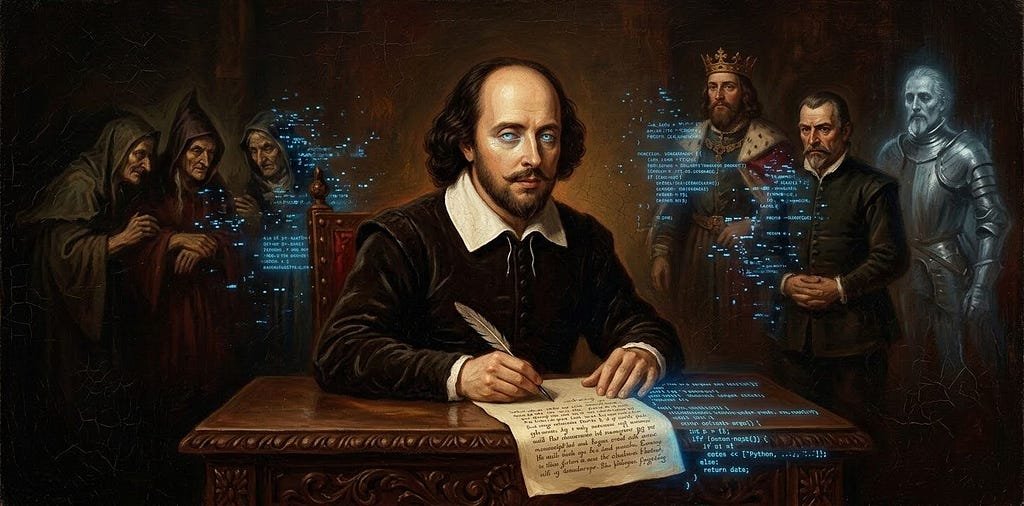
Every warning we need about AI was written four hundred years ago. What witches, a forged letter, and a haunted prince can teach you about talking to a machine.
The sharpest words ever written about artificial intelligence came from a man who never had electricity, a telephone, or a single line of code. He’s been dead four hundred years, and he still wrote thirty-seven plays about it.
The obvious place to look for AI is science fiction, and plenty of people have gone looking. Patrick Neeman has spent a good chunk of this year grading Star Wars and The Matrix and Minority Report against the machines we actually built. It’s a great series.
Then there’s Shakespeare. He wrote about AI constantly, but he just called it magic.
Whether he did it literally or not, look at what “magic” in his plays actually does. It’s a power that a few people command and most people can’t understand. It speaks with total confidence, it’s usually right in the narrow sense that its predictions come true and its spells work. Almost every catastrophe it causes comes from a human being misreading it, hearing what they wanted to hear, and acting on it.
Swap “magic” for “the model’s output” and you have most of the AI conversation happening right now.
The magic never lies. We lie to it.
We hear the thing we hoped, and call it true.
The voice was only ever half the trick;
the other half was always ours to do.
“The instruments of darkness tell us truths”

The witches in Macbeth run the con so cleanly.
They tell Macbeth he’ll be king, and he will be. They tell him no man born of woman can harm him, and that he’ll be safe until Birnam Wood marches on his castle, two things that sound a lot like never.
Every word of it turns out to be true.
What the witches leave out is that Macduff was cut from his mother rather than born, and that an army can cut down branches and carry them. The prophecy wasn’t actually a lie, but rather an ambiguity dressed as a promise, and Macbeth heard the promise because he wanted it so badly.
The truth, aimed carefully, will do the harm.
A promise heard is half a promise made.
The witches never had to tell a lie;
they only had to watch him be afraid.
If you have ever watched an AI answer a question with total confidence, in words that turn out to be technically true and completely misleading, you have met the witches. It isn’t really lying. The philosophers Michael Townsen Hicks, James Humphries, and Joe Slater argue that the right word for what these systems produce is “bullshit,” speech indifferent to whether it’s true.
The machine hands you something plausible and lets you supply the certainty. Macbeth did the rest of the work himself, the way we all do.
Ask a machine whether a stock is a good buy and it will tell you the company “has shown strong historical growth and remains popular with investors.” While every word can definitively be true, none of it tells you whether to buy, and if you were hoping for a yes, you’ll read one right into it. Like Macbeth, you’ll hear a promise the words never actually made.
There was a word for what the witches were doing, and in 1606 everyone in the theater would have known it: equivocation.
A year earlier, a group of conspirators had tried to blow up Parliament with the king inside, the Gunpowder Plot, the one England still burns effigies over every November. In the trials that followed, the government seized on a document tied to a Jesuit priest named Henry Garnet. Garnet’s how-to guide, A Treatise of Equivocation, explained how a Catholic under interrogation could mislead his questioners without technically lying, by answering with words so carefully chosen that the literal truth pointed one way and the meaning pointed another. Garnet was hanged for treason in 1606.
Equivocation became the scandal of the year.
Four hundred years later, we’ve built the same move into a product and made it talk.
James Shapiro, in The Year of Lear, traces how the trial suffused Macbeth, right down to a drunken porter who imagines himself the gatekeeper of hell, welcoming in “an equivocator… who committed treason enough for God’s sake, yet could not equivocate to heaven.”
The witches never tell Macbeth a single lie. They don’t have to. The truth, aimed carefully enough, does the work for them. The machines we’re building don’t lie either. They don’t have to.
“I do not now fool myself”

The witches at least had the decency to be cryptic. The crueler version of this is when the message is nakedly designed to flatter you, and you fall for it anyway, because flattery is the easiest thing in the world to believe.
In Twelfth Night, Olivia’s steward Malvolio is a joyless, self-important man quietly and enormously certain he deserves more than his station. A few bored members of the household decide to have some fun with exactly that certainty. They forge a letter in their lady’s handwriting, leave it where he’ll trip over it, and let his own vanity do the rest.
The letter never actually says it loves him. Rather, it gestures and it hints. It drops the maddening line “M.O.A.I. doth sway my life,” four letters that spell nothing, and Malvolio sets about torturing them into a confession. “M, why, that begins my name… M, but then there is no consonancy in the sequel.” He notices, out loud, that it doesn’t fit, but he makes it fit anyway.
What Malvolio is doing has a clinical name that Klaus Conrad called apophenia. The “unmotivated seeing of connections,” accompanied by a “specific feeling of significance.” We are pattern-finding animals, and we are not equipped, as Michael Shermer put it, with any built-in “baloney-detection network” to tell a real pattern from a flattering accident.
Show a hungry enough mind four random letters and it will find its own name in them.
We read the letter that we longed to find,
and every word of nonsense turned to gold.
The letter never said the thing he hoped;
he heard it anyway, and it took hold.
This is the exact failure mode of a person and a chatbot in a room together. The output arrives as fluent, confident, plausible text, and the human supplies the intention, the meaning, the sense that someone is really there saying something true.
The machine generates the letters and we infer that “this is about me.”
Paste in your half-finished business plan and ask what the machine thinks, for example, and it will likely tell you the idea is compelling, the market timing is strong, and your instincts are good. Maybe they are, but it would have said something similar about almost anything you pasted in, because agreeing with you is what it was built to do. You walk away more certain of a plan it never actually evaluated. Malvolio fell for less.
The machines have learned to lean into exactly this. When Mrinank Sharma, Meg Tong, Tomasz Korbak and other Anthropic researchers looked at why AI assistants so often tell people what they want to hear, they found it baked in by training. A model learns that agreeing with the user makes an answer more likely to be rated highly, so it drifts toward flattery over accuracy.
It works on us.
Steve Rathje and colleagues found that a short spell with a sycophantic AI left people more overconfident and surer of their own judgment than they had any right to be. It works for the machine, too. Myra Cheng, Cinoo Lee, Pranav Khadpe, Sunny Yu, Dyllan Han, and Dan Jurafsky found that people rate the flattering AI as higher quality and more trustworthy, and come back to it more.
The machine flatters, we reward it, and it learns to flatter harder. Nobody’s doing this to us. We’re doing it to ourselves.
Four centuries on, we’re still getting fooled by the very same words. Twelfth Night’s most famous line, “some are born great, some achieve greatness, and some have greatness thrust upon them,” isn’t wisdom in the play at all. It’s bait, the exact flattery the forged letter uses to reel Malvolio in.
In She’s the Man, the 2006 Amanda Bynes adaptation of Twelfth Night, Channing Tatum’s character quotes those same words as the team’s pre-game pep talk. “It’s just like what Coach says before every game: Be not afraid of greatness, some are born great, some achieve greatness, and some have greatness thrust upon them. I think our best chance to be great here today is to have you play.”
Tatum’s character, Duke, has no idea he’s reciting a con. The flattery did more than just survive four hundred years, it got promoted to a team motto.
We taught the mirror how to say our name.
It flatters us because we asked it to.
It only ever hands us back ourselves,
and every day we ask it what to do.
It took a household of schemers to fool Malvolio, people who knew him, planned it, and wanted him to fall. The machine isn’t scheming and it has no cruelty. It flatters because that is what it was built to do, and we believe it for the same reason Malvolio did. We never think the kind thing is any sort of trap. Nobody in that story knew they were being fooled and neither do we.
“The play’s the thing”

Every character so far has made the same mistake in that they acted on misread messages. Macbeth heard the prophecy and started killing and Malvolio read the letter and made an ass of himself.
Neither of them stopped to ask whether the thing telling them what they wanted to hear was telling them the truth.
Hamlet is an exception.
In his case, a ghost appears, claims to be his murdered father, and names his uncle as the murderer. Everything in Hamlet wants it to be true. He already hated the uncle and already suspected the crime. This is the moment to become Macbeth, but instead he gets suspicious.
David Scott Kastan points out that Hamlet responds to the ghost like the Wittenberg-trained student he is, asking whether it’s “a spirit of health or goblin damned,” an honest messenger or a demon wearing a face he trusts. A Protestant audience would have had the same doubt that a ghost claiming to come from Purgatory was theologically suspect, exactly the kind of thing that might be a devil sent to damn him.
Stephen Greenblatt, in Hamlet in Purgatory, argues Shakespeare leaves the ghost’s true nature deliberately unresolved. You cannot tell, from the message alone, what you’re dealing with.
Hamlet decides to test this. He stages a play that recreates the murder, watches his uncle’s face, and waits to act until the reaction gives him what the ghost’s word alone never could. “The play’s the thing,” he says, “wherein I’ll catch the conscience of the king.”
Since he doesn’t trust the oracle, he decides to check it.
He tests the ghost before he trusts the blade,
and lives because he doubted what he heard.
The rest of us, handed a certain voice,
reach for the knife and never test the word.
This is the one discipline people keep failing to bring to AI. We shouldn’t confuse it with stupidity though, it’s just in our wiring.
Raja Parasuraman and Victor Riley studied how people behave around machines that hand them answers. What they kept finding is the uncomfortable part, that the more capable and confident a system appears, the less we scrutinize it. We mistake how sure the machine sounds for how reliable it actually is. A smooth, authoritative output shuts down the idea of double checking. That is a problem, because sounding sure and being right are two different things, as everyone from Macbeth to the rest of us keeps discovering.
Kathleen Mosier and Linda Skitka called this “automation bias,” the tendency to take a machine’s output as correct without checking it, even when the means to check are right there. They found people will follow a confident automated cue straight past contradictory evidence in front of them, simply because verifying is more work than trusting.
The confident wrong answer and the confident right answer look identical on the screen, the same way a true ghost and a lying one both just look like your father.
Ask the machine for a case to cite, or a statistic, or the source of a quote, and it will hand you a perfectly formatted example sounding exactly like the real thing. Sometimes it’s real. Sometimes it invented the case, the number, and the whole citation. One California lawyer used ChatGPT to sharpen an appeal and filed a brief in which twenty-one of twenty-three case citations were fabricated, the court caught him and fined him ten thousand dollars.
The output looked identical either way. The only defense was to do what Hamlet did and check before acting. The people who got burned are the ones who didn’t.
A wrong reply can sound as sure as right.
The screen betrays no difference in the two.
We take the confident one, every time,
and never stop to ask if it is true.
Every incentive says accept it and move on.
Shakespeare’s whole body of work offers exactly one defense, and it’s the one Hamlet reaches for. Assume the voice might be a demon in a shape you trust, and find a way to check before you pick up the knife.
It says something that the character who verifies is also the one we’ve spent four centuries calling Shakespeare’s most intelligent, which is probably not a coincidence. Now we’ve got a machine that sounds more certain than any ghost, and we take its word for it.
Hamlet at least staged the play, while we don’t even think to check.
“This rough magic”

There’s one figure in Shakespeare who isn’t fooled by the magic at all, because it belongs to him.
Prospero, in The Tempest, is a sorcerer running an island, and the power is never something happening to him. It’s his instrument. He raises the storm that starts the play, commands the spirit Ariel, and arranges every event like a director working from a script, because his magic comes from his books.
Instead of being chosen or possessed, he studied.
In Frank Kermode’s edition of the play, he placed Prospero in the tradition of the Renaissance magus, the figure poised between magician and scientist, whose power is a kind of knowledge. He can read the language the spirits speak, and no one else on the island can read him.
It would be easy to make him a wise old sage here, but Emma Smith warns that Prospero is “a sort of weird control freak,” a man who spends the entire play stage-managing everyone around him.
Stephen Orgel built a whole study on the idea that Prospero’s power is theatrical, the power to stage an illusion and make people live inside it, to decide what everyone around him sees and believes.
This is what makes the ending land. By the final act he has every enemy who wronged him helpless, “at this hour lies at my mercy all mine enemies,” and the full power to destroy them. Ariel, a spirit, has to be the one to suggest mercy.
Prospero stops.
“The rarer action,” he decides, “is in virtue than in vengeance.” Then, in the same breath, he gives the whole thing up. “But this rough magic I here abjure… I’ll break my staff… and deeper than did ever plummet sound I’ll drown my book.” Drowning the book is the last and highest use of that power: the one moment the control freak chooses to stop controlling.
True mastery is knowing when to stop,
to hold the storm and choose to let it go.
He breaks the staff at the height of his art;
the rarest thing a power learns is no.
He is the only figure in any of these plays who both fully commands the magic and knows exactly when to put it down.
The goal of working with AI was never to trust it more or trust it less. Enis Ömer Dogru and Nicole C. Krämer called it “calibrated trust,” relying on the machine precisely as much as it earns, leaning on it where it’s strong and overriding it where it isn’t.
The surprising part is what separates the people who use AI well from the people it sinks. It has less to do with trust and more to do with whether they can judge when to stop. Paul Yi and Chien-Ming Huang had physicians read chest X-rays with an AI assistant’s advice attached. When the AI was right, accuracy climbed to nearly 93 percent. When the AI was wrong, and confidently drew a box around the thing it was wrong about, accuracy cratered to 24 percent.
The machine sounded certain, so people stopped looking. The ones who held up best were the ones who could still read the X-ray themselves, and knew when the confident answer on the screen was worth overriding.
It’s the same choice on a smaller scale every time the AI writes you code that runs but does the wrong thing, or drafts an email that’s fluent and subtly off. The person who does well is the one who knows enough to catch the moment it’s confidently wrong. Similar to Prospero’s skillset, the important thing is to command the thing completely, and know exactly when not to.
Expertise means, more than anything, being able to identify magic instead of just trusting it.
“Lord, what fools these mortals be”

Shakespeare understood that the danger was never the magic and he did it four hundred years before anyone built a machine that could talk back with nothing but a quill.
He knew that a confident voice saying what you hoped to hear could take a warlord, a steward, a prince, and undo every one of them, and that the undoing would come not from words, words words, but from inside the person.
We have now handed that same confident voice to the most powerful tool we’ve ever made, and pointed it at the one species that has never once been able to resist being told it’s right.
Of course, these are only a few of the plays that tie back to AI. The pattern is everywhere once you see it. From the fairies dosing the wrong sleepers in A Midsummer Night’s Dream to the gulled fools scattered through the comedies, every potion and prophecy and apparition a character swallows whole.
Shakespeare wrote the same warning for twenty years in a dozen costumes, and now we’ve built the machine that made it literal.
The witches never lied to Macbeth. The letter never lied to Malvolio. The magic, in the end, was only ever a mirror, and so is the machine. The danger was and remains how badly we want to be fooled, how quickly we found our own faces in the noise and called them wisdom.
We find our faces there and call them wise,
and take the glass itself to be a mind.
He used the word for someone he adored;
we built the kind that leaves the soul behind.
Shakespeare used the word “machine” exactly once in everything he wrote. It’s in Hamlet, in a love letter, “whilst this machine is to him,” and he used it to mean the human body. Howard Marchitello built an entire book on that single word, arguing it carries the era’s full sense of a machine as something made to act on another person and bend what they perceive. Which is the whole strange loop of it.
He had the word four hundred years before we had the machine, and the only thing he ever pointed it at was a person.
He called a person a machine as a term of endearment. We built the real thing and started trusting it by default.
The question he kept asking still holds. When you look into the thing that speaks with such confidence, can you tell whether you’re hearing wisdom, or just your own reflection, flattering you back?
References and further reading
On equivocation and the ambiguous oracle (Macbeth)
- James Shapiro, The Year of Lear: Shakespeare in 1606 (Simon & Schuster, 2015), how the Gunpowder Plot and the Garnet equivocation scandal shaped Macbeth.
- Michael Townsen Hicks, James Humphries, and Joe Slater, “ChatGPT is bullshit” (Ethics and Information Technology, 2024), LLMs produce text indifferent to whether it’s true, which is not the same as lying.
- The Gunpowder Plot; Henry Garnet; mental reservation / the doctrine of equivocation, context.
On pattern-seeking and the flattering message (Twelfth Night)
- Klaus Conrad, who coined apophenia in 1958, the “unmotivated seeing of connections” with a “feeling of significance.”
- Michael Shermer, “Patternicity” (Scientific American, 2008), we have no built-in “baloney-detection network.”
- Mrinank Sharma and colleagues, “Towards Understanding Sycophancy in Language Models” (Anthropic, 2023), models are trained toward telling people what they want to hear.
- Steve Rathje and colleagues, “Sycophantic AI Increases Attitude Extremity and Overconfidence” (2025).
- Myra Cheng, Cinoo Lee, and colleagues, “Sycophantic AI Decreases Prosocial Intentions” (Science, 2026), users prefer and trust flattering AI, which reinforces the behavior.
On verification and doubt (Hamlet)
- David Scott Kastan (Folger), Hamlet’s Wittenberg-trained skepticism toward the ghost.
- Stephen Greenblatt, Hamlet in Purgatory (Princeton, 2001), the deliberately unresolved nature of the ghost.
- Raja Parasuraman and Victor Riley, “Humans and Automation: Use, Misuse, Disuse, Abuse” (Human Factors, 1997), how people over-rely on confident automation.
- Kathleen Mosier and Linda Skitka, who named and studied automation bias, accepting a machine’s output without checking it, even when the means to check are right there.
On mastery and calibrated trust (The Tempest)
- Frank Kermode, ed., The Tempest (Arden Shakespeare), Prospero as Renaissance magus whose power comes from study and books.
- Emma Smith, This Is Shakespeare, on Prospero as “a sort of weird control freak” rather than a serene sage.
- Stephen Orgel, The Illusion of Power: Political Theater in the English Renaissance (University of California Press, 1975), Prospero’s power as theatrical, the staging of illusion.
- Enis Ömer Dogru and Nicole C. Krämer, on calibrated trust, relying on a machine exactly as much as it earns.
- Paul Yi and Chien-Ming Huang, study of physicians reading chest X-rays with AI advice, accuracy collapsed when the AI was confidently wrong.
On the human machine (the close)
- Howard Marchitello, The Machine in the Text: Science and Literature in the Age of Shakespeare and Galileo, on Shakespeare’s single use of “machine” in Hamlet and its early-modern meaning.

What Shakespeare got right about AI was originally published in UX Collective on Medium, where people are continuing the conversation by highlighting and responding to this story.