Blog
Rethinking the shape of design teams in an AI world

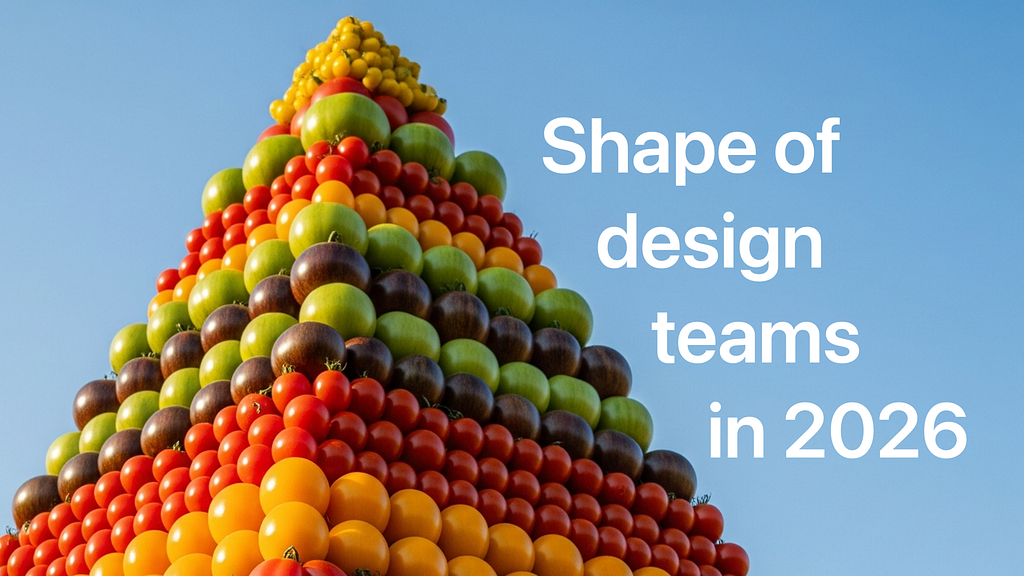
For our juniors, organisations and future generations to come.
Jenny broke the design process. As the head of Anthropics' design declared the death of a rigid sequence of steps, it has sent ripples of enthusiasm over doing more at speed with vibecoding.
https://medium.com/media/ed12ed42aeff7c8d6412736ef4759b2a/href
Thanks to her, we now have a healthy debate on the design process. Sarah Gibbons and Huei-Hsin Wang from Norman Nielsen Group argued that designers shouldn’t “throw out the process, trust your intuition, skip the research, and start building". Known as the “Master” Effect, they pointed out that experts like Wen (with years at Figma) have done the “formal” process so many times that it is now intuitive. Expert designers are doing the discovery, accessibility checks, and user flow analysis in their heads in seconds like masters.
Design Process Isn't Dead, It's Compressed
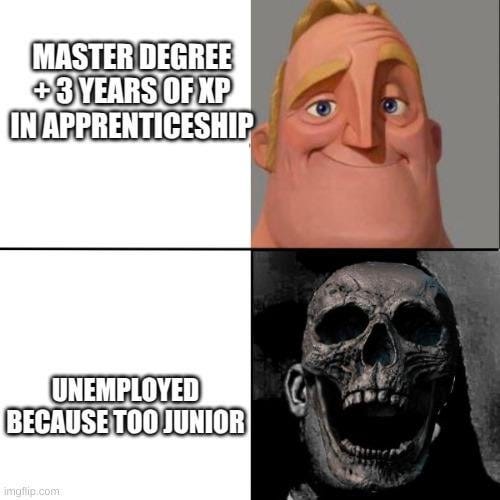
Killing the Next Generation of Seniors
However, the real issue isn’t the masters, but the juniors.
Juniors because skipping steps to use AI by trying to “trust their intuition" makes them at risk of losing their credibility. Non-designers, on the other hand, make use of AI tools like Claude to get their work done. In other words, hiring AI “juniors”. It may seem like a plausible solution to remove redundant, repetitive work, but as AI moves up the ladder of sophistication, even advanced steps of achieving a screen or flow are increasingly possible.
Over time, along with the lack of foundations developed by juniors, employers sidestep juniors and aim for seniors. Eventually, the workforce faces a reality where even the seniors thin out when the absence of juniors no longer makes them senior.
When the water leaks in the organisational pipes
We may have thought leadership on the future role of designers*. However, these changes in the industry not only affect us as individuals but also as teams and organisations, which are having a harder time adapting to AI.
*Thankfully, the design thought leaders are in agreement of the evolution of the shape of the designers. Jenny and Sarah both foresee the next level of generalist. John Maeda also affirms this shape to what he calls the “tree-shaped” designer
There is a “paradox of autonomy” emerging where AI allows a single person to do the work of a whole team, but our current corporate structures, especially in traditional organisations, are built to prevent people from moving that fast. When an individual has the power to build a functional prototype in an afternoon, the old organizational plumbing starts to burst.
Here is an expansion on how hierarchy and blurred roles are forcing a rethink of the “team”
1. Hierarchy Gets in the Way of Speed
Historically, traditional organizations were engineered for risk mitigation rather than velocity. In a pre-AI world, moving fast was a financial gamble because human labor was the primary cost. Hierarchy acted as a necessary brake to ensure that expensive resources were not squandered on the wrong ideas. It provided a safety net that led to the control of quality.
Today, that brake has become a liability. We are now paying a “Permission Tax” that we can no longer afford. Because AI has made the act of building so incredibly fast, the time spent sitting in meetings or waiting for a Director’s approval is now more expensive than the actual development of the feature itself. When the building costs pennies, the waiting becomes the true overhead.
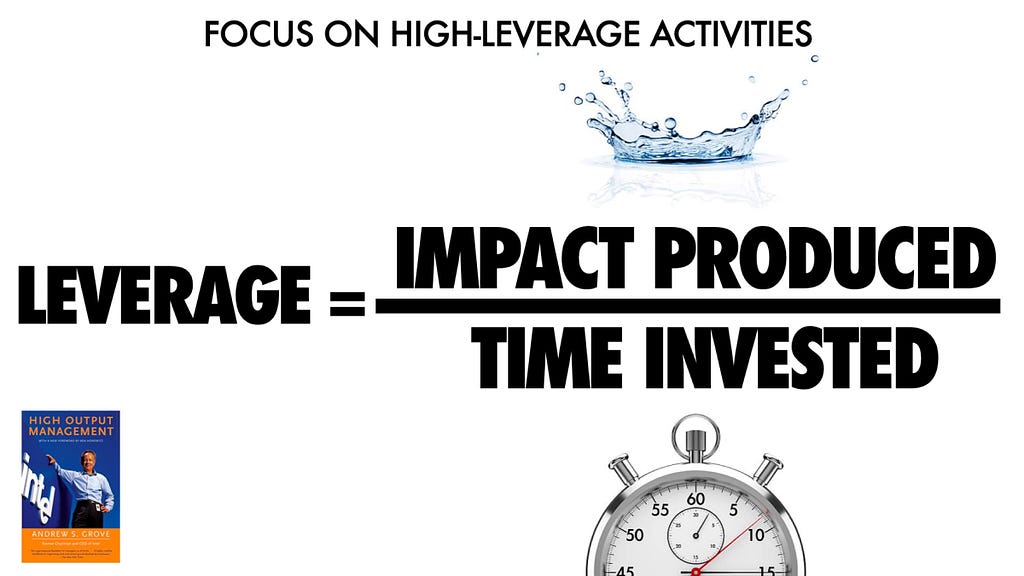
This shift marks the death of any traditional sign-off. In a world where an individual contributor can iterate ten times in a single afternoon, a manager who only checks in once a week is no longer a guide. Instead, they are a massive bottleneck. To survive, the hierarchy must pivot from a model of Command and Control to one of Support and Context.
The result is the rise of High-Density Organizations: lean structures with very few layers between the CEO and the person actually touching the code. In this new reality, if you have to ask three people for permission just to change a button’s logic, you have not just slowed down. You have already surrendered the competitive advantage that AI provided in the first place.
2. Functional Roles Get Blurred
In the traditional squad model, the walls between roles were thick and clearly defined. The workflow followed a rigid hand-off: the designer created the visuals, the engineer wrote the code, and the product manager handled the growth.
AI is effectively dismantling those walls. We are seeing the rise of the Full-Stack Everything. Designers are now writing system prompts that function as backend logic, while engineers use AI to generate UI components. This makes the once-specialized skill of creating pixel-perfect mocks accessible to more people. Even Product Managers are bypassing data scientists by using AI to build their own custom data dashboards.
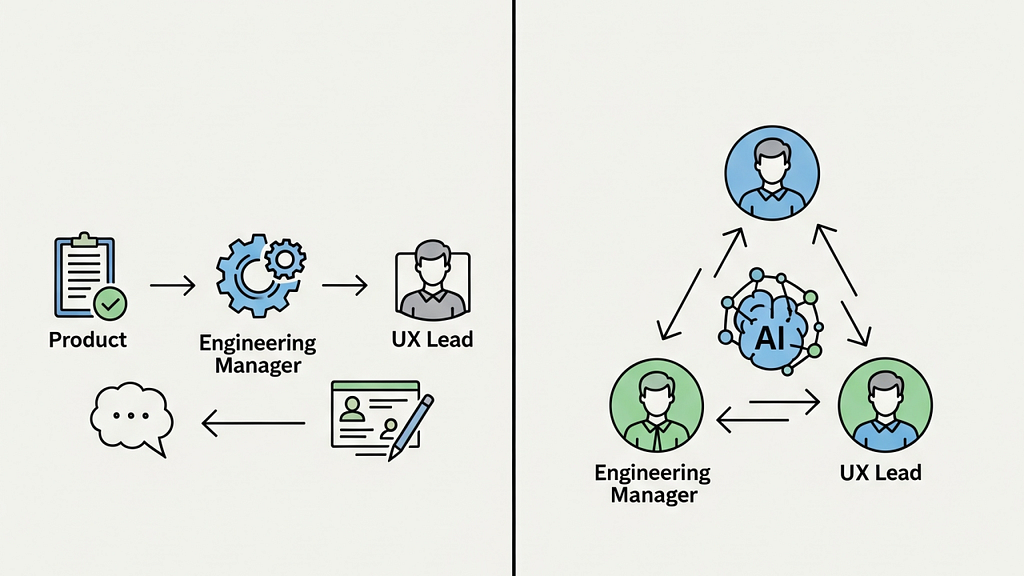
This evolution has birthed new hybrid roles like product-trio worker. This individual is becoming the most valuable asset in the AI age because they can navigate both worlds seamlessly. If a designer can prompt an AI to produce functional React code for a user interface, the label of “Designer” starts to feel too small. Conversely, if an engineer uses “Taste-as-a-Service” AI tools to perfect spacing and color palettes, the distinction between roles continues to blur. In this new landscape, the ability to bridge the gap between intent and execution is what matters most.
Rethinking teams. Redesigning structure.
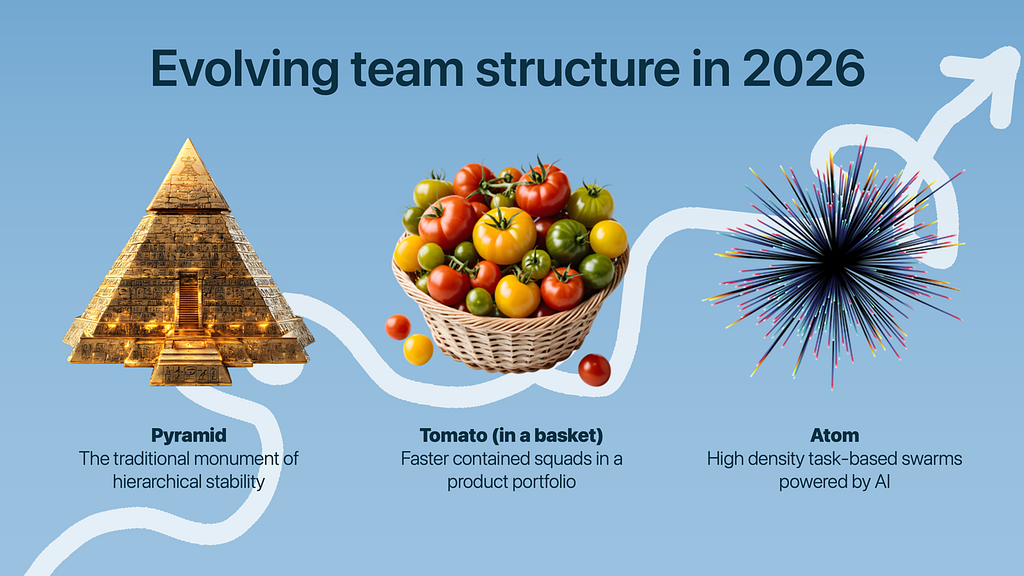
This led us to believe that team structure needs to evolve. As AI grants individuals the power to build entire systems alone, the structures we use to house that talent are fundamentally reshaping. There are three structural shifts happening:
The Pyramid: The Monument of Stability
Traditional organizations are Pyramids, built for permanence and risk mitigation. In this model, information is a heavy stone that must be passed up through layers of management before a decision is made.
The structure relies on strict specialization: designers design, and engineers build. While this provides massive scale and brand consistency, it creates a “permission tax.”
In the age of AI, where a prototype can be generated in minutes, the Pyramid becomes a tomb. By the time the “apex” approves a direction, the “base” has already moved on or the technology has shifted.
The Tomato: The Contained Squad
To gain speed, modern tech moved into the Tomato model*, or better known as the “Squad.” Here, talent is grouped into organic, self-contained chambers. A designer, a PM, and three engineers are squashed together, focused on a single slice of the product.
This model is more flexible than the Pyramid, but it remains compartmentalized. While the squad is agile within its own walls, it still respects functional boundaries. Roles are defined, handoffs are expected, and the goal is to grow the “fruit” within a predictable, protected space, and likewise, the rest of the fruits in a basket.
Inspired by the “Heirloom Tomato” model by Nan Yu, Head of Product at Linear, who takes the tomoto model to another level by suggesting that a high-growth startup’s org chart should be intentionally asymmetrical and “lumpy”, prioritizing a massive focus on the core product and high-density talent over the artificial neatness of symmetrical squads. (Thanks Wondo Jeong for the inspiration! 🍅)
The Atom: The Task-Based Swarm
The AI frontier, as described by Jenny Wen, has birthed the Atom. This structure has no walls; it is defined by a high-energy “Nucleus”, a specific mission or problem, with “Electrons” (Elite ICs) zipping around it.
In an Atom, functional roles are blurred by necessity. An electron doesn’t stay in a chamber; it moves where the energy is needed. A designer might prompt backend logic in the morning and curate UI aesthetics in the afternoon. These swarms are temporary and “atomic” — they form instantly around a task and dissipate once the goal is reached. It is the ultimate form of autonomy, trading the safety of a hierarchy for the sheer velocity of pure, unbundled talent.
The danger of homogenous seamless teams, and what’s next?
While tempting to think that the ultimate team structure is the atom, we must acknowledge that every form has a weakness. And the loss of good friction, such as healthy tensions between product manager, engineers and designers, disappear. The “full-stack everything” person might subconsciously prioritize whatever is easiest to code over what is best for the end-user. Good friction is the argument that happens when those three perspectives clash.
More importantly, how much of what we uphold as getting authentic user feedback will be protected in this fast paced swarm? Will our savviness in vibecoding soon become viberesearching with synthetic users? Will our insights be given to agents to define? Will we ever want to take the effort to speak to a real person (not your vibe-buddy or AI)?
I can’t help but to revisit an important concept shared by Dr Wong Sweet Fun regarding corals during the Don Norman Design Award Summi in 2025. The following extract follows:
When Don’s team realised they needed to scale HCD+ larger, they looked to nature for metaphors. Dandelions represent the ability to spread like weeds, creating an exponential effect. An Umbrella represents bringing different bodies together.
However, Don updated his metaphor after hearing from Dr Wong Sweet Fun regarding corals. Unlike the “Great White Shark” model (which eats everything else) or the “School of Fish” (which represents standardisation), the Coral Reef model allows diverse organisms to reach an equilibrium of coexistence. Proliferation is possible when you provide a frame with the right conditions.
Perhaps we aren’t looking for extreme team models of either a school of fish or a great white shark in our new design team structure. This is not about a faceoff between team structures and ideologies, but an acceptance that both models could coexist like corals.
Applying Dual Transformation into team structures
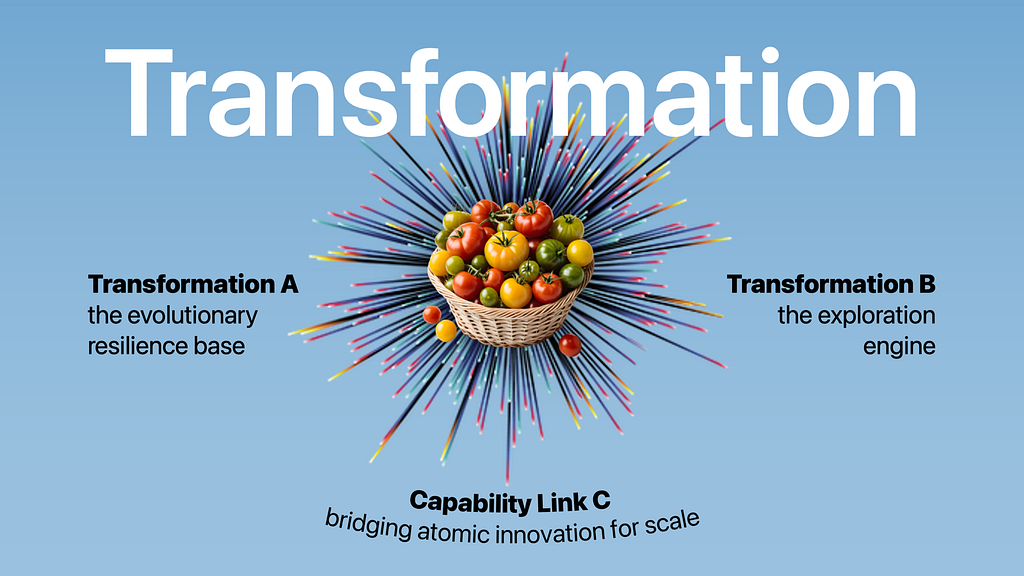
Scott Anthony’s Dual Transformation framework is the perfect lens for this debate. It suggests that successful companies must manage two different versions of “the self” simultaneously to survive a disruption like AI.
The tension between the “tomato” and the “atom” isn’t a conflict of who is right; it’s a coupling of Transformation A vs. Transformation B.
Transformation A: the evolutionary resilience base
Transformation A represents the tomato zone, focusing on making the core business resilient and efficient without breaking proven systems. The goal is to maximize the existing model, whether structured as a stable Pyramid or a specialised Tomato.
In this environment, friction acts as a critical safety feature. High-stakes industries like banking or healthcare cannot swarm into new interfaces because they must protect brand trust and precision. The tradeoff requires balancing speed with stability. AI automates the toil of documentation and pixel pushing, but stakeholders and good friction remain to prevent brand dilution or regulatory failure. This structure ensures the core remains intact while the organization evolves.
Transformation B: The Exploration Engine
Transformation B represents the atom zone, where the objective is to discover the future by building an entirely new engine for growth. This phase operates as an Atomic Swarm, prioritizing the search for a new business model or a fundamental paradigm shift in user interaction.
In this high-velocity environment, traditional friction is fatal. Because the rules are not yet written, the swarm must have the freedom to blur functional roles and skip standard handoffs to maintain momentum. The core tradeoff is the intentional sacrifice of polish and structural safety in exchange for the ability to pivot at the speed of AI. Here, the “permission tax” of the Pyramid is removed to ensure that the innovation is never smothered by the bureaucracy of the core business.
Capability Link: bridging atomic innovation for scale
The Capability Link is the bridge between the stable Pyramid and the chaotic Atom. It acts as the negotiation zone where the organization decides which high-velocity insights from Transformation B are mature enough to be “hardened” and integrated into the core of Transformation A.
The primary risk here is a structural mismatch. Forcing an innovative swarm to adopt the heavy stakeholder reviews of the core business turns “good friction” into a toxic force that smothers discovery.
Therefore, while the core business continues to evolve, albeit at a slower rate, with transformation A, a SWAT team can harness the powers of new technologies and experiment possible solutions. Our initial dilemma of juniors get resolved as they are assimilated into a stable, safer environment to develop their technical and organisational skills from senior block-shaped generalists while keeping abreast to the latest advancements from a SWAT team of senior specialists. They get the best of both worlds, and will have 2 good career pathways to choose from when they become seniors themselves.
Success requires a deliberate firewall. The Atom must remain free to explore, while the Capability Link provides a structured pathway to scale those discoveries back to the fruits in the basket once they prove their value.
There’s a space for everyone and for every initiative. The job to be done isn’t to create delineation of traditional and modern team structure, Jenny against Sarah. Instead, having a bridge of capability links enable individuals and teams to be adaptable with AI, becoming a resilient future-proof set of teams that sustains its business growth while simultaneously scaling a new, high-growth engine for the next generation.
References
Anthony, S. D., Gilbert, C. G., & Johnson, M. W. (2017). Dual transformation : how to reposition today’s business while creating the future. Harvard Business Review Press.
Lenny’s Podcast. (2026, March 1). The design process is dead. Here’s what’s replacing it. | Jenny Wen (head of design at Claude). YouTube. https://www.youtube.com/watch?v=eh8bcBIAAFo
Moran, K., Raluca Budiu, Gibbons, S., & The. (2026, January 16). State of UX 2026: Design Deeper to Differentiate. Nielsen Norman Group. https://www.nngroup.com/articles/state-of-ux-2026/
Staff, F. R. (2024, August 7). Make an Org Chart You Want to Ship — Advice from Linear on Designing Your Team. First Round. https://review.firstround.com/make-an-org-chart-you-want-to-ship-advice-from-linear-on-how-heirloom-tomatoes-should-inspire-team-design/
Wang, H.-H., & Gibbons, S. (2026, March 13). Design Process Isn’t Dead, It’s Compressed. Nielsen Norman Group. https://www.nngroup.com/articles/design-process-isnt-dead/

Rethinking the shape of design teams in an AI world was originally published in UX Collective on Medium, where people are continuing the conversation by highlighting and responding to this story.