Blog
Powerful Union Between Intelligent Low-power Design and Ultra-long-life Batteries

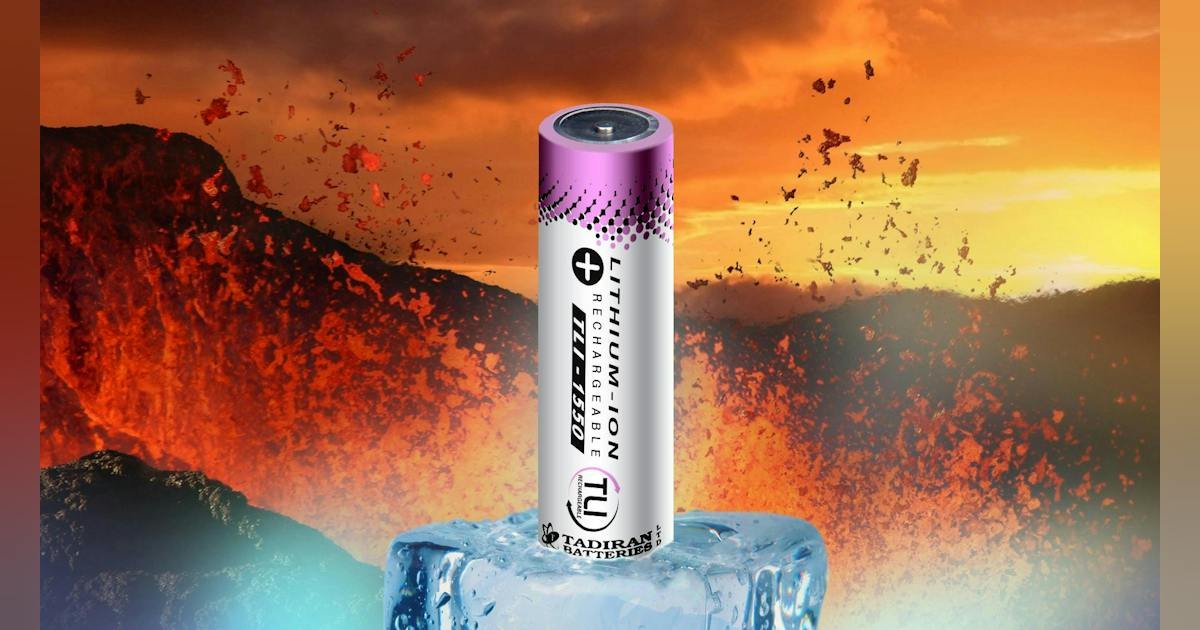
Superior quality bobbin-type LiSOCl2 cells feature a self-discharge rate of just 0.7% per year, enabling them to last up to 40 years. LiSOCl2 batteries can also be manufactured with a spiral wound construction that permits a higher rate of energy flow with the trade-off being a higher annual self-discharge rate.
The advantages of bobbin-type LiSOCl2 chemistry include:
- longer operating life of up to 40 years to lower the cost of ownership
- A wider temperature range of -80°C to +150°C to survive extreme environments
- High energy density and capacity which may permit the use of fewer or smaller batteries
- Higher voltage which may permit the use of fewer batteries
- Harsh Environments Impact Battery Performance
A battery’s potential lifespan is dictated by its storage capacity, which is measured in Ampere-hours or Amp-hours (Ah). The cell’s maximum run time is based on the average current being drawn. For example, a device consuming 1mA of average current with a storage capacity of 1,200 mAh can have a maximum run time of 1,200 hours. However, theoretical battery life is often not reflected by reality, as actual battery performance can be negatively impacted by prolonged exposure to extreme temperatures during storage and/or deployment, which can cause voltage delays and voltage drops as well as the depletion of electro-chemical constituents to accelerate the cell’s annual self-discharge rate.
Battery self-discharge results from chemical reactions that occur even when the cell is disconnected or not in use. In many cases, a low-power device will consume more energy resulting from self-discharge than is required to operate the device. Other variables can also impact a battery’s self-discharge rate, including the peak current, consumption profile, temperature range, age of the cell, and the leakage current drawn by individual components within the device, to name a few.
Passivation Pays Dividends
Bobbin-type LiSOCl2 batteries deliver the lowest possible self-discharge rate principally due to their unique ability to harness the passivation effect.
In essence, passivation involves the formation of a thin film of lithium chloride (LiCl) on the surface of the anode, which then acts as a separation barrier from the electrode to limit the chemical reactions that lead to self-discharge. Whenever a continuous current load is applied, the passivation layer initially causes higher resistance and a drop in voltage until the continuous discharge reaction causes the passivation layer to begin dissipating. Once a battery becomes inactive for an extended time the passivation layer returns, requiring another round of de-passivation.
The level of passivation varies based on several factors, including the cell’s construction, its current discharge capacity, the length of time in storage, the storage and discharge temperature, and prior discharge conditions, such as partially discharging a cell and then removing the load. While passivation is ideal for extending battery life, it must be carefully managed to avoid any over-restriction of energy flow.
Experienced battery manufacturers can harness the passivation effect through proprietary cell construction techniques and the use of higher quality raw materials. As a result, the highest quality bobbin-type LiSOCl2 batteries can feature a self-discharge rate of just 0.7% per year, able to retain 70% of their original capacity after 40 years. Conversely, lower quality bobbin-type LiSOCl2 cells can have a self-discharge rate of up to 3% per year, exhausting roughly 30% of their available capacity every 10 years from self-discharge. Lifetime Power wireless sensors could not operate for 25 years on inferior quality batteries since nearly 3/4 of the cell’s total capacity would be exhausted by self-discharge over that period of time.
Wireless Communication Draws High Pulses
Another important consideration is the cell’s ability to generate high pulses of up to 15 A to power bi-directional wireless communications. Standard bobbin-type LiSOCl2 cells cannot deliver such high pulses due to their low-rate design. This challenge was addressed by incorporating a patented hybrid layer capacitor (HLC). Utilizing this hybrid approach, the standard bobbin-type LiSOCl2 cell delivers low-level base current during ‘standby’ mode while the HLC delivers periodic high pulses during ‘active’ mode.
Supercapacitors perform a similar role for consumer electronic devices, but are typically ill-suited for industrial applications due to numerous drawbacks, including short-duration power, linear discharge qualities that do not allow for the use of all available energy, low capacity, low energy density, and very high self-discharge rates (leakage current). When supercapacitors are linked in series, they require the use of expensive cell-balancing circuits that add bulk while draining additional current to further reduce their operating life. In certain instances, supercapacitors may be paired with bobbin-type LiSOCL2 cells to enhance voltage response.
Do Your Due Diligence
When ultra-long battery life is essential, it pays to invest in a superior quality battery that can reduce or eliminate the need for costly battery replacements over the expected lifetime of the device. While bobbin-type LiSOCl2 batteries are marginally more expensive, the added investment is often worthwhile based upon the potential long-term savings.
Unfortunately, it can be difficult to differentiate between a superior grade battery and a lesser quality cell based on short-term test results, which tend to be highly inaccurate since the long-term effects of a higher self-discharge rate can take years to become fully measurable. Short-term test results can also be hindered by relatively small sample sizes that underestimate the passivation effect as well as the impact of prolonged exposure to extreme temperatures.
When extended battery life is essential, the promotional claims of battery manufacturers must be verified through due diligence. To properly evaluate competing battery brands, you need to receive fully documented and verifiable test reports. For validation, you should also obtain long-term performance data from actual batteries in the field operating under equivalent loads and environmental conditions, both during storage and deployment. Contacting the battery manufacturer’s customers offers another point of reference.
Since short-term test data can be highly inaccurate, Tadiran has amassed a large and continually expanding database from monitoring long-term battery performance over decades under laboratory conditions. Tadiran also performs tests on customer-supplied samples from the field, representing the full spectrum of power requirements and environmental conditions. As an added benchmark, Tadiran performs long-term testing on competing battery brands.
Case History
Powercast Lifetime Power wireless sensors remotely monitor and control HVAC and lighting systems in commercial buildings, reducing energy bills up to 29%
With energy costs on the rise, there is a growing need for advanced building automation solutions that utilize simple-to install remote wireless technology.
Powercast Lifetime Power sensor-control devices deliver a highly cost-effective solution for remotely monitoring and controlling HVAC systems and lighting in commercial buildings. Lifetime Power offers a flexible and scalable solution that is robust, simple and inexpensive to install, LEED-certified, and provides valuable data and insight that allows commercial buildings to remain comfortable without being wasteful.
Lifetime Power devices can reduce electrical bills by up to 29% while eliminating the need for complex wiring, thereby reducing installation costs by 40-50% versus traditional hard-wired sensor and building automation systems. These sensors feature a proprietary low-power communications protocol operating at 915MHz frequency to permit long-range transmissions of up to 300 ft. with increasing spacial diversity, including coverage across concrete-rich environments.
Powercast’s fully integrated solution incorporates web/mobile interfaces, proxy servers, with LAN/gateway access to BACnet to support a wide variety of remote monitoring functions, monitoring temperature, humidity, CO2, DP, and the intensity of luminaire-controlled lighting. This simple-to-install solution offers unlimited scalability to optimize energy efficiency and comfort, and the data provided gives building management greater control and insight, including pattern recognition, to identify potential waste and maintenance problems.
Use of a Tadiran PulsesPlus ultra-long-life hybrid LiSOCl2 battery enabled Powercast to minimize long-term maintenance costs with a proven power supply capable of far exceeding the device’s rated operating life of 25 years (Fig. 4).