
Blog
Pi PC fits in Altoids tin

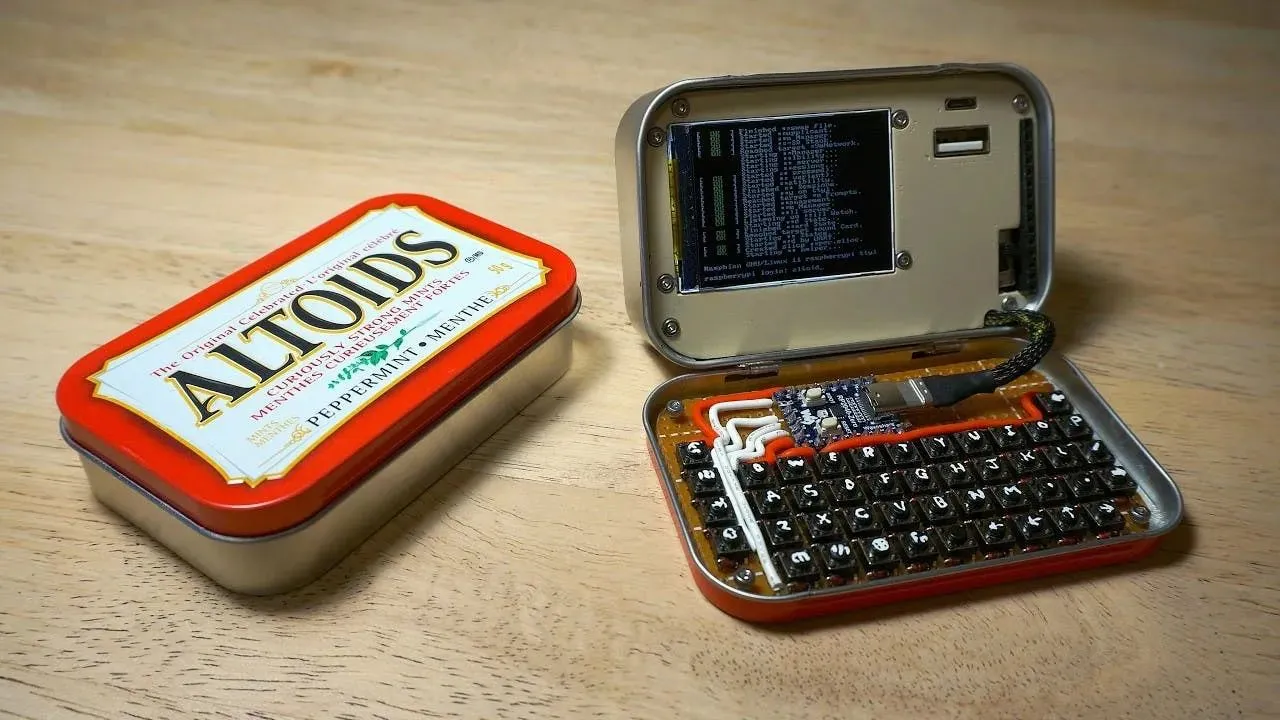
Opening the lid reveals a 2-inch display and a mechanical keyboard that is perfect for hacking on the go.
Squeezed inside the tin is a Raspberry Pi Zero W paired with a Waveshare UPS HAT and a 3.7 V LiPo battery, allowing the machine to operate untethered. A 2-inch IPS LCD provides the display, though getting the screen functioning correctly took some effort.
Exercising Ingenuity notes that compatibility issues forced the project onto a legacy version of Raspberry Pi OS, and a handful of configuration tweaks were necessary to enable the SPI-connected panel.
Instead of a membrane keyboard or touch interface, the creator opted for a miniature mechanical design built from dozens of tiny pushbuttons mounted on perfboard.
A Waveshare RP2040-Zero microcontroller scans the keyboard using a diode matrix arrangement and communicates with the Raspberry Pi over USB. Firmware duties are handled by KMK, a CircuitPython-based keyboard framework that simplified key mapping and customization.
Packing all of the hardware into an Altoids tin was a tough job. Connectors were removed from several boards to reduce their thickness, and wires were soldered directly to the Raspberry Pi and UPS board to conserve every possible millimeter of space.
A custom 3D-printed internal frame holds the components securely while flexing just enough to fit inside the curved metal enclosure.
Even with all of this effort, the hardware didn’t quite fit when the case was closed. To fix this issue, hinge sections were cut from a second Altoids tin and were soldered into place to make enough room to allow the lid to close over the oversized internals.
To keep things cool, a thermal pad transfers heat from the Raspberry Pi into the Altoids tin itself, effectively transforming the entire enclosure into a passive heatsink.
In the end, Exercising Ingenuity’s only regret is that he cannot get Linux Mint to run on this curiously minty portable computer.
Check out the full project write-up for all the details you need to build your own Altoids tin computer.
See all our Raspberry Pi content.