Blog
NXP debuts SensorGPT and SensorStage for developers

At the start of Sensors Converge 2026 on Tuesday, TDK announced two new products to beef up the way developers use sensors in creating new applications, mainly for IoT and wearables in the AI world.
The first is SensorGPT for creating and managing sensor data and the second is Invensense SensorStage, a sensor evaluation tool for development of SmartMotion inertial measurement units.
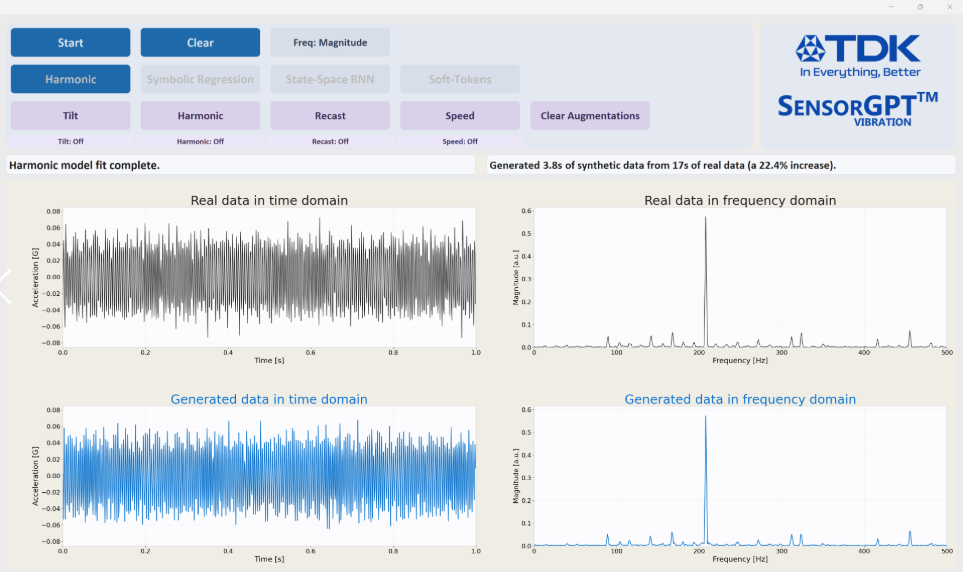
SensorGPT is the most ambitious of the two, since it uses generative AI, signal processing, statistical methods and simulations to create and manage sensor data at large scale to drastically reduce AI application development time.
“By tapping into generative AI modeling, simulation and more, engineers can use AI to generate additional, high-quality data that reflects real-world conditions,” said Jim Tran, general manager of the Americas for TDK, in a statement.
SensorGPT is designed to reduce the burden of collecting and curating data by using intelligent data synthesis, with TDK claiming it can cut data collection from the current level of 80% of a company’s AI application development time to nearly 10%. Edge AI model building time can be reduced from five or more months to a few weeks, TDK added.
The software can be used to train generative models over a limited amount of real-world data to detect underlying patterns and then create high-quality synthetic data that the company said “faithfully” mimics real-world data. It also relies on mathematical models to simulate and generate synthetic sensor data. SensorGPT generates 90% similarity between synthetic and real-world sensor data.
It can be applied to IoT, wearables, physical AI and industrial IoT.
Synthetic data for sensor data streams is not a new idea, and Nvidia has promoted Isaac Sim, Omniverse Replicator and Cosmos for creating physically accurate synthetic data in robots and physical AI. DataGen, CVEDIA, Synthesis Ai, Rendered.ai, Anyverse and Cognata focus on computer vision and use cases such as retail, drones and industrial vision. Amazon Bedrock and Microsoft/Azure are in the space as well, as are Gretel, YDATA, Mostly AI, Tonic and Hazy, although they vary in the type of applications that the synthetic data can be applied to.
The market is growing rapidly and even includes some free simulations from Gretel and Tonic, according to AI Magazine, which has identified 10 companies in the space.
Two TDK engineers wrote in an article contributed to Fierce Sensors: “As the demand for AI models grows to power smart edge applications, SensorGPT delivers the data needed to build those models faster and better.”
SensorStorage, the evaluation tool introduced by TDK, is also designed to accelerate development for SmartMotion IMUs. “Inertial sensors development has traditionally required extensive hands-on experience and deep expertise, but SensorStage speeds and simplifieds this process with its data analysis platform and prebuilt sensing features,” said Rosa Chow, software vice president for Invensence, a TDK group company.
SensorStage is already available for SmartMotion IMUs of two varieties and will soon be available for MEMS sensors.