Blog
FPGAs as Everywhere Companion Chips for Edge AI

FPGAs Bring Flexibility to AI Companion Role
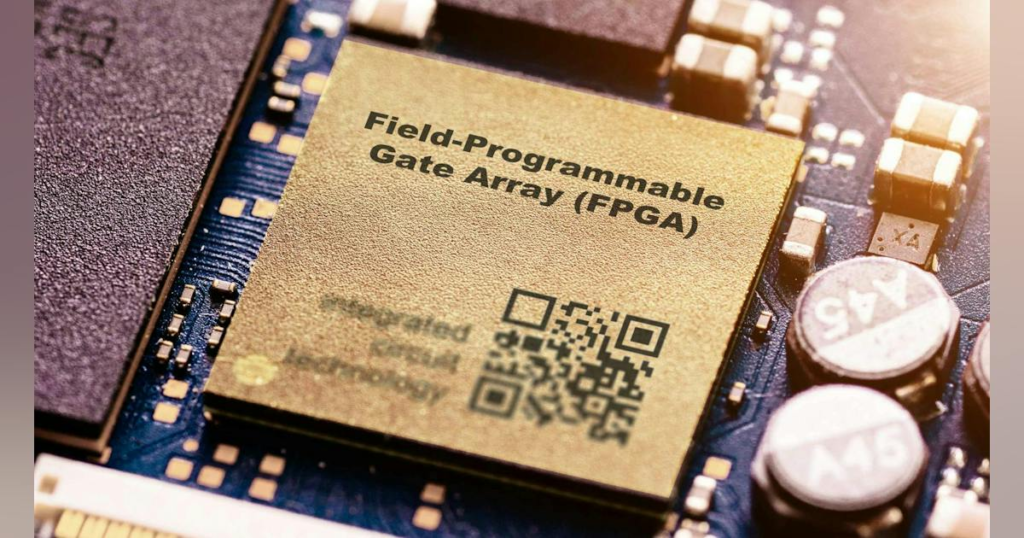
While several types of silicon can play the companion role, field-programmable gate arrays (FPGAs) offer a flexible platform for handling tasks that don’t justify tying up valuable accelerator resources.
Low-power FPGAs are particularly well-suited to the companion role: Operating at low power envelopes, they handle critical non-core tasks without competing for the power budgets that primary processors require to sustain AI workloads. As a result, they have the potential to serve as “everywhere companion chips,” equally compatible with edge, industrial, and automotive system as they are with data center racks.
FPGAs are also well-equipped to support future innovation in edge AI operations, bringing capabilities that general-purpose MCUs can’t easily match. FPGAs can execute multiple sensor, control, and I/O tasks in parallel with deterministic, low-latency timing. As a result, they can help maintain performance in demanding, high-risk environments and systems with significant resource constraints.
Furthermore, FPGAs are designed for flexibility, and critically, they don’t compete with the primary processors they sit alongside. Because they’re processor-agnostic, FPGAs can work closely with popular GPUs, CPUs, NPUs, and SoCs. Moreover, their operations can be tailored to complement the preferred primary chip, making them a low-risk architectural partner rather than a future design lock-in.
As cyberattacks become more advanced, FPGAs are becoming an increasingly important part of the security stack. They can serve as a hardware root of trust (RoT), supporting secure boot, device authentication, and the protection of sensitive data. Some FPGAs support post-quantum cryptographic (PQC) algorithms, including CNSA 2.0 and NIST standards, and since they’re reprogrammable, algorithm updates can be deployed without a full system redesign or silicon replacement.
This feature set allows FPGAs to serve as a unifying system layer that reliably offloads complexity, preserves determinism, and provides continuity throughout system lifecycles.
Where FPGAs Fit in Emerging AI Architectures
FPGAs provide engineers with a way to better connect compute, security, I/O, and sensors wherever AI workloads run, enhancing system operations in each of these applications.
In data centers, FPGAs can handle board-level control and management. While CPUs and newer classes of chips such as DPUs continue to own their specific tasks, FPGAs can take on power sequencing, system bring-up, health monitoring, and orchestration. They also handle higher-value functions such as attestation, secure boot, and PQC-ready security, where deterministic, low-latency response is non-negotiable.
Because the FPGA is first on and last off, it also provides a stable control and security foundation across processor refresh cycles. This tends to be important given the constant evolution of rack infrastructure in AI data centers.
In industrial robotics, too, FPGAs can bridge diverse sensor interfaces such as MIPI and GMSL to high-speed Ethernet, enabling precise, deterministic I/O, timing, and data conditioning. For instance, NVIDIA’s Holoscan Sensor Bridge technology uses FPGAs to handle high-bandwidth data streams from cameras, radars, and other sensors that are beyond the scope of MCUs. The FPGA can adapt MIPI CSI-2, GMSL inputs, and other sensor interfaces to high-speed Ethernet for seamless transfer.
The FPGA puts sensor data into packets with low latency and sends it over Ethernet, where the Holoscan technology delivers it directly to GPU memory with minimal host CPU involvement. By delivering tightly synchronized data streams directly into GPU memory, the FPGA enables real-time AI perception pipelines in robotics systems while the primary SoC or other processor remains free to focus on inference (Fig. 2).