
Blog
AI’s new approach to protein engineering

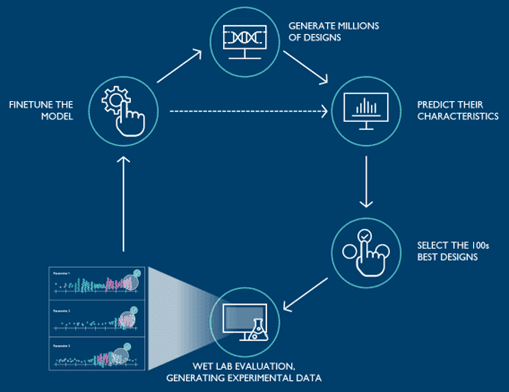
Instead of relying on incremental mutations, AI models can propose large batches of novel protein sequences – often on the order of a thousand variants at a time – designed to meet specific functional criteria.
Manual and robotic laboratory platforms then execute a series of experiments for each variant, typically involving multiple assays per protein.
The resulting data are fed back into the AI model, which updates its predictions and generates a new set of candidates. This closed‑loop, data‑driven workflow enables faster iteration and exploration of a broader design space than traditional methods.
The AI-driven lab-in-the-loop approach used to be limited by three factors: scalable AI modelling, scalable molecule synthesis, and scalable wet lab validation. The first two have improved dramatically over the past five years, but wet‑lab validation still faces major challenges.
For example, increasing throughput by miniaturizing assays – such as moving from 96‑well to 384‑well formats – reduces reagent consumption and enables larger screens, yet it also lowers protein yield per variant, which can limit downstream characterization and force trade‑offs between scale and analytical depth.
In addition, protein expression levels often vary across experiments and constructs, complicating comparisons and reducing the reliability of data used to retrain AI models. Together, these factors highlight the need for more precise, scalable, and consistent experimental platforms to fully realize the potential of AI‑driven protein design.
Lab-in-the-loop AI-driven process flow for protein engineering
Imec proposes chip-based building blocks that could innovate this wet-lab step in the protein engineering workflow