Blog
NASA contractors supply an array of sensing tech for Artemis II

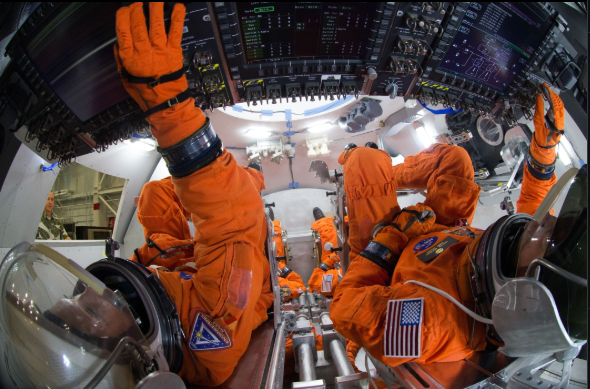
Thousands of NASA contractors have contributed technology to the Artemis II mission, including sensors and related tech used in the Orion spacecraft housing the four-member flight crew as well as the massive Space Launch System, the largest rocket ever produced by the space agency.
The 10-day crewed mission was set to launch Wednesday evening from Kennedy Space Center in Florida with the four astronauts strapped in about 4 p.m. EDT in preparation for a 6:24 p.m. EDT launch window that lasts two hours.
Many of the sensors provide optical sensing for the flight and its pathway, while others focus on the safety of the astronauts. In one system, thousands of avionics sensors are applied to the SLS.
Large suppliers to the mission include Honeywell and AMD, in partnership with Orion prime contractor Lockheed Martin . Mid-sized and smaller companies include Prague-based ADVACAM, a sensor/radiation detector specialist helping protect astronauts from deep space cosmic rays and x-rays and particles from Sun flares.
To handle conditions in space, electronics of all types also need to be hardened against radiation, which can be 100 times greater than the amount experienced on Earth, where gravity and atmosphere provide radiation protection.
Here is a sampling of Artemis II suppliers in sensing-related areas:
AMD touted its long-time association with NASA projects and promoted its radiation-hardened AMD Virtex 5QV FPGAs used in support of sensor fusion on chip in both the SLS rocket and Orion spacecraft to enable data routing and image processing for real-time visual feedback to the flight crew. According to a spokesperson, Virtex-5QV devices ingest and process sensor data, synchronize and route between subsystems and operate with “deterministic latency and high reliability in radiation environments.”
The company also took the Artemis II launch opportunity to promote its radiation-tolerant Versal AI Edge Gen 2 adaptive SoC, which is not aboard the current Artemis mission but has taken a role in development flight computers of Blue Origin. The flight computers are currently flying in the vehicle testbed that will eventually power the Mark2 lander, being developed for landing astronauts on the Moon as early as 2028. SpaceX is also developing a moon lander and NASA still faces a decision on which lander will be used. AMD’s history with NASA includes its FPGAs used in the Perseverance Mars Rover in recent years.
The Versal SoC will integrate programmable logic, AI engines and Arm cores for high-performance processing at the lunar edge where systems can analyze sensor data in real time with low latency and limited bandwidth, AMD said in a blog.
Honeywell Aerospace promoted its core sensor/navigation tech with Lockheed Martin for Orion in a blog post, saying it supplied guidance and navigation systems, command and data handling hardware, displays and control units and core flight software.
Redwire highlighted its advanced optical imaging and Sun sensor technology flying aboard Orion via contracts with Lockheed, NASA’s prime contractor for Orion. The camera system for Artemis II consists of 11 internal and external inspection and navigation cameras including wireless cameras positioned on each of Orion’s four solar arrays to allow in-flight inspection of the entire spacecraft, the company said in a release.
Redwire’s Optical Navigation Camera provides high resolution imagery to the spacecraft’s machine vision algorithm to determine Orion’s position and velocity relative to Earth, the company said in a statement. Other cameras will record 4k video and 12MP images and livestream both the inside and outside of the vehicle, including key mission events such as separation, jettison, deployment, and crew demonstrations. The Redwire cameras on board Artemis I in 2022 successfully captured imagery and video, including livestream views from the solar array wing cameras that were made available to the public throughout the mission.
Redwire, in Jacksonville, Fla., is also providing four redundant Coarse Sun Sensor (CSS) assemblies for Orion’s European Service Module (ESM) through a contract with Airbus. The CSS are part of Orion’s solar power generation system and will provide important data to the Solar Array Drive Electronics to adjust the ESM’s solar panels. The CSS were part of and performed successfully on Artemis I.
ADVACAM, based in the Czech Republic, supplied six specialized radiation-sensing chips for NASA’s Hybrid Electronic Radiation Assessor (HERA) system
(ADVACOM)
on Orion. They monitor cosmic radiation exposure, composition, and will verify shielding effectiveness during Orion’s planned deep-space lunar flyby to protect crew in high-radiation beyond low Earth orbit. The technology behind the chips originated in physics research at CERN. They also have been deployed on the International Space Station and will be used aboard the lunar orbital station Gateway.
RELATED: Sensors on Orion will monitor solar radiation to keep crew safe
L3Harris provided avionics, including sensing, control, sequencing, data handling and power distribution for electronics for the SLS rocket’s RS-25 engines and integrated vehicle systems. The avionics collect data from all across the rocket with 500 to 1,500 sensors on each stage, according to Jake Hendrickson, space avionics chief engineer at L3Harris. “The avionics are really the brain of the launch vehicle,” he told WCPO.
Ensco supplied its IData cockpit display software for Orion, which processors and presents real-time sensor data from the SLS starges and other system for situational awareness.