Blog
TI plunks mmWave radar sensing onto Jetson Thor

News about integrating sophisticated sensors into full scale applications for robotics and autonomy emerges nearly every week.
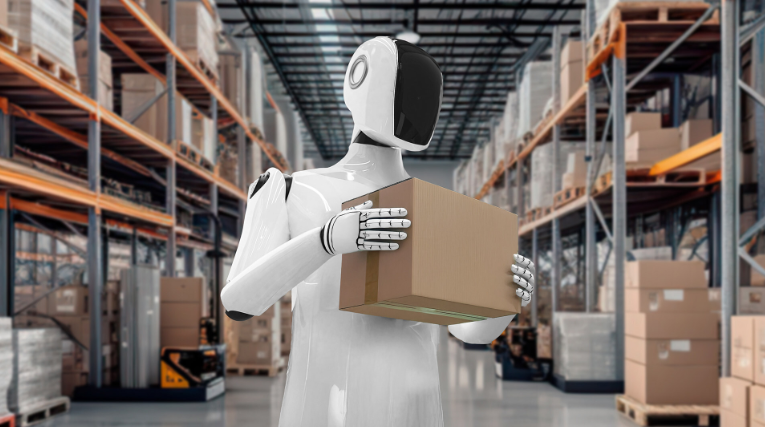
In the latest example, Texas Instruments and Nvidia are working together on pushing forward humanoid robots, with TI integrating its mmWave radar into Nvidia’s Jetson Thor chip by using Holoscan Sensor Bridge for greater 3D perception.
News of the collaboration between the two industry giants was made in advance of the upcoming Nvidia GTC 2026 event, March 16-19, where TI plans to exhibit and offer a talk on March 18 about integrating sensing and networking into GPUs for real-time physical AI at the edge of industrial operations.
TI described its role in the collaboration as one of designing a sensor fusion solution that integrates its mmWave radar tech with Nvidia Jetson Thor, using Nvidia’s Holoscan Sensor Bridge, a sensor-over-Ethernet technology designed to allow real-time data streaming with the goal of simplifying high-speed sensor fusion and actuator integration on Nvidia edge-AI platforms.
Jetson Thor is Nvidia’s high performance edge system-on-module for use in robotics and other physical AI based on a Blackwell GPU and a 14-core Arm Neoverse CPU. Thor is purpose-built for real-time multi-sensor applications for both autonomous navigation and object manipulation—essential ingredients in allowing humanoids to both move through factories and warehouses and also use arms and hands to grab and lift parts and other objects.
With the TI and Nvidia collaboration, developers can hopefully benefit by validating perception, actuation and safety early and more accurately in the development of humanoids, according to TI. This approach should help devs move faster from the virtual development role to production-ready systems.
“The next generation of physical AI requires more than just advanced compute – it demands seamless integration between sensing, control, power and safety systems,” said Giovanni Campanella, general manager of industrial automation and robotics at TI in a statement.
“TI’s comprehensive portfolio bridges the gap between NVIDIA’s powerful AI compute and real-world applications, enabling developers to validate complete humanoid systems earlier in development. This integrated approach will help accelerate the evolution from prototypes to commercially viable humanoid robots operating safely alongside humans.”
“The safe operation of humanoid robots in unpredictable environments requires a massive leap in processing power to synchronize complex AI models with real-time sensor data and motor controls,” said Deepu Talla, vice president of robotics and edge AI at NVIDIA. “The integration of Texas Instruments’ sensing and power management technologies with the NVIDIA Jetson Thor platform provides developers with a functional safety-capable foundation to accelerate the deployment of next-generation physical AI.”
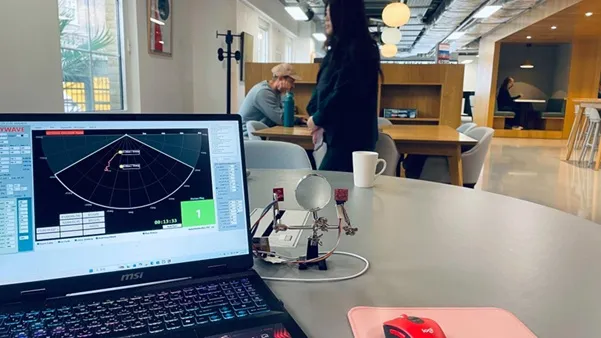
TI is using its mmWave radar sensor IWR6243 which connects via Ethernet to Jetson Thor to fuse camera and radar data for improved object detection, localization and tracking while reducing false positives, TI said. This approach will allow human-like perception in low light and bright glare and fog and dust indoors and outdoors. TI said cameras may not reliably detect glass doors or reflective surfaces, but radar will provide detection of these obstacles for smooth operation in offices, stores and hospitals. The IWR6243 operates at 57 to 64 GHz.
While it is not possible to assess early on how important TI’s mmWave contribution will become toward expanding use of humanoids in industrial settings, Jetson Thor is already making headway.
Jetson Thor has caught on with early adopter developers at industry-leading robotics companies such as Agility Robotics, Amazon Robotics, Boston Dynamics, Caterpillar, Figure and Meta, according to Nvidia. A Jetson AGX Thor developer kit was released in August 2025 for $3,499.