Blog
Four hidden dimensions of effective teams

Company success isn’t about following a magic formula or hacking the corporate game; it’s about using the context and information around us with purpose.
This year, I had the honor of joining a revolutionary LATAM design convention in Lima, Perú, where I was invited to speak about design and team strategy, two topics I’m most passionate about.
Months before the convention, I reflected on how to send a strong message that sparks questions and encourages the audience to take action to increase design’s influence in corporate decision-making, something we (the designers) have long believed we deserve by right.
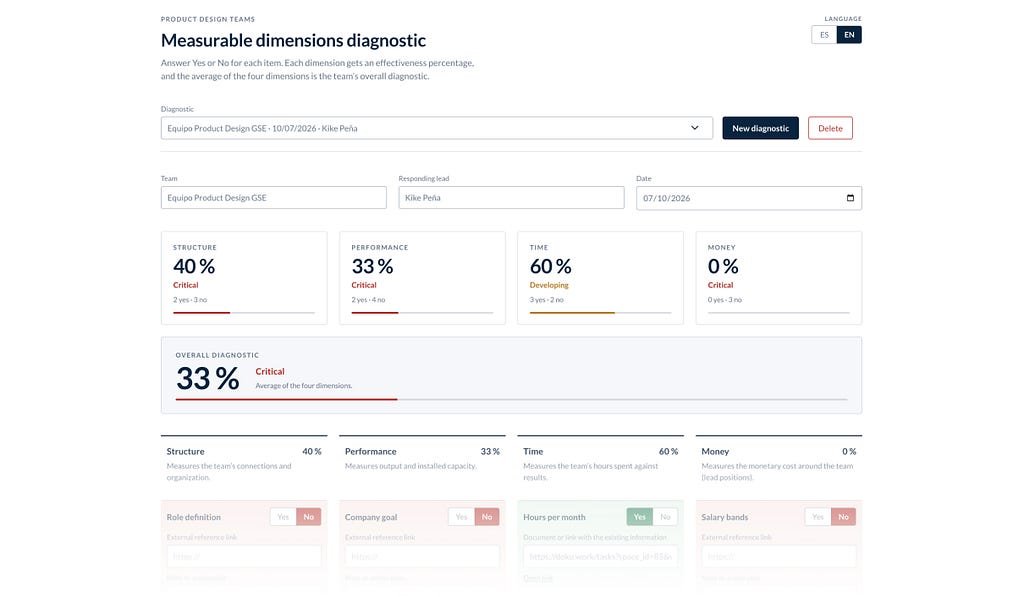
One topic I highlighted during the talk was an artifact I developed early this year that helped me bridge design and company strategy and brought me closer to strategic conversations, with promising results so far.
Building this simple new tool helped me validate a long-standing personal belief: stop accepting that designers only generate value through “cosmetics,” since some people still think design is just the visual layer of functionality.
The common language in all companies.
One idea that resonated strongly with the audience was the fact that everything we do as designers has a monetary consequence (it shouldn’t be a novelty nowadays), no matter the size of the solution, idea, or context; so thinking in numbers is one thing that should be embraced from junior design positions. Numbers aren’t just money from users; they’re everything that produces it. In that sense, developing the self-awareness to understand and measure our own work towards results could put us in a strategic position within a company.
How to measure effectiveness? The four dimensions you overlook.

This isn’t just about having KPIs or OKRs in a team; it’s about understanding all measurable resources that show how effective we are as a company.
I’ve identified some basic dimensions that define an entire company’s dynamics and, with them, all the possible challenges within. Although these dimensions seem obvious in every company, after 20+ years in the tech industry, the truth is they aren’t, and we still struggle, over and over, with the same old issues.
How did this perspective come about? Well, it wasn’t really a discovery, but rather connecting disparate dots—things people overlooked when executing projects or having conversations.
I ask my teammates a few basic questions that can paint a picture of a company or team’s state. I used to ask these questions informally, but I didn’t always have a complete picture of the overall situation. That is why, after some time, I decided to organize a set of measurable dimensions that could clearly diagnose my environment and its main challenges.
The sum of all dimensions is a metric that reflects the maturity and effectiveness level of a company or its teams, helping build a solid foundation for product creation and making the process more rewarding.
Use this metric to acknowledge the state of the company and start having relevant conversations:
The Structure

The first dimension refers to how people, teams, or areas are connected; it comes first because it reveals the system we are working in, including both positive and negative factors.
The structure dimension is built from inner concepts that, together, give us a full picture of how the system of connection works. Why is this dimension important? Because it delimits the field of action and its actors.
1. Role definition
This is the first aspect I ask when I want to understand the state of a team; it is surprisingly common to encounter companies and teams that lack information regarding this fundamental concept. For some reason, some people consider it normal to hire someone with no plan for the company or the professional.
The lack of information about a role reveals the company’s level of corporate maturity. At this point, we can find several reasons regarding this issue: “We are in a digital transformation, so we’re figuring out the design roles,” “We brought you here (the leader) to help us build the team vision,” “This team originally was under the CMO or CTO management, and his/her knowledge was limited in terms of user experience,” “We are a startup, we wear a lot of hats, so you build your own role.”
Some of those reasons may be valid, but my critique around this is a simple question: how do you move for years (sometimes under a lot of stress) without knowing your boundaries or responsibilities? I’ve seen a lot of designers immersed in constant uncertainty because they don’t know their range of actions, all disguised under the condescending phrase: “I do what I’m asked.”
I think not having a role makes you vulnerable to whatever circumstances arise, which, in my opinion, is highly detrimental to professional growth because your job keeps changing.
A clear understanding of product roles lays the foundation for how effective teams operate within a system.
2. Career path
Moving forward, the career path is the next level of structure maturity in teams or companies. Part of my assessment when joining a team is understanding all possible growth tracks within the Structure I’ll lead. When a career path is missing, the negative effects might be several.
In the short term, the impact might not be as visible, so people could feel “comfortable” for a couple of years, but the thing with this issue is that time is inevitable; eventually, when years have passed, people will realize they are way behind the latest skills in the market, which will create great frustration and a sense of wasting valuable time doing the same job without increasing their talents.
3. Org chart
Knowing who to report to, who to lead, or who to work with as a peer matters. Part of being effective is knowing who to talk to to drive results. Org charts are often dead, outdated documentation; people only see them the first week of a new job. Over time, I’ve realized this artifact is fundamental for decision-making or showing results. From a design perspective, org charts can also be stakeholder maps or the canvas for making strategic decisions for the team.
If org charts aren’t visible in a production dynamic, effective communication is almost impossible, and the consequences will hit sooner or later. That said, here’s the latest concept for the structure dimension.
4. Working flows
Imagine you have a clear understanding of your team’s structure, but communication isn’t always effective. Why? Well, it is because we haven’t connected the roles into a functional dynamic, and without that, we have nothing; imagine a classical orchestra without a director; it’s quite a mess.
Designers are experts at figuring out user flows to connect a product with clients, but they don’t think to do the same exercise to connect roles on a team to other teams towards a product goal. Strong working flows make product decisions more effective, and time will be your ally.
Performance

It is obvious we need to talk about performance as the second effective dimension, but far from having KPIs, this approach is different; it is about how much we know about success for the company and us. As for the structure, the performance dimension has inner concepts that feed into the overall dimension, and I’ll guide you through each one.
1. Company goal
I’ve been part of projects where this information is nonexistent, or teams aren’t aware of it and make decisions with a biased vision; the result? Narrowed approaches, sometimes disconnected from the main company strategic plan; sooner or later, the consequences of working away from what the company is pursuing can be expensive.
We used to think the company’s goal was something shared in an all-hands meeting, and then nobody remembered it. Still, keeping this goal present in every project helps us filter hard decisions and create more accurate, business-driven developments. Bring these goals to the next project pitch, and stakeholders will embrace your idea more than if you pitch something amazing but far from a business priority.
2. Area and team goals
Digging deep into goals, the next level is the area goals. This information is more visible than company goals. They are closer to us since we operate in a more tactical field, but remember that area goals should build toward the company objective, so being aware of the previous concept matters.
Are you aware of this information when executing something? I would say most teammates will say, “I’m not sure,” so don’t assume they are clueless about this.
Why do I bother to highlight this concept? The answer lies in how other members of the company still perceive our work: as something merely aesthetic, rather than an effort toward effectiveness and conversion. I’d wager that if designers approached a board of directors with a strategy focused on business objectives, the results would be different.
3. Installed capacity
I’ve said it before, and I’ll keep pointing out this issue: are we reactive, or do we have the capacity to react? Hard pill to swallow, right? It is sad to see how design leaders just follow in a huge reactive storm, where the day-to-day is about surviving others’ mess.
Not knowing your team’s capacity or your teammates’ capacity compels you to follow orders without negotiation, which is, most of the time, negative in every way.
As a leader, discussing capacity reveals more about you than you think; it gives you power and control over the project’s time and decisions. On the contrary, not knowing this information, as I said before, makes you accept others’ conditions with no chance to state your point of view.
4. Definition of success/failure
How do you know your team is doing right? Or wrong? Are you one of those who go with the flow? Some days we’re good, and some days everything stinks. This concept has nothing to do with accomplishing OKRs; it’s about having clear team boundaries: what to celebrate and what to penalize.
This concept should be repeatedly visible on every team, and it should become the DNA for how we operate and behave in front of others.
Building a healthy DNA for the team will create a reputation for you and your team, something that can be well rewarded in company strategic moments.
Time

The third dimension is about knowing the time we expend doing something. As you may know, time is money, and not being aware of it can lead us to an ineffective spiral with negative consequences.
One way to figure out how ineffective teams are in terms of time is simple: in ongoing projects, there is often no awareness of stages or changes that come in at the wrong time and slow down the team’s output. In these scenarios, a medium initiative can become large, expensive, and frustrating for teams.
The concepts that build the time dimensions are related to hours and their usage:
1. Team execution hours
This concept is about tracking how much time the team spends on projects; this information is usually overlooked in strategic conversations, and without it, we can’t measure how fast the team is or how long projects take.
Tracking team effort over time will give us a better perspective on how to respond to future challenges, so that the next time we face a project, we’ll be ready to provide a better time estimate.
In planning sessions with the team, having a project time matrix will give the team a solid starting point instead of jumping into the unknown without a clue how long this challenge will last.
2. Strategy hours
The other side of time is what we spend on conversations, planning, or solving situations for the team. In senior design positions, this time is crucial to account for; we will not always be able to execute tasks if our job demands that we oversee multiple teams or duties.
I recommend having some sort of artifact that can back you up when showing results to execs; whether execution or strategic time, it is important to be aware of the amount of time (money) you represent for the company.
Money

Since time is money, other monetary situations shouldn’t be strange for us. Not knowing anything about money (the common language in companies) will relegate us to a merely executing position. At the same time, other profiles will discuss whether it is profitable to take on a project.
We don’t need to be financial experts to understand our resource costs, and that’s enough. Some of the basic notions of money issues to control are:
1. Team and role cost
How much does your team cost? It is a question that is not always on our radar. Still, once you realize you have a team cost of X, you can approach project planning from a different perspective, especially when comparing it with budgets.
If you apply this information to your planning conversations, you can make smarter moves in hiring people or shifting resources across multiple initiatives.
2. Projects budget
In some decision tables, every conversation, context, or challenge starts with the budget, so you should understand the project’s financial scope from the beginning.
This information may not be attractive to junior design positions, but for leaders, it is crucial to manage and understand.
Money and time are rare areas of knowledge among designers, so developing them will put us on a different level when approaching projects or hard conversations in companies.
My takeaway from this:
There are several aptitudes we can adopt to thrive in companies, whether big or small; the goal is still the same: converting money. Around success in companies, there is way too much information from modern history to read and watch. Still, in design environments, which I think is fascinating, I feel like there is little information on how to use our expertise to our advantage in a strategic way; maybe I’m wrong, but if we’re still struggling to show our value in companies, it’s because we haven’t figured out how to back up our discipline, right?
I believe the basics always work best, and the four dimensions of effective teams come from watching teams over 20 years of experience in different contexts and industries. Maybe this is not the holy formula for success, but at least it gives us a different perspective on how to use the information that is always there, but we don’t see or use, and let other people make decisions for us.
To write this article, I want to credit all the fantastic information sources and other authors who have written about related topics, each from an exciting, different perspective.
The 3 Cs of Coaching: The Foundation of Effective Team Leadership
Building Effective Teams Is Not About Hiring Based on Skills Only
6 Essential Tips for Effective Team Collaboration — Win as one team!

Four hidden dimensions of effective teams was originally published in UX Collective on Medium, where people are continuing the conversation by highlighting and responding to this story.