Blog
Protecting Power Distribution in AI Data Centers

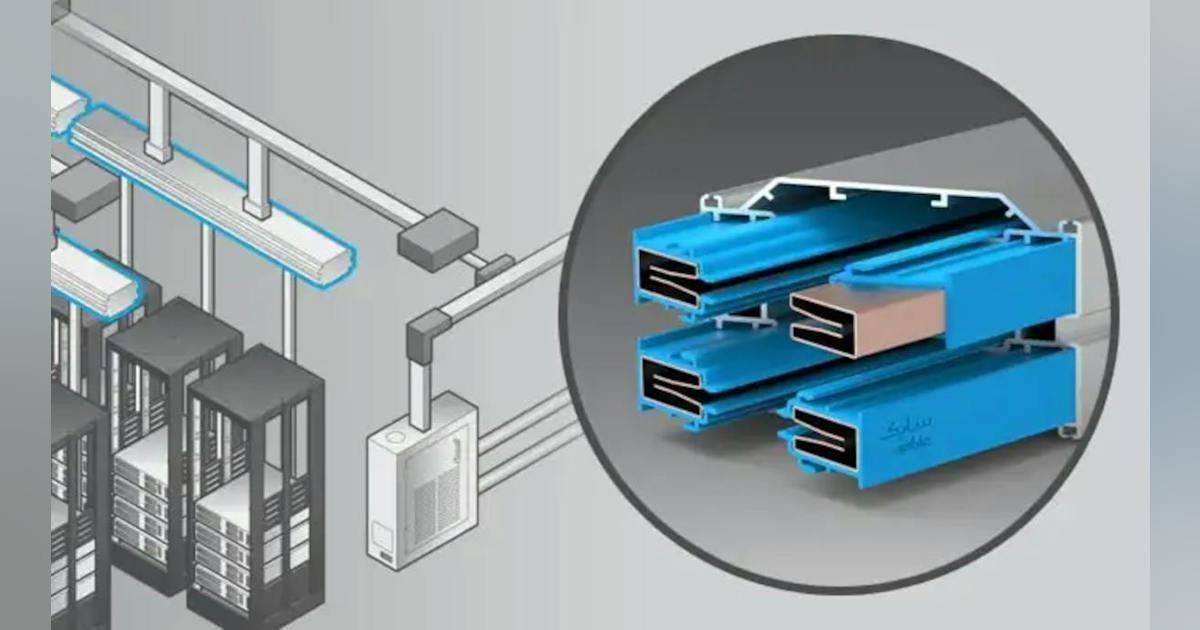
Dimensional stability to maintain precise geometries of long insulation profiles.
PPE-based resins can be extruded into profiles up to 3 meters long without added reinforcement, which PA66 profiles require for stiffness. These PPE resin profiles are rigid and hold tight tolerances, both when extruded and during use. A low coefficient of thermal expansion (CTE) in the range of 50 to 70 µm/m-°C avoids heat-related shape changes. The CTE range for PA66 resins is approximately 60 to 80 µm/m-°C. Also, PPE-based resins feature very low water uptake — 97% less than PA66 resins — to minimize swelling and warpage.
Dielectric strength to help protect against electrical breakdown, arc flash, and contact with live parts.
The dielectric strength of PPE-based resins remains stable over a wide temperature range, enabling these materials to maintain excellent insulative properties. In contrast, the insulative properties of PA66 resins decrease at high temperatures.
Further, PA66 resin’s dielectric insulative performance depends heavily on moisture content. Compared to PPE-based resins, PA66 resins readily absorb water (up to 2.5% by weight in ambient air), which increases their electrical conductivity.
Thermal resistance to withstand high temperatures and meet International Electrotechnical Commission (IEC) 61439 requirements.
To prevent material degradation and warpage under high heat exposure, busbar insulation materials require elevated relative thermal index (RTI) ratings. PPE-based resin RTIs typically range from 110 to 125°C, sufficient for AI data center busway insulation, while PA66 resins with glass fiber reinforcement have RTIs with a wider range, from 100 to 150°C.
Although PA66 resins don’t melt at these high temperatures, their insulative performance decreases. In contrast, PPE resins retain stable insulative properties under exposure to high temperatures.
Flame retardancy for safety and regulatory compliance.
While both PPE-based resins and PA66 materials must be modified with flame-retardant (FR) additives to meet the rigorous UL94 V0 standard, it’s important to choose a grade with a non-brominated/non-chlorinated FR chemistry that avoids halogens or other substances of very high concern (SVHC). This is important to avoid release of corrosive or toxic gases that could harm people or damage AI servers in the event of a fire. Ideally, the material should meet the UL standard at a thin gauge to permit slimmer insulation profiles.
Low density to reduce part weight and material usage.
Compared to glass fiber-reinforced PA66 resins, the lower density of unfilled PPE-based resins can reduce weight for easier busway installation and safer operation. It also helps reduce the amount of resin required in each insulation profile, leading to potential cost and raw material savings.
Easy processing for higher productivity.
Glass-fiber-reinforced polymers like PA66 are significantly harder to process than unreinforced PPE-based resins, which can negatively affect throughput. Unreinforced polymers melt and flow more easily than glass-fiber-reinforced materials, which exhibit high viscosity. They also require specialized, wear-resistant equipment to withstand the highly abrasive fibers.
NORYL PPE Technology: Proven Performance in Busway Insulation
SABIC’s NORYL resin portfolio, celebrating its 70th anniversary in 2026, comprises specialty dielectric materials based on PPE technology. NORYL resins have been validated by leading busway manufacturers and have shown that they can enhance the design and performance of AI data center power-distribution infrastructure compared to PA66 materials, while potentially reducing system costs (Fig 5).