Blog
What’s the Difference Between Hermetically and Environmentally Sealed Connectors?


Many industrial-grade systems favor environmental sealing because it delivers the necessary level of protection without the complexity and cost associated with a hermetic seal.
Understanding Ingress Protection (IP) Ratings
IP ratings comprise two numbers — for example, IP66 — the first number refers to protection against solid particles, the second to liquid ingress. It’s defined as follows:
Solid particle protection
0. No special protection
1. Protection against solid objects larger than 50 mm in diameter, e.g., accidental touch by hands
2. Protection from solid objects larger than 12 mm in diameter, e.g., accidental touch by fingers
3. Protection from solid objects larger than 2.5 mm in diameter, e.g., tools and wires
4. Protection against 1-mm-wide solid objects, e.g., wires, nails, screws, larger insects, or other items
5. Partial protection against dust, which may be harmful to equipment
6. Full resistance to dust and other small particulates
Liquid protection
0. No protection
1. Protection against dripping water onto item when mounted upright on a turntable and rotated at 1 rep per minute
2. Protection against vertically dripping water when the item is tilted at 15° from its normal position
3. Protection against water spray at any angle up to 60° from vertical, whether that spray is oscillating or has a counterbalanced shield
4. Protection against splashing water from any direction, from an oscillating fixture or one with a spray nozzle with no shield
5. Protection from water jets when water is projected by a 6.3-mm nozzle onto the enclosure from any direction
6. Protection from powerful water jets, i.e., with a 12.5-mm nozzle, projecting water from any direction
6K. Protection from powerful water jets with increased pressure using a 6.3-mm nozzle, projecting water from any direction or elevated pressure
7. Protection from ingress of water in an immersion of up to 1-m depth
8. Protection from ingress of water when immersed depths are higher than 1 m of water
9K. Protection from powerful high-temperature water jets, at close range and at high temperatures
Careful evaluation of the IP ratings for different connectors enables engineers to select the optimum solution for specific applications.
Pros and Cons of Hermetically and Environmentally Sealed Connectors
Although both are designed to protect electrical systems, these connectors differ significantly in construction, performance standards, and intended applications.
Environmentally sealed connectors
- Protect against water, dust, and debris
- Rated using IP standards (e.g., IP67, IP68)
- Ideal for industrial and outdoor environments
- Designed for durability and repeated mating cycles
- Incorporate O-rings and gaskets to create a compression seal
Hermetically sealed connectors
- Create a gas-tight seal
- Validated through helium leak testing
- Suitable for vacuum or pressure containment
- Used in aerospace, defense, and specialized systems
- Usually higher cost due to specialized materials and precision manufacturing processes
When Environmental Sealing is Enough — and When It’s Not
It’s key to identify the primary risks to any electrical systems before deciding which type of sealed connector to use in a particular environment.
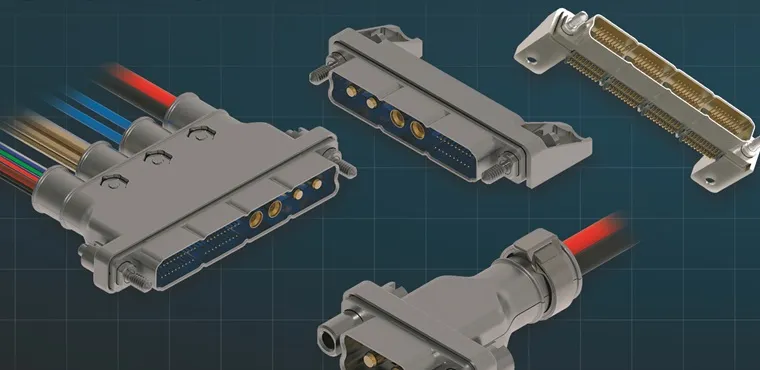
Industrial, renewable energy, transportation infrastructure, and marine systems all operate in environments where protection from rain, washdown, dust, and temperature fluctuations is necessary, but complete atmospheric isolation is not. Environmentally sealed connectors, such as Bulgin’s range of IP66, IP67, IP68, and IP69K power connectors, with the appropriate IP rating work in these situations as they provide protection against ingress of water and particulates, ensuring reliable long-term performance (Fig. 3).