Blog
NFL stadium deploys manhole sensors to secure network, tighten terror threat security

Sports fans who may be frustrated with paying high ticket prices to see their favorite hometown team are finding clever ways to enter professional sports stadiums.
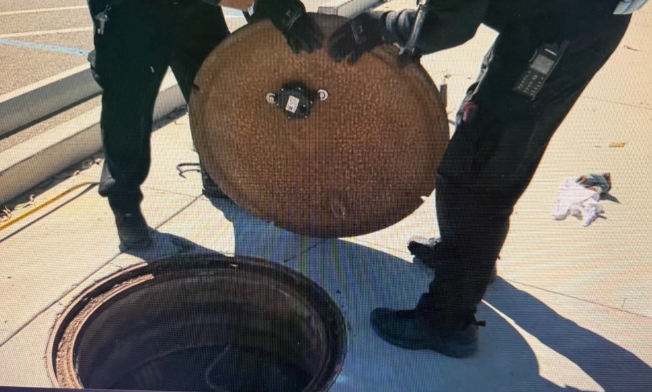
An actual NFL stadium, name withheld, recently commissioned Sensor Works to use a novel tamper-avoidance approach to prevent manhole break-ins. Stadium officials decided to install several sensors under the heavy manhole covers and network switching boxes in a proof-of-concept that can sense even the slightest budge to quickly inform security teams of a break-in via a wireless network.
Additionally, these devices offer temperature and humidity as well as ultrasonic depth sensing to provide flood or object detection. The sensors were installed earlier this year and will eventually increase to over 400 manhole covers across a 3-mile-square area of massive parking lots and service areas, according to Andy Do, president of Embedded Works and its IoT division, Sensor Works.
Stadium officials wanted the sensors installed because they wanted to tighten security controls and “monitor any intrusion as a potential terrorism threat,” Do told Fierce in an interview.
“The stadium loves it and wants to add more IoT sensors in the future,” he added, referring to the sensors and the wireless network, along with wireless gateways. Sensor Works deployed sensors using LoRaWAN wireless over a 900 Mhz frequency, with network backhaul using fixed wireless access from Verizon Wireless and gateway provider Tektelic on the project. With the 2026 FIFA World Cup and the 2028 Summer Olympics arriving to the region near the stadium, the sensors seemed a logical way to future-proof the facility.
Fierce asked, Wouldn’t crafty thieves find a way around the sensors and gingerly lift the manhole covers and pull off or destroy the sensors? Not so, Do said, because the sensors are precise in detecting x,y,z motion. Also, the sensors are built into a rugged box that attaches securely underneath the metal manhole, making it unlikely for thieves to use a crowbar or other tool to pry it loose without detection.
Do said Sensors Works has acted like a “GC of IoT”–in other words, a general contractor — in the stadium work, providing all the sensors, equipment and professional installation services with its portfolio of more than 800 different sensor types. The company stocks sensors to detect temperature and humidity changes, water levels and water leakage from pipes, smoke and fire detection, power consumption and electric current, among others.
The opportunity to outfit stadiums with sensors is immense, considering there are thousands of large stadiums used by schools and professional teams. Plus, so many companies want sensors to detect a range of needs such as when the soap dispenser is out or when the toilet paper is gone. They want smoke and vape detection and to account for foot traffic, and sensors for activity at food and beverage areas.
“A lot of verticals haven’t thought about sensorizing, including data centers. We believe in sensorizing and IoT-izing everything,” he said with a smile, claiming credit for the geeky terms. “We want to measure everything.”
Embedded Works is 20-year-old company with it roots in wireless IoT system integration, and can prepare sensors for use in a week, including testing, Do said.
“The hardest of part of selling sensors is convincing you that you need it. But if you are broadcasting a major event and if somebody tampers with the fiber feed, you’re screwed.”
Do could not reveal the total cost of deploying for the NFL stadium, adding: “I can’t share the total cost of buildout, but it’s not as much as you’d think. There’s no digging trenches or pulling cables. It’s all about being able to know what the heck your building is doing and having your building speak to you.”
Editor’s Note: Embedded Works, including the Sensor Works division, will exhibit in Booth #610 at Sensors Converge 2026, Santa Clara Convention Center, held May 5-7. Do will speak at a Live Theater Session at 1:30 p.m. Thursday on “Retrofitting Stadiums with IoT Sensors.” Registration is available online.