Blog
Royal Aeronautical Society award stealthily scooped

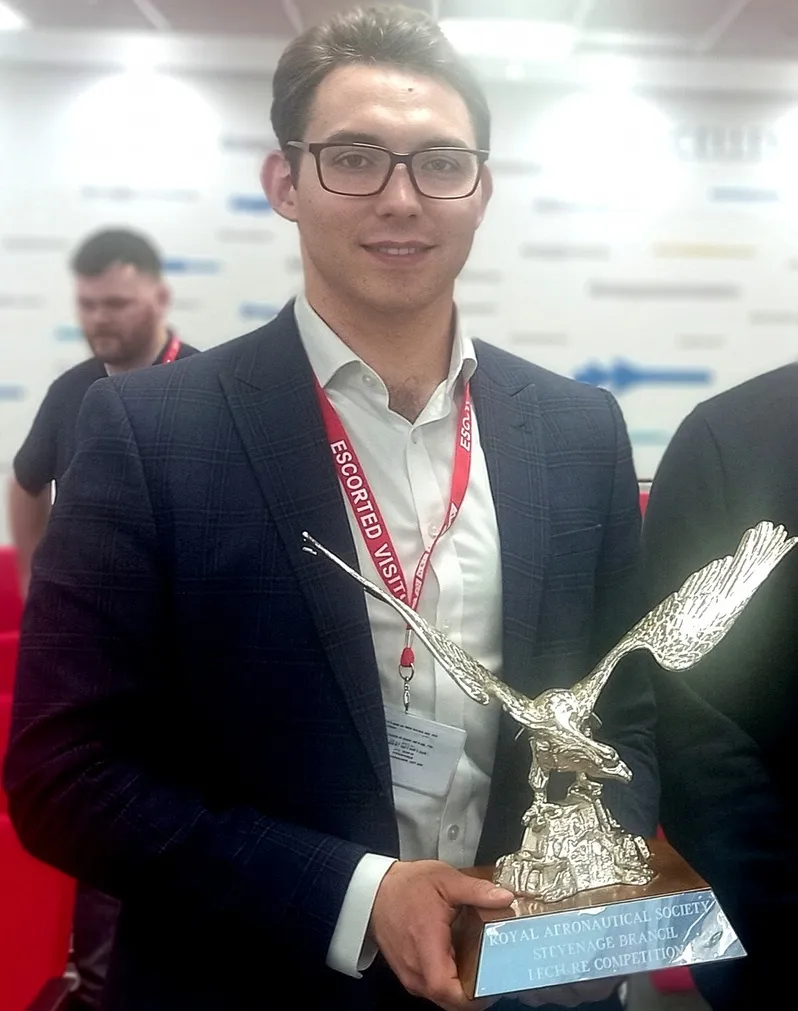
The competition encourages early career engineers to develop their communication and presentation skills. And Oliver made the most of it with his take on the evolution, physics and future of stealth technology.
Skunk works
Apparently, his inspiration was Ben Rich’s book Skunk Works. And he began to look more closely at the history of stealth technology in the UK.
“Ben Rich helped to demystify the science of stealth,” he said. “He described how engineers combined radar, advanced materials and computer modelling, to create capability that allowed aircraft to be completely undetected. That made it feel much more accessible for me. And I’m fascinated by what the future of digital stealth could be.”
“It was originally conceived that no aircraft would ever be able to beat radar because radars were improving so much, and then suddenly there was this complete change in ideology, because scientists were beginning to see the possibilities offered by mathematical modelling and computer modelling, which takes us up to the present day,” said Oliver.
Computers
“Stealth design has increasingly relied on computers – not only to shape aircraft, but also to provide critical flight controls that enable inherently unstable designs to be driven by physics rather than traditional aerodynamic requirements. Now, it has gone even further to support the evolution of digital stealth, with electronic countermeasures and tactics becoming a fundamental part of the design for stealth. So stealth today is less about shape alone and more about intelligence and sensor technology to outmanoeuvre evolving radar systems, maintaining the ongoing ‘cat and mouse’ dynamic of electronic warfare.”

Congratulations to Oliver, and what a great trophy! His EW BrightSparks profile will soon be appearing on Electronics Weekly as well.
Digital stealth
Oliver now aims to continue working in digital stealth and advanced technology at Leonardo in Luton.
The company highlights that the concepts he explored align with Leonardo’s work. Specifically, in the next generation of digital stealth and advanced sensing. For example, for programmes such as the Global Combat Air Programme (GCAP).
See also: Picture of the Day – Testing the skeleton of the ExoMars descent module